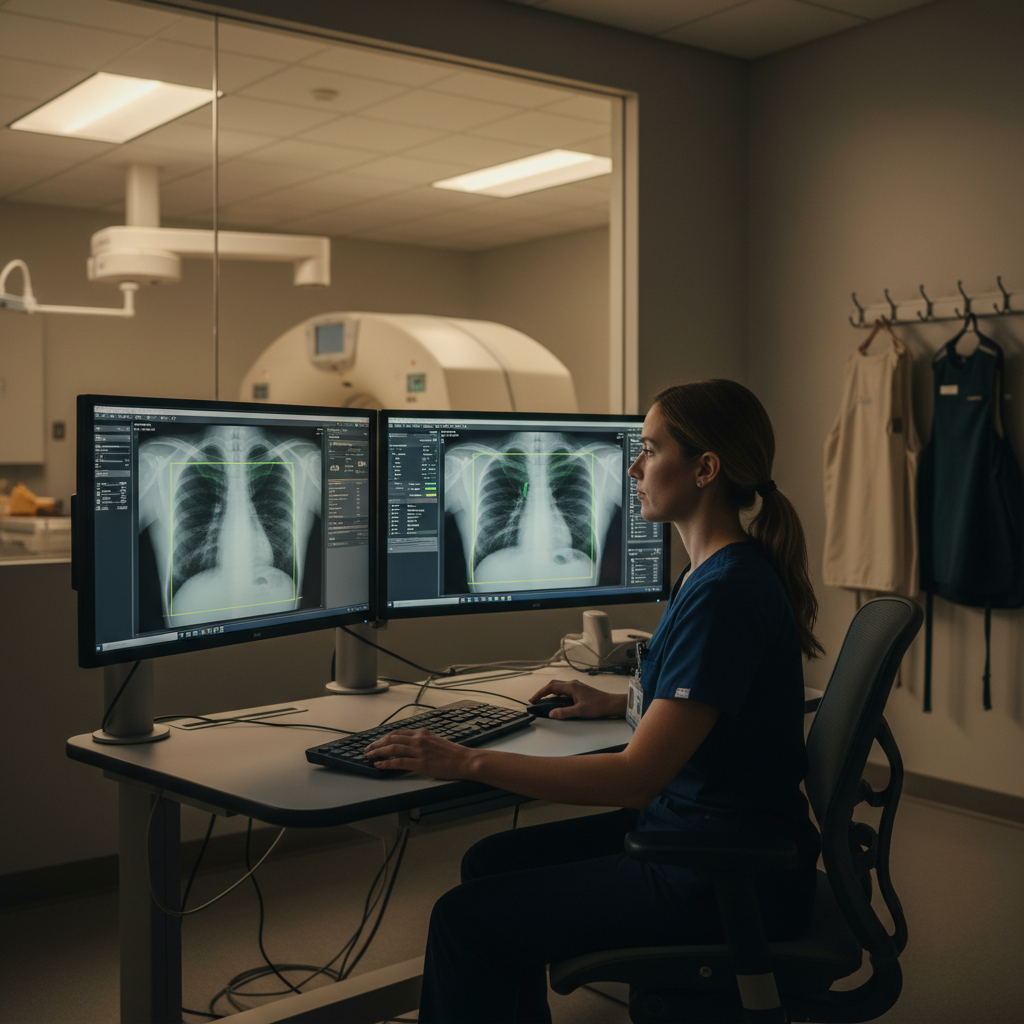
By mid-2026, AI read-assist tools are no longer ‘coming soon’ to radiology departments — they’re already here, humming quietly in the background of nearly every major imaging center across the United States. If you’re a diagnostic imaging tech, you’ve likely noticed the shift: algorithms flagging potential findings before the radiologist even opens the study, priority worklists auto-sorting based on suspected pathology, and CAD overlays appearing on your PACS like a second set of eyes.
But what did AI in radiology actually change for the people positioning patients, running protocols, and troubleshooting equipment? Not the hype-cycle promises, not the vendor white papers — the real, day-to-day workflow differences that radiology techs, CT techs, MRI techs, and ultrasound professionals are navigating right now in 2026.
Let’s take an honest look at radiology workflow 2026, what rad tech AI tools delivered (and what they didn’t), and the practical skills imaging professionals should be building today.
The Workflow Shifts That Actually Happened
Three years into widespread deployment, the most visible change isn’t dramatic — it’s incremental and specific. AI read-assist platforms have altered how studies move through departments, not whether techs are needed.
Priority queue reshuffling is now standard. Most enterprise PACS systems integrate AI triage that scores incoming studies for suspected critical findings — pulmonary embolism on CT, pneumothorax on chest X-ray, intracranial hemorrhage on head CT. Studies flagged as high-priority get bumped to the top of the radiologist worklist automatically. For techs, this means understanding that a routine chest X-ray you just completed might suddenly appear as ‘urgent’ on the board if the algorithm detected something. Communication loops tightened; you’re often the first person a radiologist asks when they see an AI flag on a fresh study.
Protocol adjustments mid-exam became more common. Some AI tools analyze scout images or initial sequences in real time and suggest protocol modifications — adding contrast phases, extending coverage, or adjusting slice thickness. Forward-thinking departments empower techs to act on these suggestions (within scope and standing orders), which means your judgment calls now include interpreting algorithmic recommendations alongside clinical history.
Quality control automation reduced but didn’t eliminate human oversight. AI can catch positioning errors, motion artifacts, and incomplete anatomy coverage faster than manual review. But techs quickly learned that algorithms trained on ideal datasets sometimes flag unconventional but clinically appropriate techniques as ‘errors.’ You still need to know when to override the software.
What Techs Are Actually Doing Differently
The day-to-day reality for imaging professionals in 2026 involves new micro-tasks that weren’t part of the job description five years ago.
- Annotation verification: Some AI platforms auto-annotate measurements (nodule size, vertebral compression ratios). Techs often do a quick sanity check before the study goes to reading.
- Algorithm selection: Larger centers run multiple AI vendors for different modalities. You might choose which pneumonia-detection model to apply based on patient population or clinical question.
- Feedback loops: When AI flags turn out to be false positives (or miss something a radiologist catches), many systems ask techs to log the discrepancy. You’re contributing to model retraining, whether you realize it or not.
- Patient communication: Patients see ‘AI analysis’ on their after-visit summaries and ask questions at the scanner. Techs became the first line for explaining that AI assists radiologists but doesn’t replace clinical judgment.
None of these tasks are overwhelming individually, but together they represent a subtle expansion of the tech role — more data stewardship, more clinical reasoning, more technology liaison work.
The Skills Gap Nobody Predicted
Here’s what surprised the industry: the biggest skills gap wasn’t technical literacy (most techs adapted to new software quickly). It was critical appraisal of algorithmic output.
Early adopters assumed techs would just accept AI suggestions as gospel. Instead, experienced imaging professionals started noticing patterns — certain algorithms consistently over-called calcifications as nodules, others missed findings in larger body habitus patients, some struggled with pediatric anatomy variations.
The techs who thrived in radiology workflow 2026 developed what one imaging director called ‘algorithmic skepticism’ — a healthy questioning of why the AI flagged this study, whether the flag makes clinical sense given the patient presentation, and when to escalate unusual AI behavior to radiologists or IT.
This isn’t about distrusting technology. It’s about understanding that rad tech AI tools are probabilistic, trained on specific datasets, and sometimes confidently wrong. The skill is knowing when to trust the flag and when to trust your own eyes.
What You Should Be Learning Right Now
If you’re an imaging tech looking at the next three to five years, here’s what the 2026 landscape suggests you focus on:
Deepen your cross-modality knowledge. AI integration is pushing toward unified radiology workflows where the same tech might handle multiple modalities in a shift. Understanding how CT protocols inform MRI sequences (and vice versa) makes you more valuable and more adaptable when AI suggests cross-modality comparisons.
Get comfortable with data hygiene. Garbage in, garbage out applies to medical AI. Techs who understand how poor technique, inconsistent labeling, or incomplete metadata corrupt algorithmic performance become indispensable. Learn your DICOM tags, understand why consistent anatomy landmarks matter, and take protocol adherence seriously — AI amplifies the consequences of sloppy technique.
Build clinical reasoning skills. The techs who add the most value in AI-assisted workflows are the ones who can contextualize algorithmic findings against patient history, prior studies, and clinical presentation. If you’ve been coasting on button-pushing, 2026 is your wake-up call to engage with the ‘why’ behind every exam.
Understand the basics of how these tools work. You don’t need a computer science degree, but knowing the difference between detection algorithms, segmentation tools, and quantification software helps you troubleshoot and communicate effectively. A 20-minute YouTube deep-dive on convolutional neural networks will make you smarter than 80% of your peers.
The Honest Bottom Line for 2026
AI in radiology didn’t replace techs. It didn’t make the job easier, exactly. It made the job different — more cognitively demanding in some ways, more efficient in others, and more collaborative across the care team.
Techs who adapted well treated AI as a tool that extends their capabilities, not a judge of their competence. They learned to interpret algorithmic suggestions, advocate for patients when AI flags didn’t match clinical reality, and contribute to continuous improvement of the systems they work alongside.
The imaging professionals struggling in 2026 are the ones who resisted engaging with the technology, who saw AI as either a threat to be ignored or an oracle to be blindly followed. Both extremes miss the point: rad tech AI tools are collaborators, and like any collaborator, they work best when you understand their strengths, limitations, and quirks.
If you’re navigating this transition — or looking for imaging roles at facilities that invest in both technology and the people who use it — the Intuites Recruiting Team works with diagnostic and imaging professionals across the country. Whether you’re exploring staff positions, PRN flexibility, or travel opportunities in departments with cutting-edge tech, reach out at contact@intuites.healthcare or visit intuites.healthcare. We’re here to help you find roles where your expertise and adaptability are valued. 🤍
The radiology department of 2026 runs on a partnership between human judgment and algorithmic assistance. The techs who thrive are the ones who show up ready to learn, question, and grow alongside the technology.
#AIInRadiology #RadTech #RadiologyWorkflow2026 #DiagnosticImaging #MedicalImaging #RadTechAITools #HealthcareTechnology #CTTech #MRITech #XRayTech #ImagingProfessionals #RadiologyTrends #HealthcareAI #PACS #RadiologyCareers
Looking for a healthcare team that truly sees your value?
The Intuites Recruiting Team is here to listen, support your career, and connect you with roles across the USA — when you're ready.