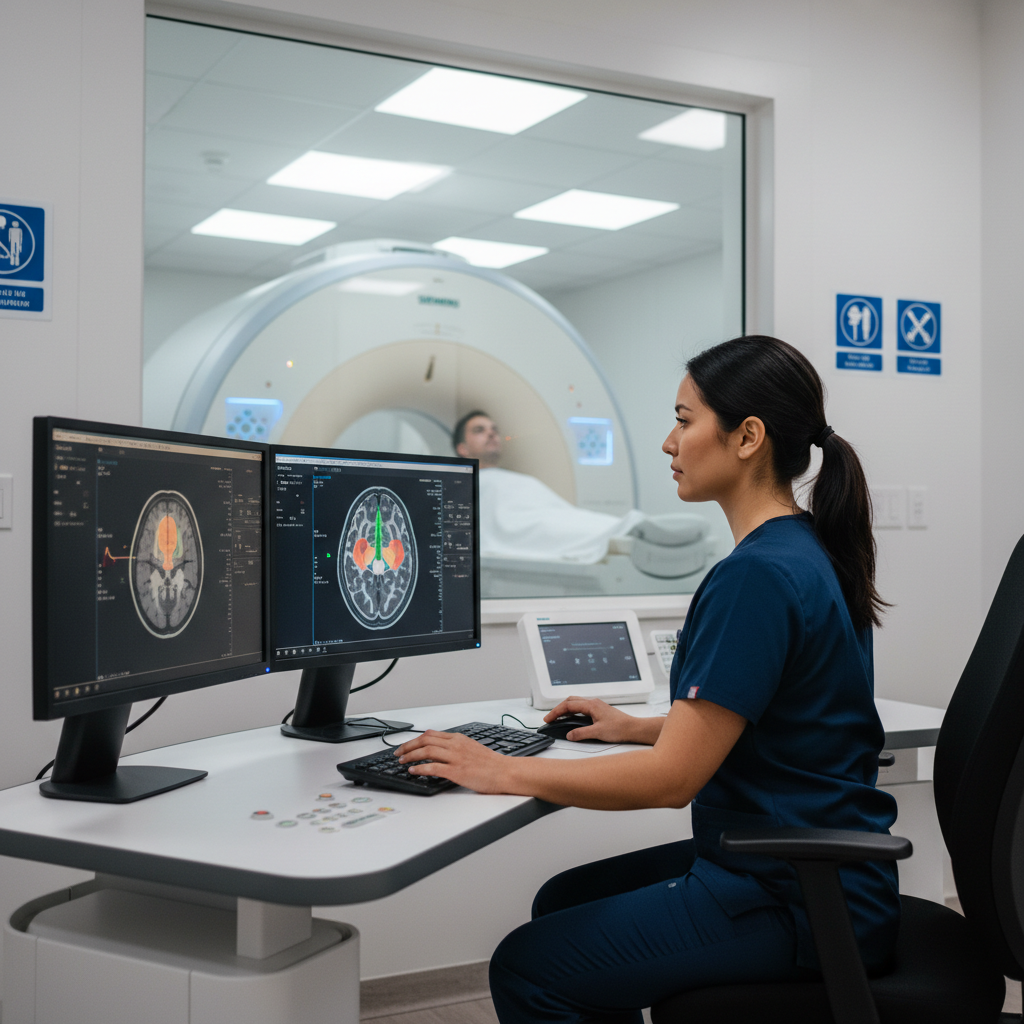
You have spent years mastering CT. You know the protocols, the contrast timing, the way a good scout image sets up everything that follows. But lately, you have been eyeing the MRI suite down the hall—wondering if the grass is greener, the work more varied, the pay a little sweeter.
Spoiler: It might be. But the jump from CT to MRI is not just about learning a new machine. It is about rewiring how you think about imaging, earning a new credential, and navigating a learning curve that can feel steep at first. The good news? Thousands of techs have made this switch successfully, and the demand for dual-modality imaging professionals has never been higher.
Here is your step-by-step guide to making the move—and what to expect when you do.
Why CT Techs Make Great MRI Candidates
Let us start with what you already bring to the table. If you have been running a CT scanner, you understand cross-sectional anatomy, patient positioning, contrast protocols, and how to troubleshoot on the fly. That foundation is gold.
MRI requires many of the same cognitive skills—spatial reasoning, protocol selection, patient assessment—but applies them through a completely different lens. Instead of ionizing radiation and iodinated contrast, you are working with magnetic fields, radiofrequency pulses, and gadolinium. Instead of 30-second scans, you are managing sequences that can take 20 minutes or more.
The learning curve is real, but your CT experience gives you a head start that someone coming straight out of rad tech school does not have. You already speak the language of imaging. Now you are just learning a new dialect.
The Cross-Training Pathway: What It Actually Takes
Most hospitals and imaging centers offer one of three routes for CT techs looking to cross train into MRI:
- Employer-sponsored training: Some facilities will pay for your MRI certification if you commit to staying for a set period (usually 1-2 years). This is the golden ticket if you can find it.
- Community college MRI certificate programs: Typically 12-18 months, these programs combine didactic coursework with clinical rotations. Expect evening or weekend classes if you are working full-time.
- Online hybrid programs: Accelerated options that let you complete theory online and arrange clinical hours locally. Faster but requires serious self-discipline.
Regardless of the path, you will need to log clinical competencies—usually around 100-125 exams across different body parts and sequences—before you are eligible to sit for the ARRT MRI registry exam. Budget 12-18 months from start to finish if you are working while training.
And yes, the ARRT exam is tough. It covers MRI physics, safety, patient care, and image production. Pass rates hover around 75-80 percent, so take your prep seriously. Flashcards, practice exams, and study groups are your friends here.
Day One in the MRI Suite: What Nobody Tells You
You passed your boards. You have your registry. You walk into the MRI suite on your first official day as a dual-modality tech, and—wait, why is this scan taking so long?
Here is what catches most CT-to-MRI switchers off guard:
The pace is different. CT is fast. MRI is methodical. A routine brain MRI might take 25 minutes. A lumbar spine with and without contrast? Forty-five minutes if the patient does not move. You will need to recalibrate your internal clock and your patience.
Patient communication is everything. In CT, you can often get a decent scan even if the patient is anxious. In MRI, motion artifact will ruin your images. You will spend more time coaching, reassuring, and sometimes holding a nervous patient’s hand (figuratively) through the exam.
Safety is non-negotiable. You already know this in theory, but the first time you see a ferromagnetic object get pulled toward the magnet, it hits differently. MRI safety is not just a checklist—it is a mindset. Every patient. Every time. No shortcuts.
Protocols are more customizable. In CT, protocols are fairly standardized. In MRI, you will adjust slice thickness, field of view, and sequence parameters based on what the radiologist is looking for. It is more of an art than a science, and it takes time to develop that intuition.
The Good News
Once you get past the initial adjustment period—usually 3-6 months—most techs say MRI feels less physically demanding than CT. You are not lifting patients on and off the table as frequently, and the workflow is more predictable. You also get to see pathology in stunning detail that CT just cannot match.
The Salary Delta: Is It Worth It?
Let us talk money. According to recent data from the Bureau of Labor Statistics and industry surveys, the average CT tech in the US earns around $68,000-$75,000 annually. MRI techs average $72,000-$80,000. Dual-modality techs—those registered in both CT and MRI—can command $78,000-$88,000 or more, especially in high-demand markets.
That is a potential $10,000-$15,000 bump just for adding MRI to your resume. And if you are open to travel assignments, dual-modality techs are among the highest-paid imaging professionals on the road. Weekly pay packages of $2,500-$3,200 are common for experienced MRI or CT/MRI travelers.
The return on investment for cross-training is solid—especially if your employer foots the bill for your education.
Making the Jump: Practical Next Steps
So you are convinced. You want to make the switch from CT to MRI. Here is your action plan:
Start the conversation with your manager. Ask if your facility offers cross-training programs or tuition reimbursement. Many hospitals are desperate for MRI techs and will jump at the chance to train someone in-house.
Research accredited programs in your area. The ARRT website has a searchable database of recognized MRI programs. Look for ones that offer flexible scheduling if you are working full-time.
Shadow an MRI tech for a day. Seriously. Spend a shift in the MRI suite before you commit. Make sure the pace and workflow feel like a good fit.
Budget for the investment. If you are self-funding, expect to spend $5,000-$12,000 on tuition, books, and exam fees. It is not cheap, but the payback period is usually under two years.
Join the MRI community. Online forums, Facebook groups, and professional organizations like the AHRA or ASRT offer support, study resources, and job leads. You do not have to figure this out alone.
You Are Not Starting Over—You Are Leveling Up
Here is the thing about switching from CT to MRI: it is not a career reset. It is a career expansion. You are not abandoning your CT skills—you are adding a powerful new tool to your toolkit. Dual-modality techs are in high demand precisely because they bring flexibility and depth to imaging departments.
Will there be moments when you miss the speed and simplicity of CT? Probably. Will there be days when you wonder why you signed up to learn pulse sequences and T1 versus T2 weighting all over again? Absolutely. But most techs who make the jump say they would do it again in a heartbeat.
The work is more varied. The pay is better. And you will never be bored.
If you are thinking about making the move—or you have already started your MRI training and want to explore what is next—the Intuites Recruiting Team would love to hear from you. We work with imaging professionals at every stage of their careers, from first-time travelers to seasoned dual-modality techs looking for their next great opportunity. Drop us a line at contact@intuites.healthcare or visit intuites.healthcare to see what is out there. We are here to help you find the right fit. 🤍
#CTtoMRI #MRITech #CrossTrainImaging #ImagingCareers #RadiologicTechnology #MRICareer #CTTech #DualModality #HealthcareStaffing #MedicalImaging #RadTech #TravelRadiology #IntuitesCareers #ImagingJobs #MRITraining
Looking for a healthcare team that truly sees your value?
The Intuites Recruiting Team is here to listen, support your career, and connect you with roles across the USA — when you're ready.