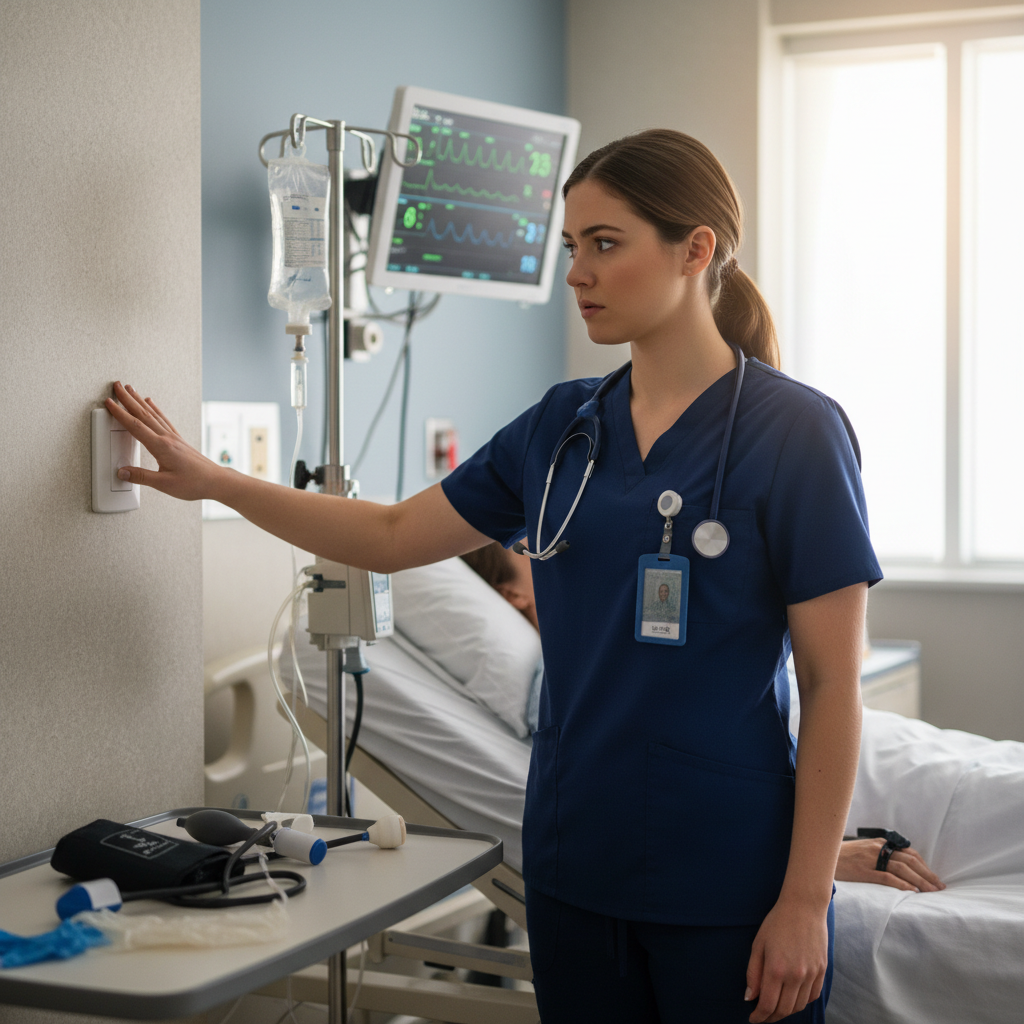
It was a Tuesday evening, six months into my first RN job. The charge nurse had stepped away to help with an admit down the hall. My preceptor had rolled off two weeks earlier. And Mrs. Chen in 412 — stable all shift, post-op day two from a knee replacement — suddenly looked wrong.
Not crash-cart wrong. Just… wrong. Her color. Her breathing. The way she could not finish a sentence without pausing. And I was alone.
That was the moment I learned what nurse autonomy actually means. Not the empowering kind they talk about in school. The kind where your hands shake and your brain runs the algorithm and no one else is coming because you are the nurse and this is your call.
The Moment Before the Call
I had done rapids during orientation. Twice. Both times with my preceptor right there, coaching me through the sequence. Both times I was one voice in a room full of people who knew exactly what to do.
This time, I was the only one in the room.
Mrs. Chen's O2 sat was 88% on room air. Respiratory rate 28. She was diaphoretic, anxious, and when I asked her to rate her pain she said “seven” — but her eyes said more. I pulled out my stethoscope. Diminished breath sounds on the left. My mind went to PE, to pneumothorax, to all the things that kill people in the first 72 hours post-op when you miss the signs.
I could page the hospitalist. I could wait for the charge nurse to come back. Or I could trust my assessment and call it.
I hit the rapid response button.
What Happens When Muscle Memory Takes Over
The team arrived in under three minutes. Respiratory. ICU nurse. Hospitalist. Someone from pharmacy. And suddenly I was giving report — clear, concise, the way I had practiced a hundred times in sim lab but never believed I would actually do under pressure.
“68-year-old female, post-op day two from left total knee replacement. Vital signs stable all shift until ten minutes ago. Now tachypneic at 28, O2 sat 88% on room air, diminished breath sounds left base, diaphoretic, anxious. No chest pain but reports ‘pressure.’ Last pain med given at 1400. Foley patent, output adequate. No calf tenderness but she has been less mobile today than yesterday.”
The hospitalist nodded. Ordered a stat chest X-ray, EKG, D-dimer, and O2 via nasal cannula. Respiratory took over. The ICU nurse gave me a look — not pity, not praise, just acknowledgment. You did the right thing.
Mrs. Chen had a small pulmonary embolism. Caught early. Treated. Transferred to step-down for closer monitoring. She went home four days later.
The Fear No One Warns You About
Here is what they do not tell you in nursing school about calling your first rapid response alone: the fear is not that you will forget the steps. The fear is that you are wrong. That you are overreacting. That the team will show up and find a stable patient and you will be that nurse — the one who cried wolf, who panicked, who could not handle the floor.
I have talked to dozens of new nurses since that night, and every single one has felt this. The imposter syndrome is loudest in the moment you have to act independently. But here is the truth that took me months to internalize:
- You are not expected to diagnose. You are expected to recognize change and escalate. That is the job.
- A rapid response is not a failure. It is the system working. Early intervention saves lives.
- Experienced nurses call rapids too. I have watched 20-year veterans hit that button without hesitation, and no one questions their judgment.
- Your gut is data. If something feels off, it probably is. You have more clinical intuition than you think, even six months in.
The charge nurse found me in the med room afterward, charting with hands that were finally steady. She did not ask if I was okay. She said, “Good catch. That is exactly what we want you to do.”
What Changes After the First One
I have called four more rapid responses since that Tuesday. Two were clear-cut emergencies. One turned out to be a panic attack — and the team thanked me anyway, because we ruled out the bad stuff fast. One was a patient I just knew was circling, even though the vitals were borderline, and he coded twenty minutes later in the ICU.
Each one gets a little less terrifying. Not because the stakes are lower, but because I trust my assessment now. I know what my scope is. I know that autonomy does not mean having all the answers — it means knowing when to pull the right people into the room.
That first rapid response alone was the moment I stopped being a senior student and started being a nurse. Not because I saved a life — the team did that. But because I made the call, and I owned it, and I learned that I could.
For the New Nurse Reading This 🤍
If you have not called your first solo rapid yet, you will. And it will be hard. Your hands will shake. You will second-guess yourself even as you are hitting the button. You will wonder if you are overreacting.
Call it anyway.
Because the worst-case scenario is not that the team shows up and the patient is stable. The worst-case scenario is that you wait, and you miss the window, and you carry that weight forever.
You were trained for this. Your assessment matters. And the first time you call a rapid response alone is the moment you step into the role you have been preparing for all along. It is okay to be scared. It is okay to feel like you are in over your head. Do it anyway.
That is what nurse autonomy looks like. That is what first year RN growth looks like. And on the other side of that fear is a version of yourself you did not know you could be.
If you are navigating those early months of practice and looking for a team that supports new nurses through every stage of growth — whether you are seeking your next staff role, exploring travel opportunities, or just need to talk through what comes next — the Intuites Recruiting Team is here. We work with nurses at every experience level, and we understand what it takes to build confidence in those first critical years. Reach out anytime at contact@intuites.healthcare or visit intuites.healthcare. We would love to hear your story. ✨
#NewNurseStory #RapidResponse #NurseAutonomy #FirstYearRN #NursingReflection #RNLife #NewGradNurse #ClinicalJudgment #NursingGrowth #HealthcareHeroes #NurseSupport #RNJourney #NursingConfidence #TravelNursing #IntuitesCareers
Looking for a healthcare team that truly sees your value?
The Intuites Recruiting Team is here to listen, support your career, and connect you with roles across the USA — when you're ready.