
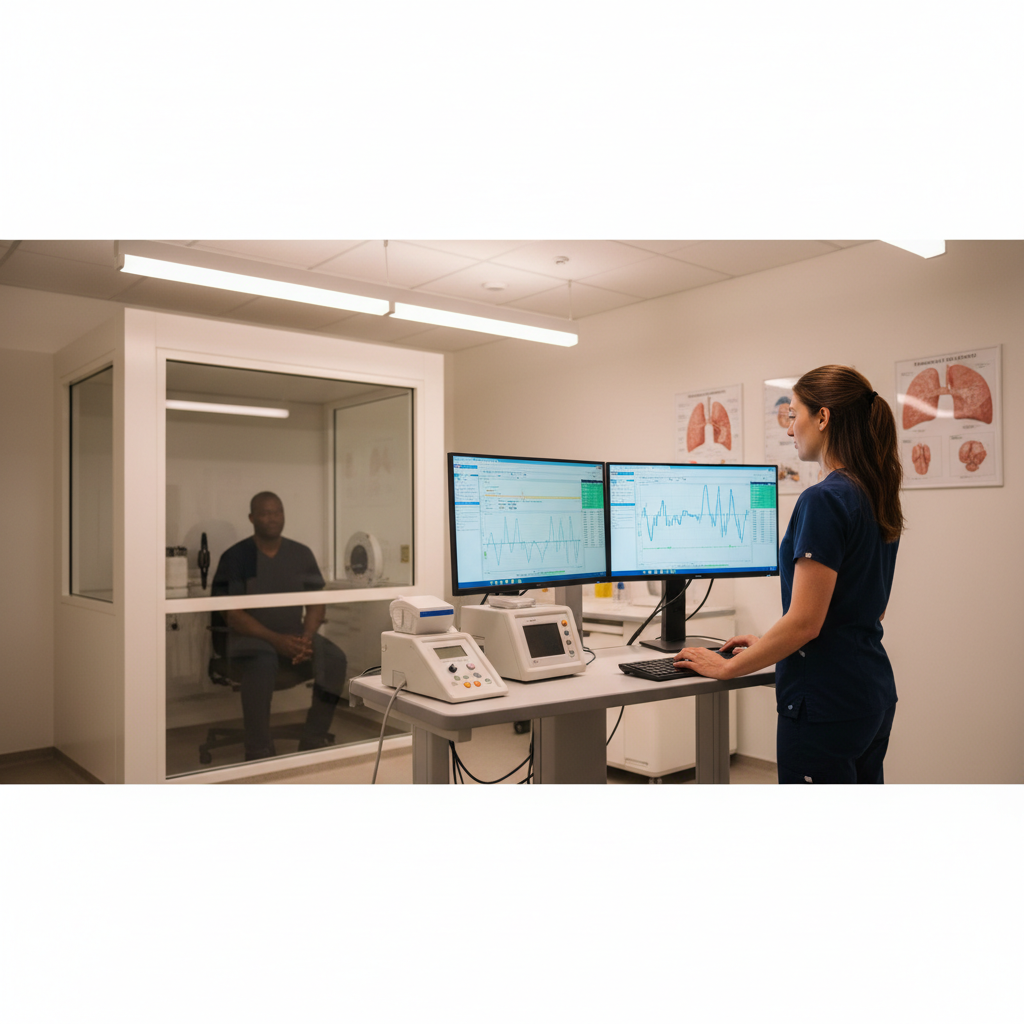
If you have been working as a respiratory therapist on acute care floors — managing vents, running codes, responding to stat calls at 3 a.m. — you already know the pace can be relentless. The work is vital, but many RTs eventually wonder: what else is out there?
One compelling answer is the pulmonary function testing lab. PFT labs offer a different rhythm, deeper diagnostic work, and the chance to become a true specialist in lung mechanics and cardiopulmonary diagnostics. Yet the path from floor RT to pulmonary function tech is not always obvious, and many therapists are not sure where to start.
This guide maps the career transition step by step, covering credentials, skills, job market realities, and what daily life looks like once you make the move. 🌱
Why Respiratory Therapists Choose PFT Lab Work
The shift from acute care to pulmonary function testing is not just about slowing down — though the predictable schedule is a genuine draw. It is about depth over breadth. In a PFT lab, you are no longer triaging emergencies; you are conducting precise, protocol-driven diagnostic studies that directly shape treatment plans for patients with chronic lung disease, pre-surgical candidates, and occupational health screenings.
Here is what draws experienced RTs to this specialty:
- Predictable hours: Most PFT labs operate Monday through Friday, daytime only, with rare weekend or on-call shifts.
- Deeper patient interaction: You coach patients through complex maneuvers, explain results, and build rapport over 30–60 minute sessions.
- Diagnostic expertise: You become fluent in spirometry, lung volumes, diffusion capacity, bronchoprovocation, and cardiopulmonary exercise testing.
- Intellectual challenge: Interpreting flow-volume loops, spotting restrictive versus obstructive patterns, and troubleshooting equipment require continuous learning.
- Lower physical demand: Less patient lifting and fewer emergencies mean less cumulative physical strain.
For many RTs, the pulmonary function lab feels like a natural next chapter — a way to leverage bedside experience while building a new skill set that is both technical and intellectually rewarding.
What Credentials and Training Do You Need?
The good news: your RRT credential is your foundation. Most PFT lab positions require a Registered Respiratory Therapist license, and hospitals or clinics rarely hire non-credentialed techs for diagnostic pulmonary work.
Beyond your RRT, here is what strengthens your candidacy:
Pulmonary Function Technologist Certification (CPFT or RPFT)
The National Board for Respiratory Care offers two advanced credentials specifically for PFT work:
- CPFT (Certified Pulmonary Function Technologist): Entry-level PFT credential. Requires your RRT and passing the CPFT exam. Many employers accept this as the baseline.
- RPFT (Registered Pulmonary Function Technologist): Advanced credential. Requires the CPFT, one year of PFT experience, and passing the RPFT exam. This is the gold standard for senior lab roles.
You do not need these certifications to start, but they dramatically improve your job prospects and salary ceiling. Many RTs earn the CPFT within their first year in a PFT role, then pursue the RPFT once they have hands-on experience.
On-the-Job Training
Even with strong RT fundamentals, most hospitals provide 3–6 months of structured training when you transition into PFT work. You will learn equipment operation (often brand-specific, like CareFusion or MGC Diagnostics systems), quality control protocols, and how to coach patients through difficult maneuvers.
Expect to shadow senior techs, practice interpreting studies under supervision, and gradually take on your own patient load. This apprenticeship model is standard across the field.
Skills That Transfer — and Skills You Will Build
Your floor experience gives you a head start in several areas:
- Patient assessment: You already know how to read a patient, spot distress, and adjust your approach on the fly.
- Respiratory mechanics: Understanding lung compliance, airway resistance, and gas exchange is foundational to PFT interpretation.
- Equipment troubleshooting: If you have kept vents running and swapped circuits at bedside, you will adapt quickly to PFT hardware.
What you will need to develop:
- Coaching skills: PFTs require maximal patient effort. You will spend significant time coaxing patients to blow harder, inhale deeper, and repeat maneuvers until you get reproducible data.
- Quality control rigor: Every test must meet ATS/ERS acceptability and repeatability criteria. You will learn to spot artifacts, reject poor efforts, and document meticulously.
- Diagnostic interpretation: While physicians make final diagnoses, PFT techs provide preliminary reads and flag abnormalities. You will train your eye to recognize obstructive, restrictive, and mixed patterns.
- Report writing: Clear, concise documentation is essential. You will learn to summarize findings, note patient effort, and communicate technical details to ordering providers.
The learning curve is real, but it is manageable — especially if you approach it with curiosity and patience.
What the Job Market Looks Like for Pulmonary Function Techs
PFT lab jobs are less abundant than general RT positions, but demand is steady and growing. Key drivers include:
- Aging population: COPD, interstitial lung disease, and pre-operative pulmonary clearances are all rising.
- Occupational health screening: Industries with respiratory hazards (mining, manufacturing, firefighting) require regular PFT monitoring.
- Specialized clinics: Asthma centers, transplant programs, and pulmonary rehab facilities all rely on in-house PFT capabilities.
Where you will find openings:
- Academic medical centers and large hospital systems (often the best training environments)
- Outpatient pulmonary clinics
- Occupational health providers
- Sleep and pulmonary diagnostic centers
Salaries for pulmonary function techs typically range from $55,000 to $75,000 annually, with higher pay in metro markets and for RPFT-credentialed professionals. Many positions also offer better work-life balance than floor RT roles, which can be a significant quality-of-life upgrade.
How to Make the Transition: Practical Steps
Ready to explore this RT career path? Here is a roadmap:
1. Express interest internally. If your hospital has a PFT lab, start there. Ask to shadow for a day, talk to the lab manager, and let your supervisor know you are interested in cross-training. Internal moves are often easier than external job searches.
2. Study for the CPFT exam. Even before you have a PFT job, you can begin preparing. The NBRC offers study materials, and several online courses (Kettering, RRT Review) provide CPFT-specific content. Passing the exam signals serious intent to hiring managers.
3. Highlight transferable skills on your resume. Emphasize patient education, equipment competency, and any experience with diagnostic testing (ABGs, EKGs, or other bedside studies).
4. Network with PFT professionals. Join the AARC PFT section, attend conferences, and connect on LinkedIn. Many PFT jobs are filled through word-of-mouth referrals.
5. Be open to part-time or per-diem starts. Some RTs transition gradually, picking up PFT shifts while maintaining floor work. This hybrid approach lets you test the waters without burning bridges.
6. Keep learning. PFT interpretation is a career-long discipline. Read case studies, attend webinars, and pursue the RPFT once you have a year of experience. The more expertise you build, the more doors open.
What Daily Life Looks Like in a PFT Lab
A typical day might include:
- Calibrating equipment and running quality control checks each morning
- Conducting 8–12 PFT sessions (spirometry, lung volumes, DLCO, sometimes exercise testing)
- Coaching patients through maneuvers and troubleshooting poor efforts
- Reviewing tracings for quality, flagging abnormalities, and generating preliminary reports
- Coordinating with pulmonologists, referring providers, and scheduling teams
The work is methodical and detail-oriented. You will have slower days and busier days, but the chaos of acute care is largely absent. For RTs who thrive on precision and patient education, it is a deeply satisfying niche.
If you have been wondering whether there is more to your RT career path than the floor, pulmonary function testing might be the answer. It is a specialty that rewards experience, values continuous learning, and offers a sustainable long-term career with real intellectual depth. ✨
Thinking about your next move? The Intuites Recruiting Team works with PFT labs and pulmonary departments nationwide, and we would love to help you explore what is out there. Reach out anytime at contact@intuites.healthcare or visit intuites.healthcare to see current openings. We are here to support your growth. 🤍
#RTCareerPath #PulmonaryFunctionTech #RespiratoryTherapist #PFTLabJobs #CPFT #RPFT #AlliedHealth #HealthcareCareers #RespiratoryCare #PulmonaryDiagnostics #ClinicalSpecialty #HealthcareJobs #MedicalCareers #RespiratoryCareWeek #LungHealth
Looking for a healthcare team that truly sees your value?
The Intuites Recruiting Team is here to listen, support your career, and connect you with roles across the USA — when you're ready.