
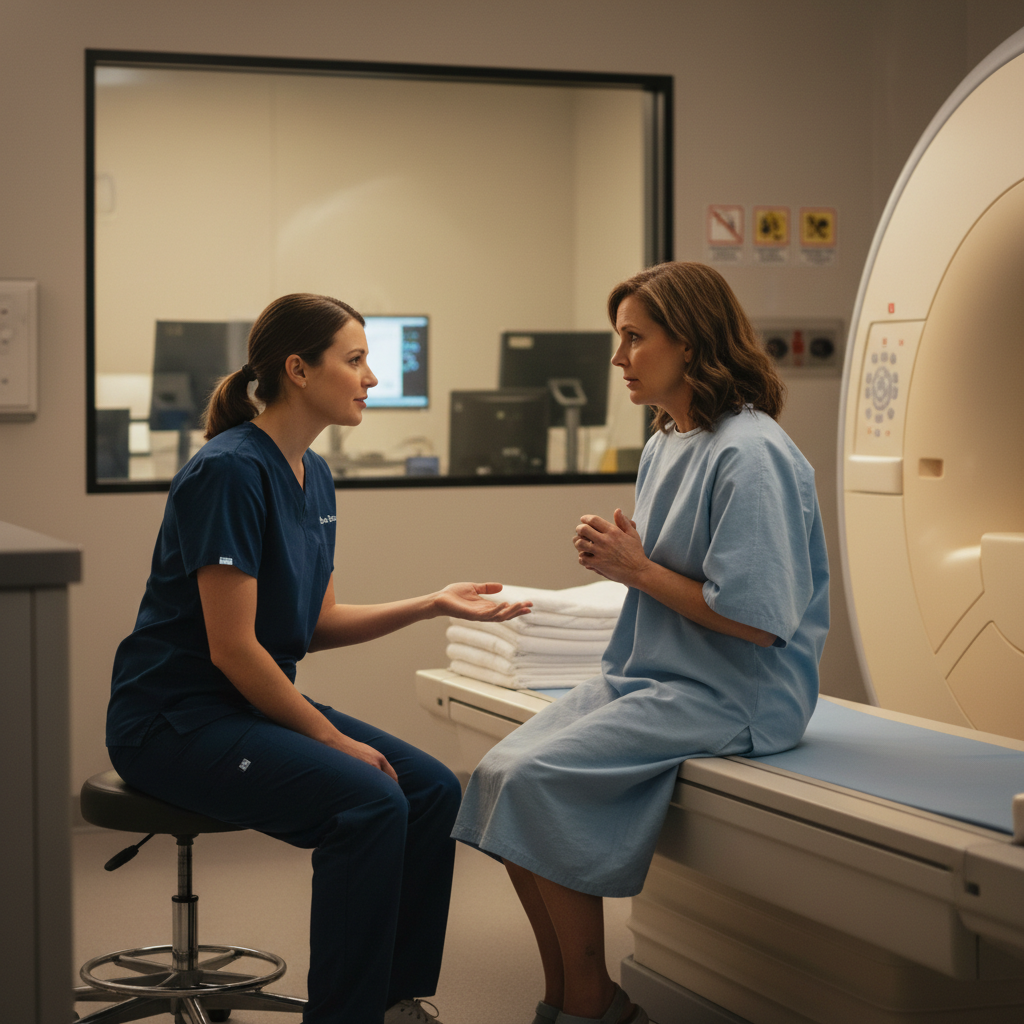
You have seven patients scheduled. The morning is already running twenty minutes behind. The next name on your list is a routine lumbar spine — straightforward, thirty minutes tops if everything goes smoothly.
Then you meet her in the waiting room, and you know immediately: this will not go smoothly.
She is gripping the arms of her chair. Her intake form lists claustrophobia in careful handwriting under “previous imaging concerns.” When you call her name, she stands but does not move toward you. This is one of those MRI tech stories that never makes it into productivity metrics — the kind that happens in the unmeasured spaces of your day.
The Labor That Does Not Scan
You walk her back. You show her the machine. She takes two steps into the room and stops.
“I cannot do this,” she says quietly.
Here is where the job splits into two versions. There is the version on paper: position patient, acquire images, move to the next case. Then there is the version you actually live, the one where compassionate imaging means sitting down on a rolling stool and saying, “Tell me what scares you most.”
Forty-five minutes. That is how long you sat with her before the scan. Talking. Listening. Letting her look inside the bore with the lights on. Explaining every sound. Offering a washcloth for her eyes. Suggesting she picture her kitchen at home, the window over the sink, the way light comes through in the morning.
You did not bill for those forty-five minutes. No CPT code exists for sitting with a human being who is afraid. Your scheduler will see a gap in the morning's flow and wonder why you fell behind. But you know: some of the most essential work we do lives entirely outside the metrics.
What Claustrophobia MRI Moments Teach Us
Patients do not always arrive ready. Sometimes readiness is something we help them build, breath by breath, question by question. Here is what those forty-five minutes actually looked like:
- Five minutes of just letting her stand in the doorway and talk about the last time she tried this — the panic, the early exit, the feeling of failure.
- Ten minutes of walking her through every phase: how she will lie down, how the table will move, what the sounds mean, how she can signal you to stop.
- Fifteen minutes of practice — lying on the table with the bore still far away, then closer, then with her head near the opening but not inside.
- Ten minutes of stillness, eyes closed, while you talked her through a grounding exercise a psychiatrist once taught you during your own hard season.
- Five minutes of silence, where she decided on her own that she was ready.
And then she went in. And she stayed. And you got every sequence you needed, clean and diagnostic.
The Unbilled Emotional Work of Imaging
This is the part of the job nobody warns you about in school. You learned contrast protocols and T1 versus T2 weighting and how to optimize your coil selection. You did not learn how to become a steadying presence for someone whose fear is bigger than their body.
But you learned it anyway, the way most of us do: on the job, in real time, with real patients who needed more than technical excellence.
The healthcare system does not know how to measure this labor. It shows up nowhere:
- Not in your productivity numbers
- Not in patient throughput reports
- Not in the reimbursement your facility receives
- Not in your performance review
Yet it is some of the most skilled work you do. Staying calm when someone else is panicking. Reading a room. Knowing when to talk and when to stay quiet. Holding space for fear without trying to fix it too quickly. These are not soft skills — they are core skills, and they are exhausting, and they matter immensely.
When the Magnet Is Not the Hardest Part
After she finished, after you helped her sit up slowly and handed her a cup of water, she cried. Not from fear this time. From relief. From something like gratitude.
“Thank you for not rushing me,” she said.
You wanted to say: I did rush you — I had six other people waiting. But that was not what she meant. She meant: thank you for treating my fear as legitimate. Thank you for not making me feel foolish. Thank you for sitting with me until I could do the hard thing.
This is the contradiction we live inside. The system wants speed. Patients need time. And you, in the middle, have to navigate that gap with whatever reserves you have left.
Some days you have forty-five minutes to give. Some days you do not. And both realities are true, and neither one makes you a better or worse tech. You are working inside constraints you did not design.
Carrying the Weight of Compassionate Imaging
Here is what nobody tells you: those forty-five minutes stay with you differently than a perfect scan does. You will remember her face. You will remember the way her breathing slowed when she finally believed she could do it. You will carry that moment alongside all the other unmeasured work — the patient you helped translate instructions for, the teenager you distracted with conversation during a shoulder MRI, the elderly man whose hearing aids you safely stored and then helped him reinsert afterward.
These moments add up. They become the archive of why you stay in this work, even when the schedule is unforgiving and the pay does not match the skill and the breaks are too short. You stay because every so often, someone looks at you with relief and recognition, and you remember: this is what I am here for.
But they also add up in another way. Emotional labor accumulates. Compassion has a cost. And if you are giving forty-five unbilled minutes here and thirty unmeasured minutes there, you are spending something real — your patience, your energy, your capacity to stay present. That spending is worthy. And it is also worth naming, worth protecting, worth recognizing as labor.
You Are Allowed to Acknowledge the Weight ✨
If you are reading this and thinking yes, I do this, and it is hard, and nobody sees it — you are right. It is hard. And we see it. Your colleagues see it. The patients who make it through because of you see it, even if they cannot name exactly what you did that made the difference.
You are allowed to feel both pride and tiredness. You are allowed to love this work and also wish it were structured differently. You are allowed to be excellent at the technical parts and the human parts, and still admit that some days, the human parts cost more than you have to give.
That does not make you less compassionate. It makes you honest.
If you are looking for a staffing partner who understands the full scope of what you do — the billed and the unbilled, the measured and the unmeasured — the Intuites Recruiting Team gets it. We work with imaging professionals who know that great care lives in the margins, and we help connect you with opportunities that respect both your technical skill and your humanity. Reach out anytime at contact@intuites.healthcare or visit intuites.healthcare. We would be glad to talk. 🤍
To every tech who has ever sat with a scared patient for longer than the schedule allowed: thank you. The magnet does not run without you. Neither does the trust.
#MRITech #RadiologicTechnologist #CompassionateImaging #ClaustrophobiaMRI #ImagingTech #MRITechStories #HealthcareHeroes #DiagnosticImaging #RadiologyLife #PatientCare #MedicalImaging #CTTech #XRayTech #UltrasoundTech #HealthcareStaffing
Looking for a healthcare team that truly sees your value?
The Intuites Recruiting Team is here to listen, support your career, and connect you with roles across the USA — when you're ready.