
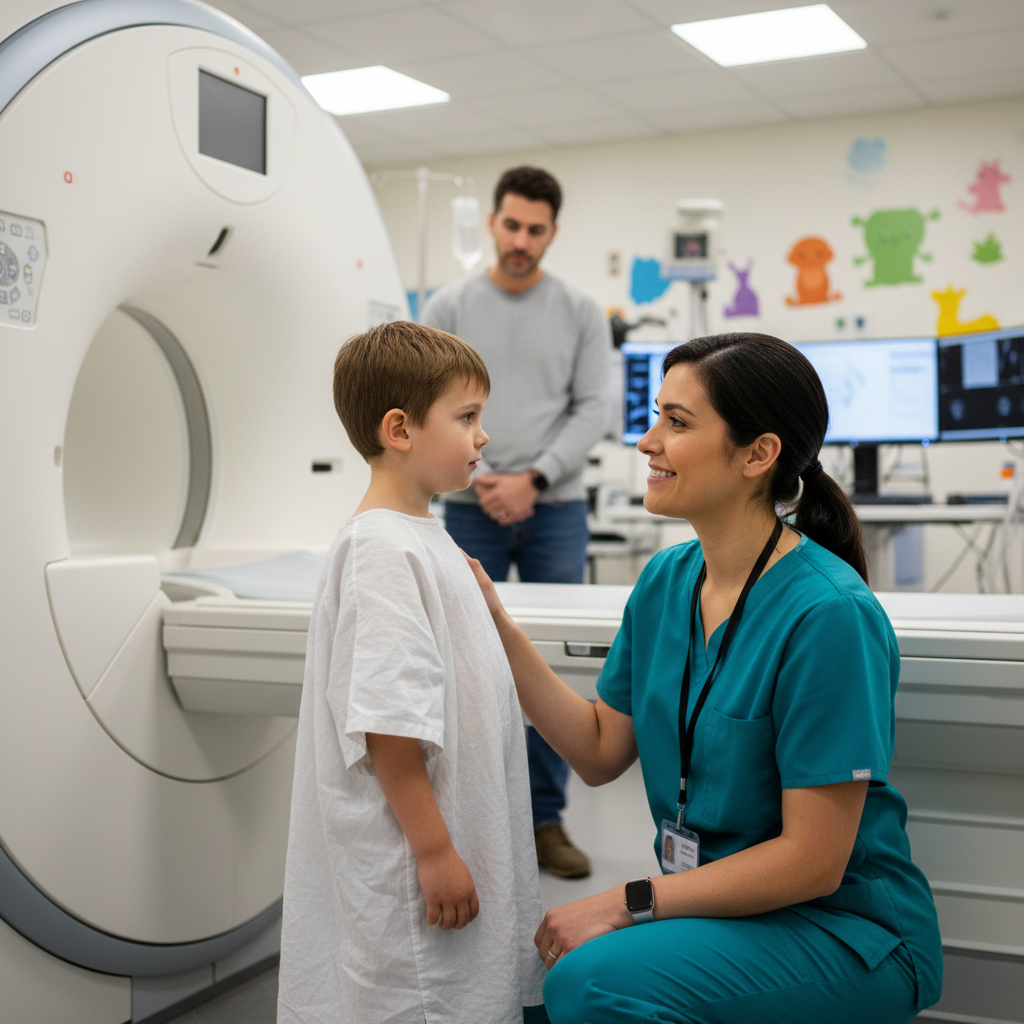
His name was Oliver. He was seven years old, clutching a stuffed dinosaur, and his mom was trying very hard not to cry in the waiting room.
I have been an MRI technologist for twelve years, and I have worked in pediatric imaging for the last six. I have seen this scene hundreds of times—the wide eyes, the tight grip on a parent's hand, the questions tumbling out faster than anyone can answer them. Will it hurt? Will I be able to breathe? Can my mom come in?
That day with Oliver, I used the same ritual I have refined over years of first scans. It is not in any textbook. It is not part of the protocol. But it is the part of this job that matters most.
The Ritual Begins in the Waiting Room
Before we even walk back to the scanner, I sit down. Not at my desk, not standing over them—I sit in the chair next to the child, at their eye level.
I introduce myself by first name. I ask about the stuffed animal or the shirt they are wearing or the book in their lap. With Oliver, we talked about dinosaurs for three minutes. His favorite was the Brachiosaurus. Mine, I told him, was the Stegosaurus, because I loved the plates on its back.
His mom relaxed a fraction. He stopped squeezing her hand quite so hard.
Then I say the same thing I always say: “I am going to tell you everything that is going to happen before it happens. No surprises. And if you have a question, you ask me. Deal?”
They always nod. And I always keep that promise.
The Walk Back: Naming the Noise
We walk slowly. I let the child set the pace. If they want to stop and look at the fish tank in the hallway, we stop.
When we reach the MRI suite, I do not rush them inside. I stand at the door and I say, “This is the room. It is big and it is cold and the machine is loud. But here is what I want you to know—you are safe in there. I will be right on the other side of that window the whole time, watching you. And your mom will be in the room with you.”
Then I take them inside and I let them see the scanner before we talk about anything else.
I name the noise. This is the part parents always remember.
“It sounds like a drum. Like a really big drum that someone is banging on over and over. Some kids think it sounds like a construction site. Some kids think it sounds like a spaceship. What do you think it will sound like?”
Oliver thought it would sound like a robot trying to beatbox. His mom laughed for the first time that morning.
The Practice Run: Control in a Scary Moment
We do a practice run. Always.
I have the child lie down on the table. I show them the coil. I let them hold the call button—the squeeze ball that lets them talk to me if they need to stop.
“This is your magic button,” I say. “You squeeze this, and I stop everything and come talk to you. You are in charge of that button.”
Then I move the table into the bore—just a few inches. I ask them how it feels. I tell them they can keep their eyes open or closed, whichever feels better. I remind them that their mom is right there, holding their foot.
We back out. We talk about what just happened. I answer every question, no matter how small.
Then we do it for real.
What I Have Learned from Scared Kids
Pediatric MRI is not just about the scan. It is about trust.
These children are being asked to lie perfectly still inside a loud, narrow tube while adults they just met disappear behind a window. That is terrifying. And if we do not acknowledge that—if we rush, if we minimize, if we talk over their heads to their parents—we lose them.
Here is what I have learned:
- Let them ask the same question five times. They are not testing you. They are trying to feel safe.
- Never lie. If it is going to be loud, say it will be loud. If they have to stay still, tell them that. Trust breaks the moment you sugarcoat something they will experience as hard.
- Give them a job. Hold the button. Count the noises. Pick the music we play. When they have something to do, they feel less helpless.
- Talk to the parent, too. They are scared. They are trying to be brave for their kid. I always tell them: “You can stay in the room. You can hold their foot. I will talk to both of you the whole time.”
- Celebrate the small wins. When the scan is done, I tell them they did an amazing job. I give them a sticker. I high-five them. They remember that part.
Oliver made it through his scan. Twenty-eight minutes, completely still, no sedation. When we were done, he sat up and asked if he could do it again sometime.
His mom cried then. But this time, they were different tears.
Why This Work Matters
There are days when this job feels like a factory line—scan after scan, rushing to stay on schedule, fighting with insurance, troubleshooting equipment that breaks at the worst possible moment.
But then there is a kid like Oliver.
Pediatric MRI teaches you that imaging is not just about the pictures. It is about the person in the scanner. It is about the mom in the corner who has been awake for two days worrying. It is about the seven-year-old who walked in terrified and walked out proud.
We are technologists. But we are also translators, coaches, and steady hands in a moment that feels enormous.
That is the part of the job no one tells you about in school. And it is the part I would never trade.
A Note from Intuites
If you are an MRI technologist—pediatric or otherwise—and you are looking for a role where your compassion and skill are valued equally, we would love to talk with you. The Intuites Recruiting Team works with imaging departments across the country that understand what it means to do this work well. Reach out anytime at contact@intuites.healthcare or visit intuites.healthcare. We are here when you are ready. 🤍
#PediatricMRI #MRITech #ImagingCompassion #ChildMRI #RadiologyTech #MRITechStory #PediatricImaging #HealthcareHeroes #DiagnosticImaging #MedicalImaging #RadiologyLife #MRITechnologist #HealthcareStories #ImagingProfessionals #CompassionateCare
Looking for a healthcare team that truly sees your value?
The Intuites Recruiting Team is here to listen, support your career, and connect you with roles across the USA — when you're ready.