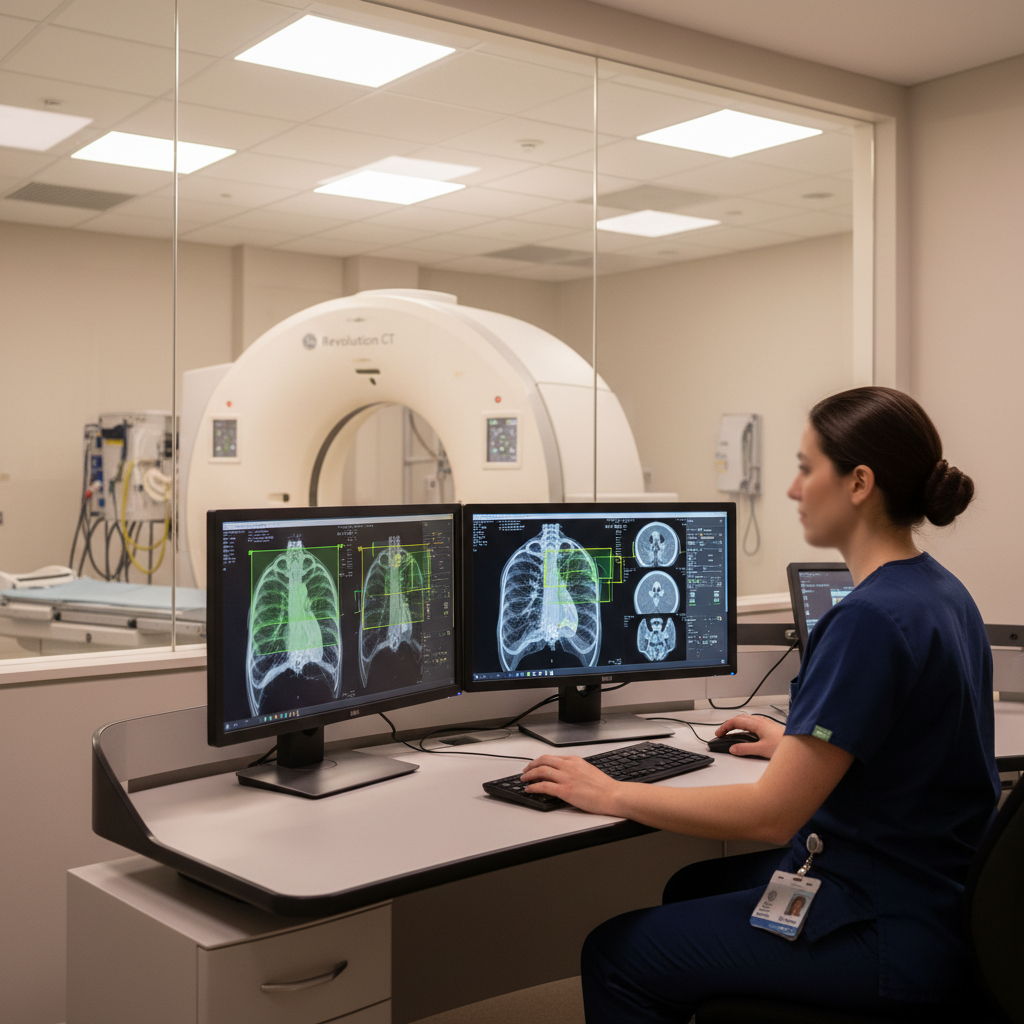
If you’ve worked a shift in radiology lately, you’ve probably noticed something new on your console. AI-assisted read tools are no longer pilot programs confined to academic centers — they’re live in community hospitals, outpatient imaging centers, and mobile units across the US. And they’re quietly changing how you spend your day.
This isn’t about robots reading films or techs losing jobs. It’s about triage. AI imaging tools are flagging priority cases before the radiologist even opens the worklist, which means your workflow — what you prep, what you communicate, what you double-check — is shifting in real time.
Here’s what rad techs, CT techs, MRI techs, and ultrasound professionals need to know about AI radiology in 2026.
What AI Triage Actually Does at the Console
Most FDA-cleared AI radiology tools don’t interpret images — they rank them. When you send a chest X-ray or head CT to PACS, the AI scans it in seconds and assigns a priority score based on findings like pneumothorax, intracranial hemorrhage, pulmonary embolism, or fractures.
The result? Studies with critical findings get bumped to the top of the radiologist’s queue. Non-urgent exams stay in standard order. For techs, that means you’re often the first person to see the AI flag, especially if your facility routes alerts through the console or a separate notification system.
Some sites now expect techs to:
- Acknowledge AI alerts within a set timeframe
- Notify the ordering provider or charge nurse immediately for flagged cases
- Document the alert and your notification in the patient chart
- Re-scan or adjust technique if the AI flags a positioning or artifact issue
It’s a new layer of responsibility that didn’t exist two years ago — and it’s reshaping what “tech workflow” means in 2026.
How This Changes Your Day-to-Day Priorities
Before AI triage, your job was to acquire quality images, get patients through safely, and keep the schedule moving. That hasn’t changed — but now there’s an interrupt-driven element.
When an AI tool flags a study, you can’t always wait for the radiologist’s final read. Many facilities have protocols that require immediate tech action: a phone call, a page, a chart note. If you’re in the middle of positioning a patient for lumbar spine films and the AI pings a PE on the chest CT you just sent, you’re suddenly managing two priorities at once.
Travel rad techs report that AI imaging tools vary widely by facility. Some hospitals integrate alerts seamlessly into existing workflows. Others bolt on a separate app or dashboard that techs have to monitor in parallel with PACS, RIS, and the EMR. The inconsistency means every contract requires a new learning curve — not just for the scanner or protocol, but for how AI fits into communication chains.
The upside? When AI triage works well, it catches things fast. Techs at Level I trauma centers say they’ve seen stroke alerts trigger interventional teams within minutes of the scan hitting PACS. That kind of speed saves lives — and it puts imaging professionals at the center of the care chain in a more visible way than ever before.
What Techs Are Learning on the Fly
AI-assisted read tools don’t replace your clinical judgment, but they do require new skills. Here’s what imaging professionals are picking up in 2026:
Understanding sensitivity vs. specificity. AI tools are tuned to catch almost everything — which means false positives happen. A “possible nodule” alert on a chest X-ray might be an artifact or overlapping anatomy. Experienced techs are learning to contextualize AI flags without dismissing them, a balance that takes time and mentorship.
Knowing your facility’s escalation protocol. Does the AI alert go straight to the radiologist, or do you notify the ED attending first? Is there a separate pathway for outpatient vs. inpatient studies? These protocols are still being written in many hospitals, and techs are often the ones stress-testing them in real time.
Documenting your actions. If you receive an AI alert and make a notification, that needs to be charted. Compliance and risk management teams are building audit trails around AI workflow, and techs are on the front line of that documentation.
Troubleshooting when AI gets it wrong. Motion artifact, metallic hardware, or unusual anatomy can confuse AI algorithms. Knowing when to re-scan — and when to override a false alarm — is a judgment call that falls increasingly to the tech before the image even reaches the radiologist.
The Traveler Angle: AI Onboarding Across Contracts
If you’re a travel rad tech, CT tech, or MRI tech, expect AI radiology onboarding to become a standard part of your facility orientation. Some hospitals offer a half-day training module. Others hand you a one-page quick-reference guide and expect you to learn by doing.
Top travel imaging markets in 2026 — Phoenix, Dallas, Atlanta, Jacksonville, and the Inland Empire — are rolling out AI tools at different speeds. Urban trauma centers tend to have more mature AI workflows; rural critical-access hospitals may have just gone live or are still in pilot mode. That inconsistency makes flexibility a core travel tech skill.
Agencies are starting to ask about AI experience in screening calls. It’s not a dealbreaker if you haven’t used a specific platform, but familiarity with AI triage concepts — and comfort with interrupt-driven workflows — can make you a more competitive candidate for high-acuity contracts.
One practical tip from veteran travelers: ask your recruiter which AI platforms the facility uses before you accept the contract. Knowing whether it’s Aidoc, Viz.ai, Zebra Medical, or an in-house tool lets you review the interface and workflow in advance, shortening your ramp-up time on day one.
What This Means for Your Career Path
AI imaging tools aren’t replacing rad techs — they’re expanding the role. Facilities are looking for imaging professionals who can manage technology, communicate clearly under pressure, and adapt to evolving protocols. Those skills translate into leadership opportunities, whether you’re eyeing a lead tech position, an imaging informatics role, or advanced modality cross-training.
Some techs are becoming super-users for their facility’s AI platform, training new hires and troubleshooting workflow issues. Others are moving into quality assurance roles, analyzing how AI flags correlate with final radiologist reads and refining protocols to reduce false positives.
If you’re early in your career, getting comfortable with AI radiology now sets you up for the next decade. If you’re a seasoned tech, this is a chance to mentor newer colleagues through a technology shift that’s happening faster than most people expected.
A Quick Word from Intuites
Whether you’re navigating AI workflow changes at your current facility or exploring travel contracts in markets where AI tools are standard, the Intuites Recruiting Team is here to help you find the right fit. We work with imaging professionals across all modalities — radiology, CT, MRI, ultrasound, mammography, nuclear medicine, and lab — and we understand what matters to you in 2026. If you have questions about a specific contract, want to talk through your next move, or just need a recruiter who gets the day-to-day realities of diagnostic imaging, reach out anytime at contact@intuites.healthcare or visit intuites.healthcare. We’re in your corner. 🤍
#AIRadiology #RadTech #CTTech #MRITech #ImagingProfessionals #RadTechWorkflow #AIImagingTools #Radiology2026 #TravelRadTech #DiagnosticImaging #HealthcareAI #MedicalImaging #RadiologyTech #ImagingTechnology #HealthcareStaffing
Looking for a healthcare team that truly sees your value?
The Intuites Recruiting Team is here to listen, support your career, and connect you with roles across the USA — when you're ready.