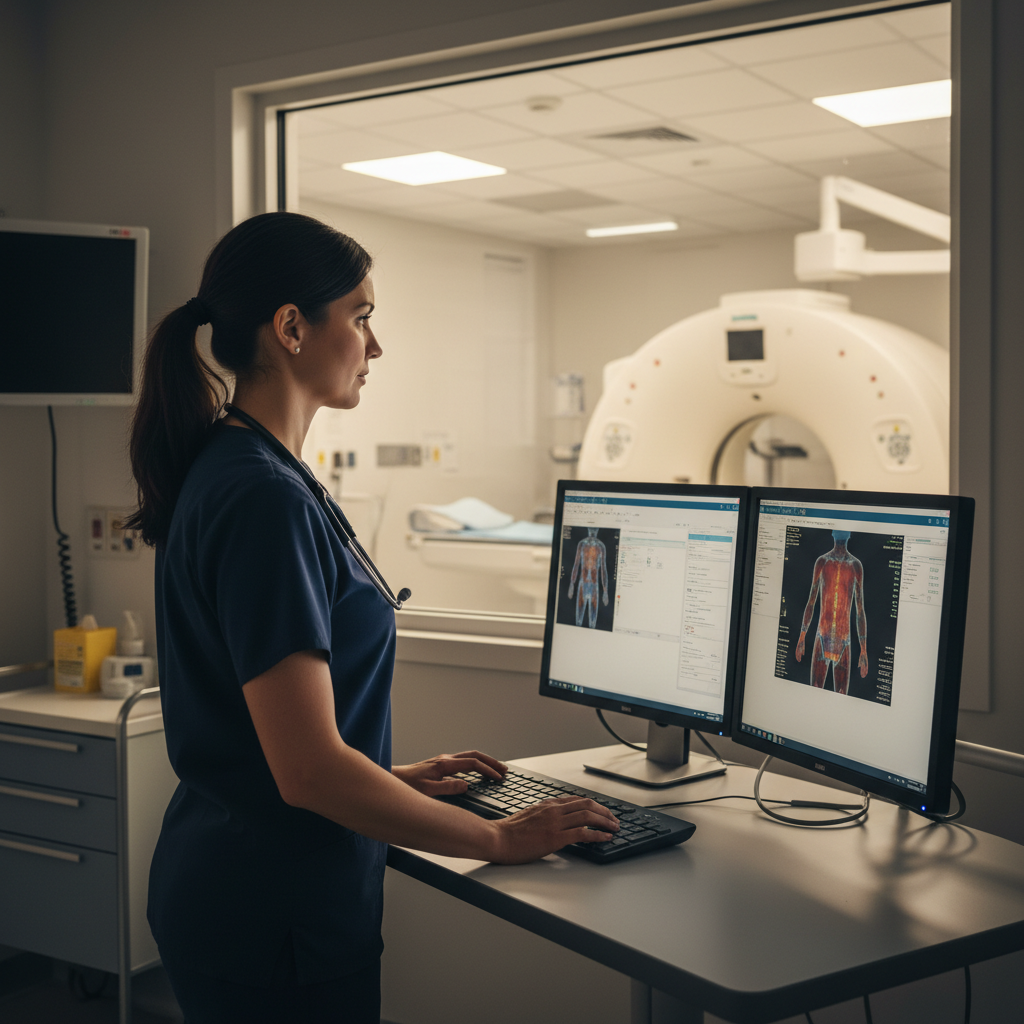
You're positioning a patient for a routine chest CT when something stops you mid-protocol. The name on the order. The birthdate. That scar on the left shoulder you remember asking about six months ago.
“I've scanned you before, haven't I?” you say, more to yourself than to them.
The patient smiles—tired, but real. “Yeah. Last summer. And the time before that in January.”
The Third Time You Meet a Stranger
It's a strange feeling, isn't it? You see hundreds of patients. Thousands, if you've been in imaging long enough. Most of them blur together—not because you don't care, but because the pace doesn't leave room for memory. You're focused on positioning, contrast timing, radiation dose, motion artifact. You're thinking about the next patient already queued in the system.
But then someone comes back. And then again. And suddenly they're not a stranger anymore.
This is what happened with Mrs. Chen. First scan: pulmonary embolism rule-out, January. Second: follow-up nodule, June. Third: pre-op clearance, November. Three times in one year. Each time, you recognized her a little faster. By the third visit, you knew she'd ask for an extra warm blanket. You knew she'd apologize for being “too much trouble.” You knew she hated the taste of the barium.
You didn't plan to form a relationship with her. Imaging continuity isn't something we talk about in radiology. But it happened anyway.
The Relationships We Don't Realize We're Building
In most of healthcare, continuity is built into the model. Primary care physicians see the same patients for years. Oncology nurses walk through entire treatment arcs with their patients. Even in the OR, surgical techs often work with the same surgeons, the same teams, the same rhythms.
But in diagnostic imaging? We're supposed to be the pass-through. The objective eye. The technologist who captures the data and moves on.
Except we're not machines. And neither are our patients.
When you scan someone three times in a year, you start to notice things:
- How their anxiety has softened since the first visit, or how it's gotten worse
- Whether they're alone this time, or if someone's waiting in the lobby
- The way they hold their breath differently now—more confident, or more scared
- That they remember your name, too
These aren't clinical observations. They don't go in the report. But they matter. They shape how you position that patient, how you explain the scan, how you adjust your tone when you say “just a few more seconds.”
Accidental Continuity in a Transient World
Healthcare is increasingly transient. Travel contracts. PRN shifts. Registry work. Patients bounce between facilities depending on insurance, wait times, specialist referrals. The odds of seeing the same person twice—let alone three times—are slim.
Which makes it even more striking when it happens.
One CT tech in a busy metro hospital told me she scanned the same construction worker four times over two years—each time after a different jobsite injury. By the fourth visit, she knew his kids' names. He knew she was studying for her MRI cross-training. They'd joke about his “frequent flyer miles” in radiology.
Another tech described scanning a young woman for kidney stones three times in eighteen months. The third time, the patient teared up and said, “I'm so tired of being here.” The tech held her hand for a moment before starting the scan. No protocol for that. Just human.
This is imaging continuity. It's not planned. It's not tracked in the EHR. But it's real, and it changes the work.
What These Moments Teach Us
Accidental continuity reminds us why we got into this field in the first place. It's easy to lose that thread when you're running twelve scans in a four-hour block, troubleshooting contrast extravasations, and fighting with outdated PACS software.
But then someone comes back. And you realize: this person trusts you. They remember you. In a healthcare system that can feel cold and impersonal, you were the steady presence. The technologist who took an extra thirty seconds to explain what the machine was doing. Who didn't rush them when they needed a moment to breathe.
You didn't set out to be that person. But you were.
Here's what these CT tech stories teach us about radiology relationships:
- Presence compounds. Small acts of care—learning a name, adjusting a pillow, explaining the scan clearly—add up when a patient returns.
- Continuity isn't just longitudinal. Even if you only see someone three times in a year, those moments form a thread of trust.
- We remember more than we think. You might not consciously recall every patient, but something in you recognizes the repeat visitors. And they feel it.
- It's okay to care. Imaging isn't just data capture. It's a human exchange, even in a 12-minute time slot.
The Goodbye You Didn't Expect
Here's the hard part: you don't always know when it's the last time.
Mrs. Chen's third scan was her pre-op clearance. The surgery went well. She didn't need another CT after that. You never saw her again.
You don't get closure in diagnostic imaging. Patients come, you scan them, they leave. Sometimes they come back. Sometimes they don't. You rarely know the full story—whether the nodule resolved, whether the treatment worked, whether they're okay now.
But you were part of their story. A small part, maybe. Three scans across twelve months. Fifteen minutes of interaction each time. But you were there, in those vulnerable moments when they were lying on the table, holding their breath, waiting to find out what the images would show.
That's not nothing. That's the work. 🤍
Carrying These Stories Forward
If you're a CT tech, an MRI tech, an X-ray tech, a mammographer—any of us in diagnostic imaging—you have these stories, too. The patient who came back. The face you recognized on the schedule. The small moment of connection in a field that's supposed to be purely technical.
These stories matter. They remind us that imaging continuity exists, even if it's accidental. That radiology relationships are real, even if they're brief. That we're not just operating machines—we're caring for people, sometimes across multiple chapters of their healthcare journey.
So the next time you see a familiar name on the schedule, take a second to acknowledge it. “I've scanned you before, haven't I?” It's a small thing. But it tells that patient: I see you. I remember. You're not just a number in the queue.
And maybe, just maybe, that's the most important image we can offer.
If you're looking for your next imaging role—whether it's a travel contract, a permanent position, or a PRN opportunity that gives you the schedule flexibility to show up fully for your patients—the Intuites Recruiting Team is here to help. We work with CT techs, MRI techs, X-ray techs, and diagnostic professionals across the country. Reach out at contact@intuites.healthcare or visit intuites.healthcare. We'd love to hear your story. ✨
#CTTechStories #ImagingContinuity #RadiologyRelationships #DiagnosticImaging #CTTech #MRITech #RadiologicTechnologist #HealthcareStories #PatientCare #MedicalImaging #RadTech #ImagingTech #HealthcareJourney #CTScanner #RadiologyLife
Looking for a healthcare team that truly sees your value?
The Intuites Recruiting Team is here to listen, support your career, and connect you with roles across the USA — when you're ready.