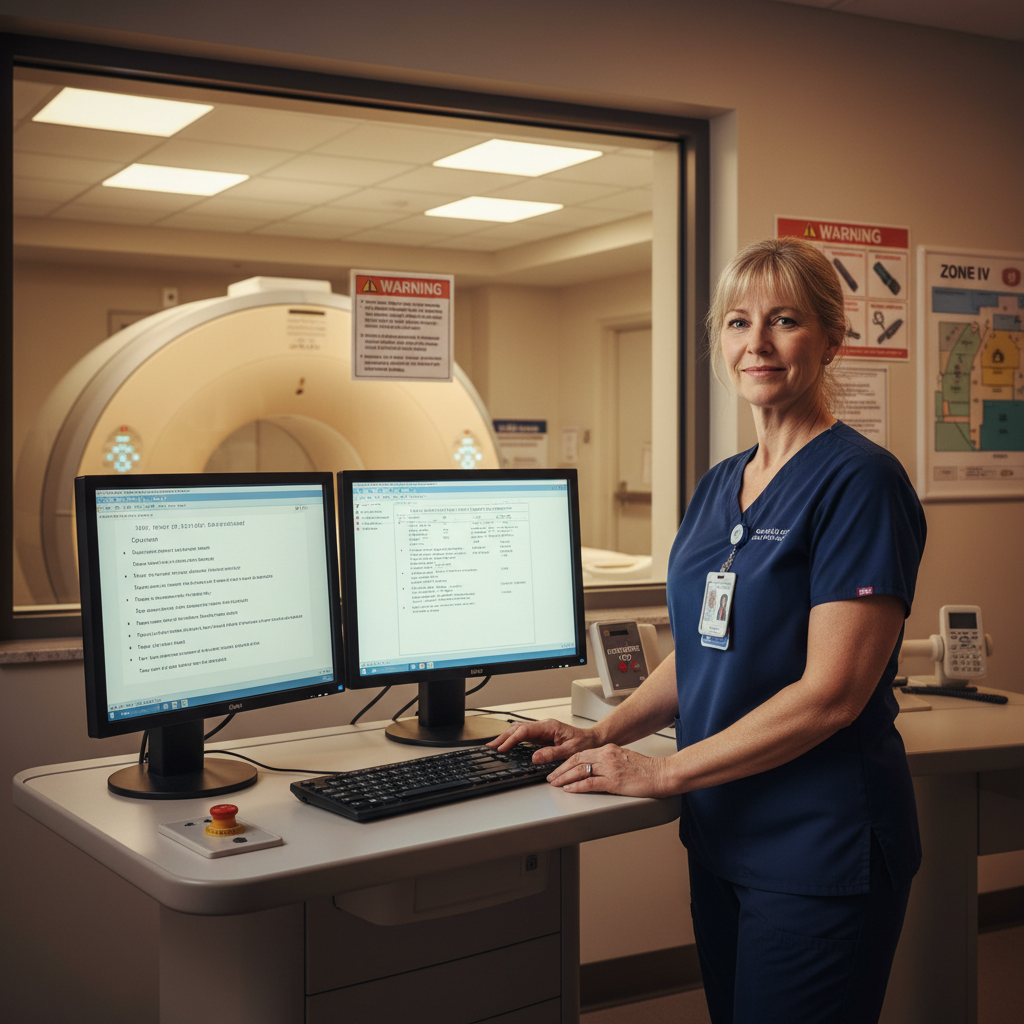
You have been scanning patients for years. You know your sequences, your contraindications, and exactly how loud that gradient coil gets during a FLAIR. But lately, you have been eyeing something different: the MRI safety officer role.
Maybe your facility just posted an MRSO opening. Maybe a colleague mentioned the credential at lunch. Or maybe you are simply ready for your next move and wondering whether this specialized path makes sense for your career, your schedule, and your bank account.
Let's walk through an honest self-check. Because becoming an MRI safety officer is not just about passing an exam — it is about whether the day-to-day reality fits who you are and where you want to go.
What Does an MRI Safety Officer Actually Do?
Before you invest time and money in MRSO certification, get clear on the job itself. This is not “MRI tech, but fancier.” It is a distinct role with distinct responsibilities.
An MRI safety officer oversees all safety protocols for the MRI suite. You are the person who:
- Develops and enforces policies around screening, zoning, and ferromagnetic object control
- Trains staff — techs, nurses, anesthesiologists, housekeeping, everyone who enters the magnet environment
- Investigates incidents and near-misses, then updates procedures to prevent recurrence
- Keeps your facility compliant with ACR guidelines and Joint Commission standards
- Evaluates new implants, devices, and contrast protocols for MRI compatibility
- Coordinates with radiology leadership, risk management, and sometimes legal teams
Notice what is missing? Scanning. Most MRSOs still scan part-time, but the core job is administrative, educational, and risk-focused. If you love the technical puzzle of optimizing a shoulder protocol, you will still get to do that. But a big chunk of your week will be meetings, policy reviews, and teaching the same ferromagnetic safety lecture to new hires.
The Temperament Question: Are You Built for This?
Here is where people get tripped up. MRSO certification looks great on paper, but the role itself demands a specific skill set that has nothing to do with how good you are at finding subtle ligament tears.
Ask yourself:
Do you enjoy teaching? Not just showing a coworker how to set up a sequence, but standing in front of a room full of skeptical ER nurses and convincing them why the metal detector matters. You will repeat yourself. A lot.
Can you enforce rules without apologizing? You will be the person who stops a surgeon from bringing an unapproved retractor into Zone IV. You will tell an impatient physician that no, we cannot scan this patient until we verify that pacemaker model. If confrontation makes your stomach hurt, this role will be hard.
Are you detail-obsessed in a documentation way? MRI safety officer work involves spreadsheets, audit trails, and incident reports. You are not just doing safety — you are proving you did it, in writing, in case someone asks three years from now.
Do you like being the ‘go-to’ person? You will field questions all day. Some will be smart. Many will be repetitive. (“Wait, why can't we bring the crash cart closer?”) If you prefer heads-down technical work, the constant interruptions might drain you.
None of this makes you a bad tech. It just means the MRSO path might not be your best fit. And that is okay.
Time Investment: What You Are Really Signing Up For
Let's talk logistics. MRSO certification through the American Board of Magnetic Resonance Safety (ABMRS) requires a two-day course, then an exam. The course itself is not brutal — you have been living MRI safety for years — but the prep and ongoing maintenance add up.
Before you sit for the exam, expect to spend 30-40 hours studying. Not because the material is obscure, but because you need to know the “why” behind every policy, not just the “what.” You will dig into SAR calculations, quench procedures, and cryogen safety at a level most techs never touch.
After you pass, recertification happens every three years. That means continuing education hours specifically in MRI safety — not just general radiologic CE. You will attend webinars, review updated ACR white papers, and stay current on new implant research.
Then there is the on-the-job time. If your facility creates a dedicated MRSO position, great. But many hospitals split the role: you scan three days a week and do safety work the other two. That sounds balanced until you realize safety work does not stop when you are scanning. Incident reports do not wait. Policy questions come in at 6 p.m. If you are already stretched thin, adding MRSO duties without reducing scan shifts is a recipe for burnout.
The Pay Bump: Let's Be Realistic
Now for the part everyone wants to know: what does MRI safety officer certification actually pay?
The honest answer: it depends, and the range is wide.
In many facilities, MRSO certification earns you a modest bump — think $2-5 per hour if you are adding the credential to your existing tech role. If you move into a dedicated MRI safety officer position, salaries typically range from $75,000 to $95,000 annually, depending on region, facility size, and whether you are still scanning part-time.
High-complexity academic medical centers and large health systems tend to pay better, especially if the role includes multi-site oversight. Smaller hospitals might offer the title but not the compensation to match.
Here is the trade-off: you are moving toward a role with more responsibility, more administrative weight, and often more stress — but not always a proportional pay increase. For some people, the career growth and variety make it worth it. For others, the juice is not worth the squeeze, especially if you are happy scanning and have no interest in meetings.
One upside: MRSO certification makes you more marketable. If you ever want to pivot into radiology management, education, or compliance, it is a strong differentiator. Travel MRI techs with safety officer credentials can also command higher rates, particularly for short-term contracts at facilities launching new MRI programs.
The Verdict: A Framework for Your Decision
So, should you pursue MRI safety officer certification? Here is a quick self-check framework:
Go for it if:
- You genuinely enjoy teaching and policy work, not just scanning
- You want a career path that blends clinical work with leadership
- You are comfortable being the “no” person when safety is on the line
- Your facility has a clear MRSO role with defined responsibilities (and ideally, a pay structure to match)
- You are looking to differentiate yourself for future management or education roles
Hold off if:
- You love the technical side of MRI and do not want to spend half your week in meetings
- Your facility expects you to add MRSO duties without reducing your scan load
- The pay bump does not justify the extra responsibility and stress
- You are already stretched thin and adding another certification feels like one more thing, not an exciting next step
There is no wrong answer here. MRI tech career growth does not have to mean becoming an MRSO. You can specialize in advanced imaging techniques, pursue applications specialist roles with vendors, or focus on high-acuity scanning in trauma or pediatrics. The key is choosing a path that fits your strengths, not just checking a box.
Ready to Explore Your Next Move?
Whether you are leaning toward MRSO certification, exploring travel MRI opportunities, or just curious what else is out there, the Intuites Recruiting Team is here to help. We work with imaging professionals across the country and understand the nuanced career paths available to diagnostic techs.
If you want to talk through your options — no pressure, just real conversation — reach out anytime at contact@intuites.healthcare or visit intuites.healthcare. We are happy to help you think through what makes sense for your career, your lifestyle, and your goals. 🤍
#MRISafetyOfficer #MRSOCertification #MRITech #RadiologyCareers #ImagingTech #MRICareerGrowth #DiagnosticImaging #HealthcareCareers #MRISafety #RadTech #MedicalImaging #CTTech #RadiologicTechnology #CareerGrowth #HealthcareJobs
Looking for a healthcare team that truly sees your value?
The Intuites Recruiting Team is here to listen, support your career, and connect you with roles across the USA — when you're ready.