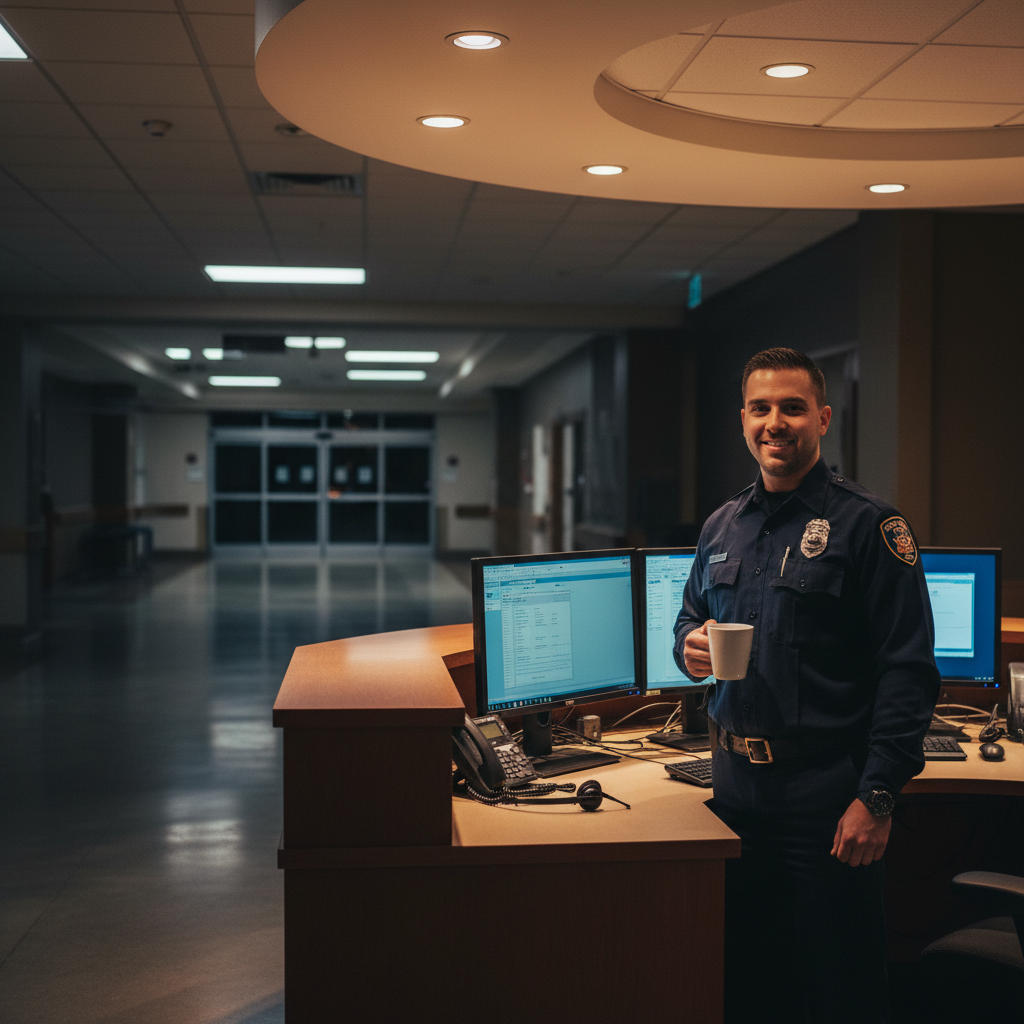
It's 2:47 AM on a Tuesday, and you're walking through the main entrance after a bathroom break. The building hums with that particular middle-of-the-night quiet — not silent, but softer. Monitors beep two floors up. A ventilator cycles. And at the security desk, Marcus looks up from his crossword and says, “Good morning, Sarah. Rough one tonight?”
He knows your name. He's known it for six months, since your first overnight orientation shift when you got lost trying to find the staff elevator. He walked you there, told you about the shortcut through radiology, and made a joke about how everyone gets lost at 3 AM.
This is a story about the hospital community most of us take for granted — the night shift healthcare workers who aren't charting vitals or pushing meds, but who hold the entire ecosystem together while we do.
The Security Guard Who Sees Everything
Hospital security on the night shift isn't just about checking badges. It's about knowing which nurse is walking to her car alone at 0630 and making sure someone watches until her headlights pull away. It's about de-escalating a confused patient in the lobby at 4 AM with nothing but a calm voice and a cup of water. It's about unlocking the medication room when your badge glitches and you've got a patient waiting.
Marcus has worked nights for nine years. He knows which doctors park in the wrong lot and need an escort. He knows which EVS worker's daughter just started nursing school. He knows the sound of a problem before it becomes a crisis — the particular tone of voices that means he should walk that direction, just in case.
What night shift security handles that you might not see:
- Walking staff to cars during shift changes in dark parking areas
- Responding to behavioral health situations before they escalate
- Unlocking doors, finding lost badges, troubleshooting building access at odd hours
- Watching monitors for falls, elopements, or safety concerns across units
- Being the first friendly face for anxious family members arriving in crisis
- Knowing who belongs and who doesn't — and handling it with dignity
He's part of the hospital workers constellation that makes your shift possible. And he probably knows your coffee order.
The EVS Team Keeping Your Floors Safe
At 3:15 AM, Maria is mopping the hallway outside the ICU. Not because it's on the schedule — it is, but that's not why she's here right now. She's here because someone's family member tracked in mud during a storm, and wet floors near critical care aren't just messy. They're dangerous.
Environmental services on the night shift works in the margins. They clean operating rooms between cases while the world sleeps. They restock supply closets. They respond to spills and codes and the hundred small crises that happen when you're caring for sick people around the clock.
Maria has worked nights for fourteen years. She's seen nurses cry in the stairwell and didn't say anything, just made sure the floor was extra clean the next night and left a small plant on the break room table. She's held doors for respiratory therapists sprinting to codes. She's quietly cleaned rooms after deaths, understanding that what she does next matters to the family coming to collect belongings.
The EVS night team sees the hospital the way you do — as a living, breathing place that never stops. They're not background. They're infrastructure. And on the nights when everything goes wrong, they're the ones making sure the physical space doesn't add to the chaos.
The Cafeteria Worker Who Keeps the Soup Warm
The cafeteria technically closes at 8 PM. But James, who works the overnight prep shift, knows that technically doesn't mean much when you're ten hours into a twelve-hour shift and the vending machine is out of everything except stale pretzels.
So there's soup. There's always soup. Sometimes it's the soup from dinner service, reheated. Sometimes it's the soup James made himself because he knows Wednesday nights are rough in the ED and people need something warm. It's not on any menu. It's not hospital policy. It's just what happens when someone understands the night shift healthcare ecosystem.
James also knows which nurses are vegetarian, which respiratory therapist is allergic to dairy, and who's training for a marathon and needs the extra carbs. He leaves containers of fruit in the staff fridge. He makes sure there's decaf for the night shift workers who've learned that caffeine after 2 AM is a mistake they'll pay for at 9 AM when they're trying to sleep.
The small things that matter on night shift:
- Hot food available when your break finally happens at an odd hour
- Someone who remembers you don't eat meat
- A space that feels less institutional at 4 AM
- The recognition that your meal break matters, even if it's at 0300
- Kindness from someone who didn't have to be there, but is
These aren't clinical interventions. But they're care, just the same.
Why the Unseen Hospital Community Matters
Here's what we forget when we talk about healthcare staffing and hospital workers and the crisis of burnout: We forget that a hospital isn't just a collection of clinical roles. It's a community. And community means the person who fixes the elevator at 5 AM so you can get your patient to CT. The person who salts the walkway before dawn so no one slips on their way in. The person who knows your name and asks how you're doing, even though their job description doesn't require it.
The hospital community on night shift is tighter because it has to be. There are fewer of you. The building feels bigger. The stakes feel higher. And the people who show up — clinical and non-clinical alike — become something more than coworkers. You become the ecosystem that holds each other up.
When we talk about retention and job satisfaction and what makes people stay in healthcare, we often focus on pay and ratios and benefits. All of that matters. But so does this: the security guard who walks you to your car, the EVS worker who leaves you a plant, the cafeteria worker who keeps the soup warm. The healthcare stories that don't make headlines but make the nights survivable.
Seeing the Whole Picture
Next time you're walking through the hospital at 3 AM, look around. Notice who else is there. The person restocking linens. The person monitoring the doors. The person prepping breakfast in a kitchen most staff never see. They're part of your team, even if they're not in your department.
Say hello. Learn their names. Thank them, not in a performative way, but in the way you'd thank anyone who makes your hard job a little easier. Because they do. Every single night.
The night shift healthcare world is small and strange and sometimes lonely. But it's also full of people who've chosen to be there, in the margins, doing work that often goes unnoticed. They deserve to be seen. 🤍
If you're looking for your next role — whether that's night shift, day shift, or something in between — the Intuites Recruiting Team gets it. We understand that healthcare is more than a job title. It's a community. Reach out anytime at contact@intuites.healthcare or visit intuites.healthcare. We'd be honored to help you find a place where you're seen.
Because everyone who shows up deserves that. ✨
#HospitalCommunity #NightShiftHealthcare #HospitalWorkers #HealthcareStories #SecurityGuards #EVSWorkers #CafeteriaHeroes #NightShiftLife #HealthcareEcosystem #IntuitesCares #HealthcareJobs #HospitalLife #NightShiftNurse #RespectAllRoles #HealthcareFamily
Looking for a healthcare team that truly sees your value?
The Intuites Recruiting Team is here to listen, support your career, and connect you with roles across the USA — when you're ready.