
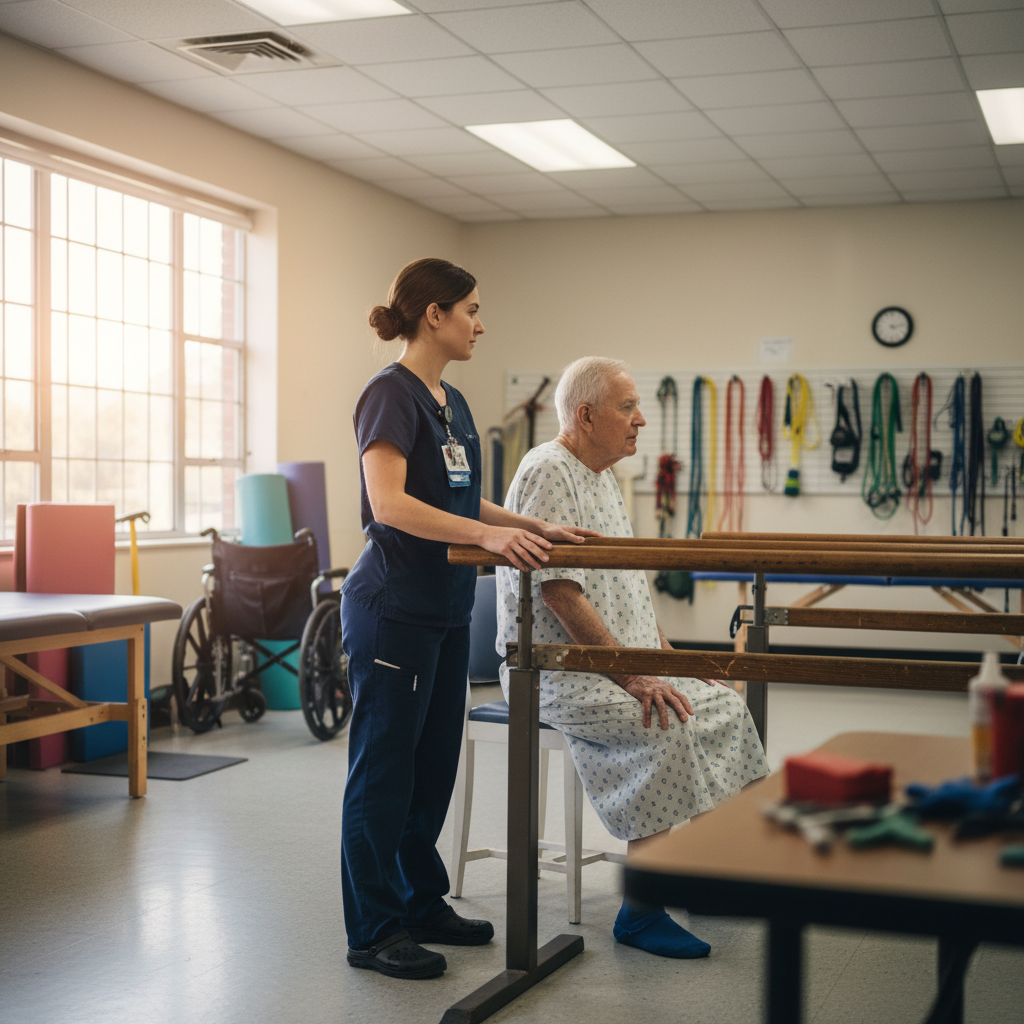
I saw his name on the schedule before I walked into the gym that Tuesday morning. Not “Mr. Johnson” or “patient in Bay 3.” Just his name. My father’s name.
He’d had the stroke six days earlier. My mom called me from the ER, and I drove three hours through the night. By the time the rehab placement came through, I was back at work in the same health system, two floors down. And now here we were.
This story is a composite, built from conversations with occupational therapists who’ve treated family members, loved ones, people they knew before they became patients. The details are changed to protect privacy, but the emotional truth—the boundary questions, the grief that sits beside the progress notes—that’s real. If you’ve been there, you know.
When Professional Distance Collapses
Most OT programs teach you about therapeutic boundaries. You learn to maintain professional distance, to document objectively, to separate your personal feelings from clinical judgment. But nobody tells you what to do when the man in the wheelchair used to teach you how to ride a bike.
The first session, I stuck to the eval protocol. ROM measurements. Manual muscle testing. Cognitive screen. I wrote everything down like he was any other patient, and he answered my questions like I was any other therapist. We both knew we were performing a kind of theater, but we didn’t talk about it.
What made it harder: I could see things other staff might miss. The way he compensated with his unaffected side before anyone asked him to. The frustration he hid behind jokes. The fear in his eyes when we talked about return-to-home evals. I knew his baseline. I knew exactly how much he’d lost.
What made it easier: I also knew what mattered to him. Not the ADL checklist items—the real things. He wanted to hold a coffee mug again. He wanted to button his own shirt. He wanted to feel like himself. Those became our goals, written in clinical language but rooted in three decades of knowing him.
The Questions Nobody Asks in School
Occupational therapist stories about family in healthcare often skip the messy middle parts. The practical questions that don’t have clear answers:
- Do you tell the patient you’re conflicted, or do you protect them from your emotions? I chose honesty, in small doses. “This is hard for me too, Dad.” He nodded. We moved on.
- How do you document when every word feels weighted? I wrote the truth: “Patient demonstrates good effort but moderate frustration with fine motor tasks.” I didn’t write that I wanted to cry watching him struggle with shirt buttons.
- Do you advocate harder because it’s family, or do you step back to avoid accusations of bias? I advocated the same way I would for any patient who needed more time, more repetitions, more adaptive equipment trials. But I second-guessed myself constantly.
- When do you hand off care? I didn’t. He was discharged after three weeks. In retrospect, maybe I should have asked another therapist to take over. But he didn’t want that, and neither did I.
The OT Emotional Moments That Change You
There was a day, maybe two weeks in, when something shifted. We were working on transfers—bed to wheelchair, wheelchair to mat table. Routine stuff. He’d been doing well, but that morning he was off. Slower. More hesitant.
“I’m tired,” he said.
Not physically tired. Tired of being a patient. Tired of needing help. Tired of the whole thing.
I didn’t have a therapeutic response ready. I just sat down next to him on the mat table, breaking about four positioning rules, and said, “I know.”
We sat there for maybe two minutes. Then he said, “Okay. Let’s try the stairs.” And we did.
That moment taught me more about occupation-based practice than any textbook ever did. Sometimes the most therapeutic thing you can offer isn’t a new compensatory strategy or a perfectly graded activity. It’s just bearing witness. Sitting with someone in their exhaustion and not rushing them through it.
What It Means for Your Professional Identity
Treating family changes how you see your role. You realize how much power you hold—not just in the clinical decisions, but in the tone of voice you use, the hope you offer or withhold, the way you frame progress.
You also realize how much you don’t control. I couldn’t fix the stroke. I couldn’t speed up neuroplasticity. I couldn’t make the insurance company approve more sessions. All I could do was show up, do the work, and trust the process I’d trusted a hundred times before with other patients.
The boundary questions don’t resolve neatly. Even now, years later, I’m not sure I made all the right calls. But I know this: I showed up as both a daughter and a therapist, and somehow that was enough. He made progress. He went home. He learned to button his shirts again.
If You’re in It Right Now
Maybe you’re reading this because you’re treating a family member, or you just found out a loved one is coming to your facility, or you’re wrestling with whether to stay on the case or refer out. Here’s what I wish someone had told me:
It’s okay to feel conflicted. You’re not less professional because you care deeply. You’re human, and that humanity can coexist with clinical excellence.
Document everything carefully. Not because you distrust yourself, but because clear documentation protects both you and your family member. Objectivity in the chart creates space for subjectivity in the relationship.
Ask for support. Talk to your supervisor. Consult with colleagues. You don’t have to carry this alone, and asking for help isn’t a sign of weakness—it’s a sign of wisdom.
Know when to step back. If your emotions are compromising your clinical judgment, or if your family member would be better served by a therapist without the emotional history, it’s okay to hand off care. That’s not failure. That’s recognizing limits.
Give yourself permission to grieve. You’re allowed to be sad about what’s happening to someone you love, even while you’re professionally helping them adapt. Those feelings don’t cancel each other out.
The Gift Nobody Wants
I never wanted to treat my dad in rehab. I wouldn’t wish that experience on anyone. But it taught me things about occupational therapy—and about myself—that I carry into every session now.
I’m gentler with families who hover during therapy, because I understand the need to stay close. I’m more patient with patients who seem unmotivated, because I know that sometimes “tired” means something deeper. I’m better at sitting with hard emotions, because I’ve learned that not everything needs to be fixed or reframed right away.
Family in healthcare stories are complicated. They don’t tie up neatly. They don’t always have clear lessons. But they’re part of the landscape of being a healthcare professional—especially in smaller communities, or when you’ve been in the field long enough that your worlds inevitably overlap.
If you’ve lived some version of this story, you’re not alone. And if you’re facing it now, trust yourself. You know more than you think you do, and you’re stronger than you feel in this moment. 🤍
If you’re navigating a career transition, looking for a role that fits your life right now, or just need someone who understands the complexities of allied health work, the Intuites Recruiting Team is here. We place OTs, PTs, SLPs, RTs, surgical techs, and pharmacy techs in positions across the country—and we actually listen. Reach out anytime at contact@intuites.healthcare or visit intuites.healthcare. Sometimes it helps to talk to people who get it.
#OccupationalTherapist #OTLife #AlliedHealth #HealthcareStories #OccupationalTherapy #RehabTherapy #TherapistLife #HealthcareBoundaries #FamilyInHealthcare #OTCommunity #ProfessionalIdentity #TherapistSupport #ClinicalExcellence #HealthcareCareers #IntuitesHealthcare
Looking for a healthcare team that truly sees your value?
The Intuites Recruiting Team is here to listen, support your career, and connect you with roles across the USA — when you're ready.