
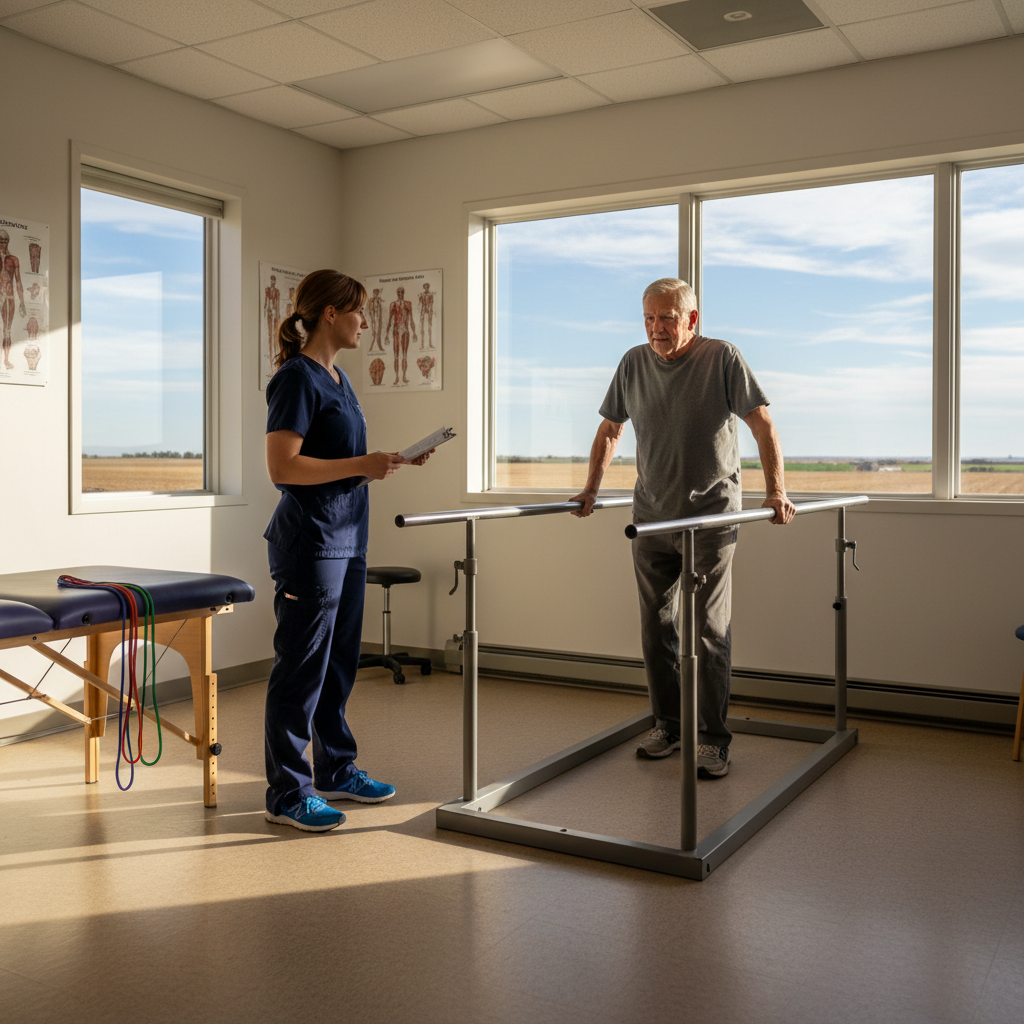
You pull into the gravel lot before sunrise. The clinic sign needs paint. Inside, the waiting room is empty but it will not be for long. By eight a.m., you will see the farmer with the rotator cuff tear who waited three months for this appointment, the high school athlete whose ACL rehab depends entirely on your protocol, and the stroke survivor who drives forty minutes because you are the only PT within an hour in any direction.
You are it. The only physical therapist in town. No colleague to consult in the hallway. No team meeting to workshop a tricky case. Just you, your clinical judgment, and a community that has placed its trust—and its healing—in your hands.
This is the reality of rural physical therapy. It is lonely in ways the job posting never mentioned. It is also profound in ways you could not have anticipated. 🤍
The Weight of Solo Clinical Decisions
In a hospital system or urban outpatient center, you have backup. A colleague two doors down. A supervising therapist who has seen your exact case presentation a dozen times. Access to specialists, imaging within the hour, interdisciplinary rounds where you can advocate and collaborate.
In a rural clinic, you often make the call alone.
You are evaluating a sixty-two-year-old man with new-onset back pain radiating down his leg. Red flags are dancing in your mind—night pain, unexplained weight loss, age over fifty. You know the guidelines. You also know the nearest MRI is ninety miles away, his insurance requires pre-authorization, and he has already missed two days of farm work he cannot afford to lose.
Do you refer immediately, knowing it may take weeks to get imaging and he may not follow through? Do you trial conservative treatment while monitoring closely, risking a delay if this is something serious? There is no one to ask. The decision sits with you.
This is the isolation that PT students do not train for. You develop a different kind of confidence—one built on thorough examination, detailed documentation, and the humility to know when a patient needs more than you can provide in a small-town clinic. You become excellent at clinical reasoning because you have to be.
Building Trust When You Are the Outsider
Rural communities are tight-knit. Many families have lived in the same county for generations. You, the new PT from two states over with a degree from a city they have never visited, are the outsider.
Trust is not automatic. It is earned one patient at a time.
You learn to listen differently. The seventy-year-old woman with knee arthritis is not just a joint problem—she is worried about keeping up with her grandchildren, maintaining her garden, staying independent in a town where asking for help feels like admitting defeat. You adjust your treatment plan to honor what matters to her, not just what the research says is optimal.
You show up. Every appointment. Every time. In a small town, consistency is currency. When you are reliable, word spreads. When you genuinely care, people notice. Slowly, the waiting room fills. Patients start bringing their family members. The local doctor begins calling you by your first name and trusting your clinical judgment in shared patients.
You become part of the fabric of the town. Not because you tried to fit in, but because you showed up with competence and compassion, day after day.
The Slow, Sacred Reward of Watching a Town Heal
There is something extraordinary about treating the same community over months and years. You do not just see patients—you see lives unfold.
The high school pitcher you rehabbed after Tommy John surgery? You watch him graduate, then see him coaching little league three years later. The post-stroke patient who could barely stand at evaluation? You pass her at the grocery store, walking independently with her granddaughter. The farmer with the back injury? He brings you a dozen eggs every December as thanks.
In urban settings, patients often disappear after discharge. You rarely know the long-term outcome. In a small town, you see the impact of your work walking down Main Street.
This continuity creates a different kind of professional satisfaction. You are not just treating episodes of care—you are contributing to the long-term health and function of an entire community. Your clinical decisions ripple outward. Your commitment to evidence-based practice raises the standard of care in an underserved area.
You also see the gaps. The patients who need specialized neurologic rehab you cannot provide. The complex orthopedic cases that really need a hand therapist. The pediatric patients who would benefit from a PT trained in developmental disorders. You do your best, you refer when necessary, and you carry the quiet ache of knowing some people are not getting the care they need because of geography and resources.
Practical Realities of Being the Solo Clinician
Beyond the emotional landscape, there are concrete challenges and strategies that define rural PT practice:
- Continuing education becomes critical. Without peers to learn from daily, you invest heavily in online courses, professional networks, and mentorship relationships with clinicians in other regions. You become resourceful about staying current.
- Your scope expands by necessity. You treat everything—orthopedics, neuro, geriatrics, peds, vestibular, wound care. You become a generalist out of necessity, which makes you a better clinician even if it feels overwhelming at first.
- Telehealth fills some gaps. You connect patients with specialist consultations via video. You participate in virtual case discussions with other rural PTs. Technology becomes a lifeline against isolation.
- You build creative solutions. Limited equipment? You teach patients to use household items. No gym access? You design home programs around farm work and daily activities. Constraints force innovation.
- Self-care is non-negotiable. Burnout is real when you carry the clinical load alone. You learn to set boundaries, take your lunch break, and recognize when you need support—even if that support has to come from outside your immediate work environment.
Finding Your People, Even When You Are Alone
The isolation of being the only PT in town is real, but it does not mean you have to be professionally alone.
Many rural allied health professionals find community through online forums, state practice associations, and virtual peer networks. You text a PT friend three states away when you have a complex case. You join a rural clinician support group that meets monthly via video. You attend state conferences not just for CEUs but for the chance to talk shop with people who understand.
You also build relationships with the local healthcare team—the family medicine doc, the home health nurses, the athletic trainer at the school. These become your interdisciplinary colleagues, even if they are not PTs. You learn to collaborate across professions in ways that enrich your practice.
And slowly, you realize that being the only PT in town has made you a better therapist. More resourceful. More confident. More connected to the human side of rehabilitation. More aware of what healthcare access really means.
You are still lonely sometimes. But you are also proud. You are doing work that matters, in a place that needs you, for people who see you not as a healthcare provider but as a member of their community. 🌱
If you are considering a rural allied health role—or if you are already living this reality and looking for a change—the Intuites Recruiting Team understands the unique challenges and rewards of these positions. We work with clinicians who want meaningful work in communities that truly need them. Reach out anytime at contact@intuites.healthcare or visit intuites.healthcare to explore opportunities that honor your skills and your story.
You are not just a physical therapist. You are the PT an entire town depends on. That is isolation. That is also legacy. ✨
#RuralPhysicalTherapy #PTStories #AlliedHealthRural #ClinicianIsolation #RuralHealthcare #PhysicalTherapist #SmallTownPT #RuralRehab #AlliedHealthProfessionals #CommunityHealth #HealthcareHeroes #RuralClinician #PTLife #RehabTherapy #UnderservedCommunities
Looking for a healthcare team that truly sees your value?
The Intuites Recruiting Team is here to listen, support your career, and connect you with roles across the USA — when you're ready.