
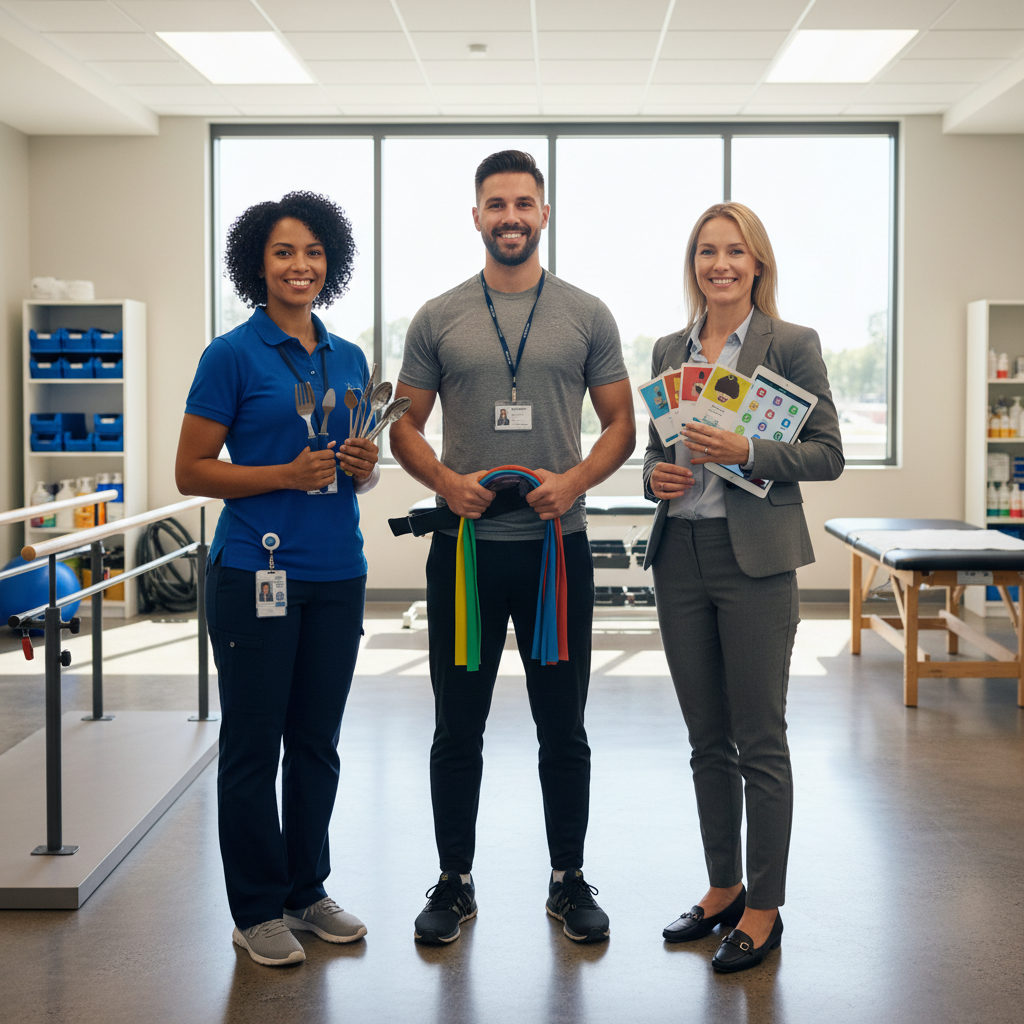
If you're scrolling through grad school programs at 11 PM trying to figure out whether to pursue occupational therapy, physical therapy, or speech-language pathology — you're not alone. These three allied health careers get lumped together constantly, but the day-to-day realities? Completely different.
Let's cut through the glossy program brochures and do an honest side-by-side. Because whether you're a pre-health student, a career-switcher, or someone who just realized their current path isn't it — you deserve the real story before you commit three years and six figures to a degree.
The Money Talk: Salary Ranges in 2026
Let's start where everyone secretly wants to start: what do OT vs PT vs SLP professionals actually earn?
Physical Therapists typically see the highest median salaries, hovering around $95,000 to $105,000 annually for staff positions. Outpatient ortho PTs in metro markets can push $110,000+, and travel PTs? We're seeing contracts in the $2,200–$2,600/week range right now. The catch: PT programs are often the most competitive to get into, and the job market has tightened in some saturated metros.
Occupational Therapists land in a similar range — $85,000 to $98,000 for full-time staff roles, with pediatric OTs sometimes on the lower end and hand therapy or acute-care specialists on the higher end. Travel OT rates are strong, especially for SNF and home health placements. The OT job market remains steady, particularly in underserved rural areas and specialized settings.
Speech-Language Pathologists see the widest variance. School-based SLPs might start around $65,000–$75,000 (but get summers off and better benefits), while medical SLPs in hospitals or private practice can earn $80,000–$95,000. Travel SLP contracts are hot right now — particularly for acute care and NICU specialists — with rates climbing to $2,000–$2,400/week.
The real differentiator isn't always base salary. It's setting flexibility, loan forgiveness eligibility (hello, PSLF for school-based SLPs), and whether you want to work 40 hours or build a private practice on your own terms.
Schedule Reality Check: What Your Week Actually Looks Like
This is where the PT vs SLP vs OT comparison gets interesting, because “flexibility” means something different in each discipline.
Physical Therapists often work the most structured schedules. Outpatient clinics typically run 8 AM to 6 PM with back-to-back 45-minute to hour-long sessions. You might see 10–14 patients a day depending on your setting. Hospital PTs work shifts (including weekends), but travel PTs love the 13-week contract flexibility. Productivity expectations are real — most clinics track billable hours closely.
Occupational Therapists have slightly more schedule variety depending on setting. Pediatric OTs might do half-clinic, half-school visits. SNF OTs often work 8–5 with documentation time. Hand therapy OTs in outpatient settings have similar productivity pressure to PTs, but early intervention and home health OTs get more autonomy over their daily routes. The trade-off? More windshield time, less predictability.
Speech-Language Pathologists win the flexibility contest — if you choose the right settings. School SLPs work academic calendars (huge for parents), but manage large caseloads and IEP meetings. Hospital SLPs work shifts but often have more varied patient interactions. Private practice SLPs can build their own schedules entirely, though income becomes less predictable. Per-diem and contract SLP work is abundant right now, giving you real control over your calendar.
The Documentation Reality
All three disciplines drown in paperwork, but the flavor differs. PTs document treatment sessions and progress notes constantly. OTs do similar documentation plus often more ADL assessments and adaptive equipment justifications. SLPs write evaluation reports that can take hours — especially in schools — but daily session notes tend to be shorter. None of these careers escape the EMR grind. Plan accordingly.
Stress Levels and Burnout: The Stuff No One Mentions in Class
Here's where the allied health career comparison gets uncomfortable but necessary.
Physical Therapy burnout often stems from productivity pressure and patient volume. Outpatient mill clinics that demand 14+ patients per day with minimal support staff? That's where PTs burn out. Add insurance denials, shrinking reimbursement, and patients who don't do their home exercises — it's a lot. The upside: PT outcomes are often visible and measurable, which can be deeply satisfying.
Occupational Therapy burnout looks different. Pediatric OTs love the work but wrestle with parent expectations and the emotional weight of complex cases. SNF OTs face Medicare documentation demands that can feel soul-crushing. The invisible labor of OT — teaching someone to button a shirt, helping a stroke survivor relearn how to cook — doesn't always get the recognition it deserves, even though it's life-changing work.
Speech-Language Pathology burnout varies wildly by setting. School SLPs manage massive caseloads (60+ students isn't unusual) and endless IEP paperwork. Medical SLPs deal with acutely ill patients, difficult swallow studies, and life-or-death decisions about feeding tubes. But many SLPs also report high job satisfaction because communication and swallowing are so fundamental to quality of life. When you help someone speak again or eat safely? That stays with you.
Common Stress Factors Across All Three
- Insurance authorization battles and claim denials
- Productivity quotas that prioritize billing over patient care
- Lack of mentorship or clinical support in first jobs
- Student loan debt ($80K–$150K is common for all three)
- Emotional labor of working with complex, sometimes non-compliant patients
- Professional isolation, especially in school or home health settings
The Day-to-Day: What You'll Actually Be Doing
Let's get specific, because “helping people” is vague and unhelpful.
Physical Therapists spend their days assessing movement, designing exercise programs, doing manual therapy, and teaching body mechanics. You'll work with post-op knees, stroke survivors relearning to walk, athletes recovering from injuries, and elderly patients preventing falls. Expect to be on your feet, hands-on, physically active. If you loved kinesiology and anatomy, PT delivers on that daily.
Occupational Therapists focus on helping people do the activities that matter to them — whether that's a toddler learning to hold a crayon, an adult relearning to dress after a brain injury, or a senior modifying their home to age in place safely. You'll do a lot of problem-solving, adaptive equipment trials, and creative activity modifications. OT is beautifully holistic but sometimes frustratingly hard to explain at parties.
Speech-Language Pathologists assess and treat communication and swallowing disorders. You might spend your morning doing a swallow study with a stroke patient, your afternoon in a school working on articulation with a kindergartener, and your evening running a social communication group for teens with autism. SLPs need to be part detective (figuring out why someone can't produce /r/ sounds), part teacher, part counselor. The variety is real.
So Which One Should You Choose?
Honest answer? The one that matches how your brain works and what you value most.
Choose PT if you love movement science, want clear treatment protocols, and thrive in structured environments. If you geek out over gait analysis and muscle mechanics, PT is your home.
Choose OT if you're a creative problem-solver who loves helping people live independently. If you want holistic, client-centered work and can handle ambiguity, OT will feel right.
Choose SLP if you're fascinated by language, communication, and swallowing — and you want setting flexibility. If you like variety and can toggle between pediatrics and geriatrics comfortably, SLP offers that range.
There's no wrong answer here. All three are in-demand, recession-resistant, and deeply meaningful. The key is picking the one that aligns with your strengths and lifestyle goals — not just the one with the highest starting salary or the program your friend got into.
And if you're an established OT, PT, or SLP exploring travel contracts, PRN work, or permanent placements? The Intuites Recruiting Team works exclusively with allied health professionals and actually understands the nuances of your discipline. Reach out at contact@intuites.healthcare or visit intuites.healthcare — we'd love to help you find a role that fits your career stage and lifestyle. ✨
Wherever you land in the OT vs PT vs SLP decision, you're choosing a career that matters. Trust your gut, do your shadowing hours, and pick the path that makes you curious — not just comfortable.
#OTvsPT #PTvsSLP #AlliedHealthCareers #OccupationalTherapy #PhysicalTherapy #SpeechPathology #HealthcareJobs #OTJobs #PTJobs #SLPJobs #AlliedHealthProfessionals #CareerComparison #HealthcareCareerAdvice #TravelTherapy #TherapyCareers
Looking for a healthcare team that truly sees your value?
The Intuites Recruiting Team is here to listen, support your career, and connect you with roles across the USA — when you're ready.