
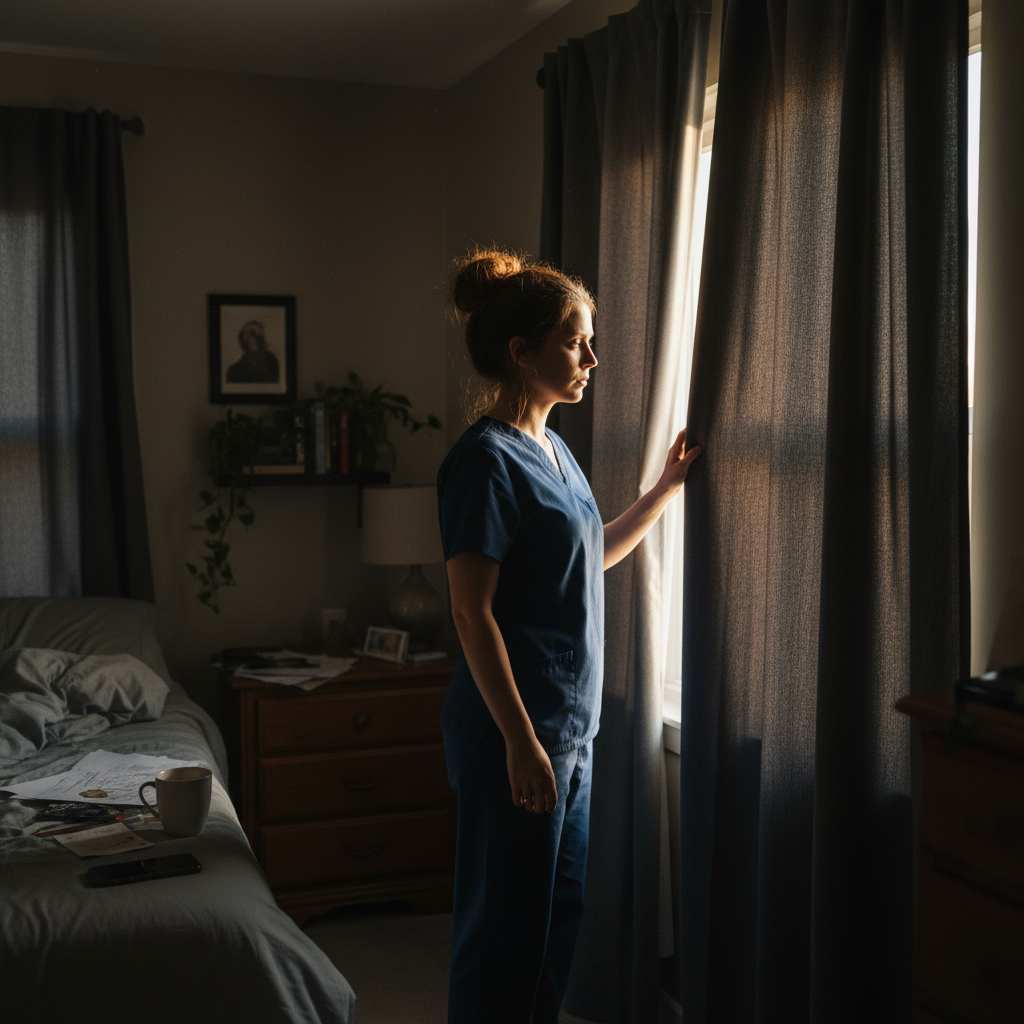
It's Tuesday. Or maybe Wednesday—you stopped checking halfway through this stretch. You clock out at 7:15 a.m., drive home while everyone else is driving to work, and pull your blackout curtains tight against the summer sun that's already climbing high and bright.
You haven't seen it properly in six days.
Not the afternoon light. Not the golden hour. Not the long summer evenings everyone else is posting about. You've seen parking lot streetlights, the blue glow of monitor screens, and the particular quality of fluorescent light at 3 a.m. when a patient codes and everything moves fast and sharp.
The Summer You're Missing
There's something uniquely hard about working nights in summer. In winter, everyone's in the dark—you're just on a different schedule. But summer? Summer is cruel to the night shift nurse.
While your friends are texting about weekend lake trips and evening barbecues, you're calculating whether you can make a 6 p.m. birthday party work between a stretch of nights, knowing you'll be the zombie in the corner nursing one drink and trying not to fall asleep in your chair.
The world is happening in daylight, and you're living in the margins.
You see it in small, sharp ways: the farmers market you never make it to. The outdoor yoga class that's always at 9 a.m. The way your family has stopped inviting you to Sunday brunch because you're always sleeping. The vitamin D deficiency your doctor mentioned at your last physical.
And the guilt—oh, the guilt—when you snap at someone who says just go to bed earlier like your circadian rhythm is a light switch you can flip at will.
What Consecutive Nights Do to Your Body
Let's be clear: this isn't just about missing summer fun. Working consecutive night shifts, especially without adequate recovery time, takes a measurable toll on your body.
Your circadian rhythm isn't designed to flip every few days. When you work nights in summer, you're fighting against every biological signal your body receives. Sunlight in the morning tells your brain to wake up—right when you desperately need sleep. The heat of midday makes it harder to stay asleep. The sounds of lawnmowers, delivery trucks, and neighborhood kids playing filter through even the best earplugs.
Night shift nurses report higher rates of:
- Sleep disorders and chronic sleep deprivation
- Gastrointestinal issues and irregular eating patterns
- Increased risk of metabolic syndrome and weight gain
- Higher rates of anxiety and depression
- Weakened immune system function
- Difficulty maintaining relationships and social connections
And when you string together six, seven, eight nights in a row? Your body never fully adjusts. You exist in a permanent state of jet lag, your cortisol levels confused, your melatonin production disrupted, your body never quite sure what time zone it's living in.
The research backs this up, but you don't need studies to tell you what you already feel in your bones.
The Invisible Labor of Night Shift
Here's what people don't see: the night shift nurse carries a different kind of weight.
You're working with a smaller team. When something goes wrong at 2 a.m., you can't just call the attending—you make the call yourself, trusting your assessment, your gut, your years of experience. The pharmacy isn't fully staffed. The lab is running slower. If you need a second pair of hands, you're pulling from an already stretched crew.
And in summer, when day shift is taking vacations and using up PTO for family trips and wedding weekends, guess who's picking up the slack? You are. Because night shift is always the shift that's hardest to fill, the shift that's always short, the shift where they're begging for someone to pick up extra.
So you do. Because your patients need you. Because your coworkers need you. Because the unit would be dangerously understaffed without you.
And then you go home to a world that's been awake for hours, and you try to explain to your partner why you're too tired to go to the beach, why you need the house quiet at 11 a.m. on a Saturday, why you can't commit to anything that happens before 4 p.m.
Small Rebellions and Survival Strategies
You've developed your own ways of surviving. Maybe you've invested in blackout curtains that cost more than you wanted to spend but are worth every penny. Maybe you've trained your family to text instead of call. Maybe you've found the one 24-hour grocery store where you can shop at 8 a.m. in relative peace.
Some night shift nurses swear by these strategies:
- The post-shift sunlight rule: Ten minutes of morning sun exposure before you black out the world—it helps reset your rhythm on days off
- The sacred sleep space: Bedroom as cool and dark as possible, white noise machine, phone on Do Not Disturb with only emergency contacts allowed through
- The protein-first approach: Real meals at regular intervals during your shift, not just vending machine survival
- The cluster strategy: When possible, grouping nights together so you stay on night schedule rather than flipping back and forth
- The morning decompression: A small ritual after your shift—a specific playlist on the drive home, a particular breakfast, something that signals to your body that it's time to wind down
These aren't cures. They're just ways to make it more bearable.
You're Not Dramatic, You're Tired
If you've ever felt like you're being dramatic for struggling with nights, let this be your permission slip: you're not.
The night nurse who hasn't seen sunlight in six days isn't weak or complaining or failing to find the positive. She's working a shift that disrupts every natural rhythm her body has, doing life-saving work while the rest of the world sleeps, and trying to maintain some semblance of a life outside the hospital.
That's not dramatic. That's just really, really hard.
And if you're reading this at 9 a.m. after a particularly brutal shift, still too wired to sleep despite the exhaustion sitting heavy in your chest, wondering if you can sustain this schedule for another year, another month, another week—you're not alone.
Every night shift nurse knows this feeling. The particular loneliness of being awake when everyone else is asleep. The strange disconnection of living on a different clock than the people you love. The way summer feels like something happening to other people.
When It Might Be Time for a Change
Sometimes the validation you need isn't you can do this—it's you don't have to keep doing this.
If night shift is eroding your health, your relationships, your mental well-being—if you're not just tired but fundamentally depleted—it might be time to explore other options. Day shift positions. Different units. Different facilities. Per diem work that gives you more control over your schedule.
You don't owe your body to the night shift forever.
The Intuites Recruiting Team works with nurses navigating these exact transitions—finding positions that honor your skills while respecting your need for a sustainable schedule. Whether you're looking for day shift opportunities, travel assignments with more flexibility, or just want to talk through what else might be possible, we get it. Email us at contact@intuites.healthcare or visit intuites.healthcare. No pressure, no sales pitch—just real conversations about real options.
Because here's the truth: you're an exceptional nurse. Your ability to work nights, to stay sharp at 3 a.m., to make critical calls with a skeleton crew—that's a skill set that translates anywhere. You have options, even when you're too tired to see them clearly.
For now, if you're in the middle of a stretch and just trying to get through it: close those blackout curtains. Silence your phone. Let yourself sleep as long as your body needs. The summer will still be there—maybe you'll catch the tail end of it on your days off.
And to the night shift nurse reading this in the dark: we see you. Even when the sun doesn't. 🌙
#NightShiftNurse #NightNurse #NightShiftLife #NurseLife #NightShiftProblems #HealthcareHeroes #NursingCommunity #RNLife #NurseSupport #NightShiftHealth #SummerNights #NurseWellness #ShiftWork #NurseBurnout #NursingIsHard
Looking for a healthcare team that truly sees your value?
The Intuites Recruiting Team is here to listen, support your career, and connect you with roles across the USA — when you're ready.