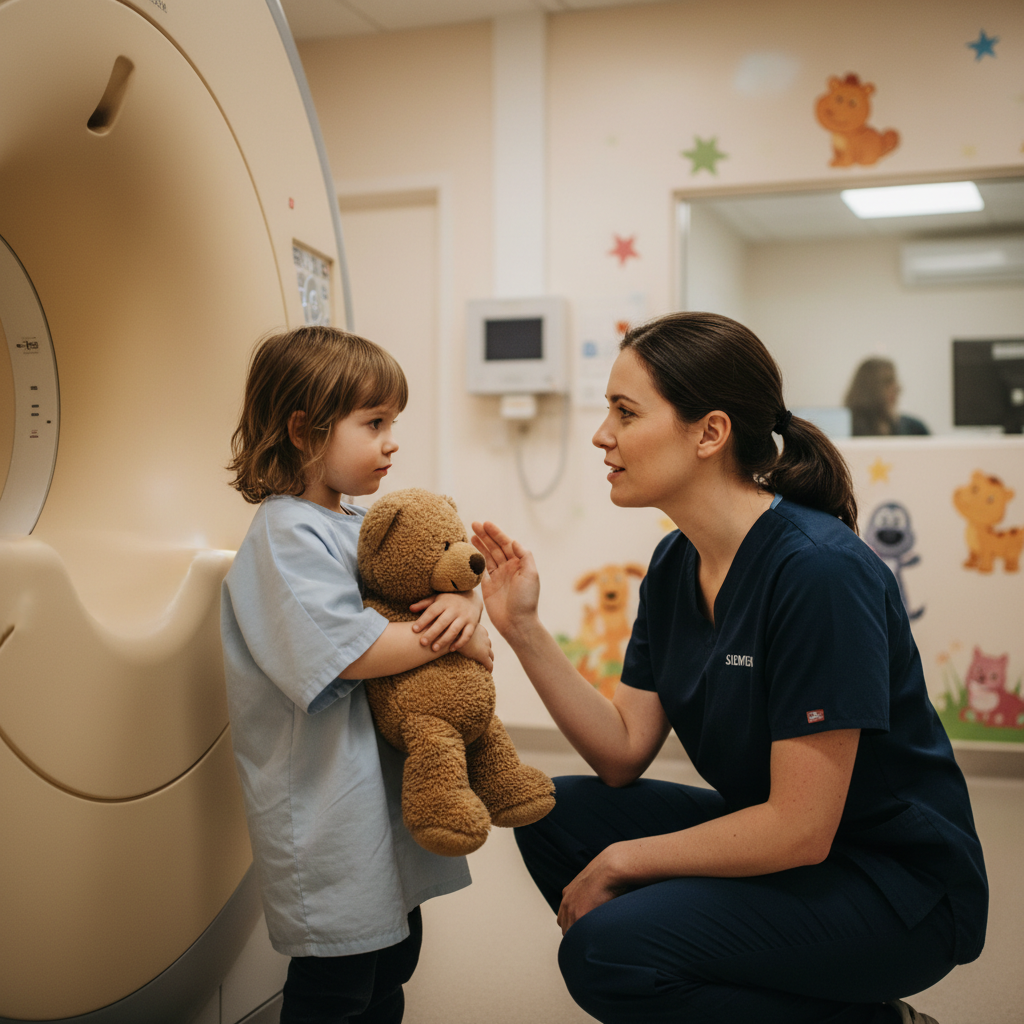
You remember your first pediatric MRI. The training, the protocols, the parent consents. But nothing quite prepares you for the moment a six-year-old looks up at you with eyes that say, 'Please don't make me go in there.'
Her name was Emma. At least, that is what we will call her. She clutched a stuffed rabbit with one ear missing, and her mom stood behind her with that particular expression every parent wears when they are trying to be brave for their child while falling apart inside.
This is not a story about a perfect scan or a textbook procedure. This is about 45 minutes that taught me more about being an imaging tech than any certification exam ever could.
The Moment Before the Bore
Emma needed a brain MRI to rule out a vascular malformation after she had experienced recurring headaches and one frightening episode at school. Routine, medically speaking. Terrifying, if you are six.
I had done the prep work. Showed her the machine while it was quiet. Let her press the table button. Explained that it would be loud, like a drumbeat or a spaceship. Her rabbit could come too, I promised, as long as he did not have any metal buttons or zippers.
She nodded through it all, but when the time came to actually lie down on that table, she froze.
'I changed my mind,' she whispered.
Her mother's face crumpled. We had already rescheduled once. Sedation was an option, but it came with its own risks and delays. I knelt down to Emma's eye level.
'What if,' I said slowly, 'we make a deal?'
The Deal We Made
Here is what I have learned about pediatric MRI work: sometimes the protocol matters less than the person. Not the medical protocol, of course. That is sacred. But the human protocol, the one that is not written in any manual.
I asked Emma what her rabbit's name was. Mr. Floppy, she said. I asked Mr. Floppy if he was scared of loud noises. Emma made him shake his head no. I asked if Mr. Floppy would go in first, just for ten seconds, to make sure it was safe.
We did a practice run. Mr. Floppy went into the bore. I turned on the localizer sequence for exactly ten seconds. Emma watched from her mom's lap as her rabbit 'survived' the spaceship sounds.
Then I made her the deal: She could hold Mr. Floppy the whole time. She could keep her eyes closed if she wanted. And every two minutes, I would talk to her through the intercom and ask her a question. If she answered, we would keep going. If she did not, we would stop and take a break.
She looked at her mom. Her mom looked at me. And Emma said, 'Okay. But you have to promise to ask good questions.'
Forty-Five Minutes of Held Breath
I have run hundreds of MRI scans. I know the sequences, the timing, the artifacts to watch for. But that scan was different. Every two minutes, I kept my promise:
- 'Emma, what is your favorite ice cream flavor?'
- 'If Mr. Floppy could have any superpower, what would it be?'
- 'What do you want to be when you grow up?'
- 'If you could visit any planet, which one?'
- 'What is the silliest word you know?'
She answered every single one. Her voice was small through the intercom, but it was there. Steady. Brave.
Her mother stood beside me in the control room, tears streaming silently down her face, watching her daughter be braver than she ever knew she could be.
The sequences ran clean. T1, T2, FLAIR, contrast series. Forty-five minutes that felt like both an eternity and an instant. When the table finally slid out and Emma sat up, still clutching Mr. Floppy, she looked at me and said, 'That was not so bad.'
Her mother sobbed. I might have too, once they left.
What They Do Not Teach You in MRI School
We learn physics. We learn anatomy. We learn safety protocols and contrast contraindications and how to troubleshoot when the magnet quenches. All of that matters immensely.
But nobody teaches you how to hold space for a scared child. How to make a deal with a stuffed rabbit. How to ask questions that matter more than the answers. How to be the calm, steady presence that makes the impossible feel possible.
Pediatric MRI is not just imaging. It is trust-building. It is creativity under pressure. It is recognizing that sometimes the most important part of the scan happens before the first sequence even starts.
These are the skills that separate a good technologist from an exceptional one:
- Reading the room and adjusting your approach in real time
- Earning trust in under five minutes
- Keeping your own emotions steady when parents are struggling
- Knowing when to follow the script and when to rewrite it
- Celebrating small victories that feel enormous
Emma's scan was clear. No malformation. Just migraines, manageable with medication and time. Her mother sent a thank-you card two weeks later with a photo of Emma and Mr. Floppy. On the back, in a child's handwriting: 'Thank you for the good questions.'
Why We Remember These Moments
I have been an MRI technologist for over a decade now. I have scanned athletes and executives, patients in crisis and patients in routine follow-up. I have worked night shifts and double shifts and holiday shifts.
But I remember Emma.
I remember her because she reminded me that our work is not just about images. It is about the people inside the bore. It is about meeting fear with steadiness. It is about small acts of kindness that ripple outward in ways we may never fully see.
Every imaging tech has a story like this. A patient who stayed with them. A moment that redefined what it means to do this work well. These stories do not make it into our resumes or our certification renewals, but they are the heartbeat of why we show up.
If you are early in your imaging career, you will have your Emma moment soon. If you have been doing this for years, you have probably had several. Hold onto them. They are the proof that technique and compassion are not separate skills. They are two halves of the same whole.
You Deserve a Team That Gets It ✨
Stories like Emma's are why the right workplace matters. You need colleagues who understand that pediatric MRI is as much art as science. Leaders who value the technologist who stays late to help a frightened child. Teams that celebrate the scans that almost did not happen but did because someone cared enough to try one more approach.
If you are searching for a role where your full skill set is recognized, where emotional intelligence is valued alongside technical expertise, the Intuites Recruiting Team would love to hear your story. Whether you are exploring pediatric imaging, looking for a department that invests in professional growth, or simply ready for a change, reach out at contact@intuites.healthcare or visit intuites.healthcare. We are here to help you find the place where your best work happens.
Because every Emma deserves a technologist who will ask the good questions. And every technologist deserves a team that sees the full scope of what they bring to the bore. 🤍
#PediatricMRI #ImagingTechStories #MRITechnologist #RadiologyEmotional #HealthcareHeroes #DiagnosticImaging #PediatricRadiology #MedicalImaging #RadTech #HealthcareStories #MRISafety #ImagingTech #RadiologyCareers #HealthcareJourney #WhyWeDoBetter
Looking for a healthcare team that truly sees your value?
The Intuites Recruiting Team is here to listen, support your career, and connect you with roles across the USA — when you're ready.