
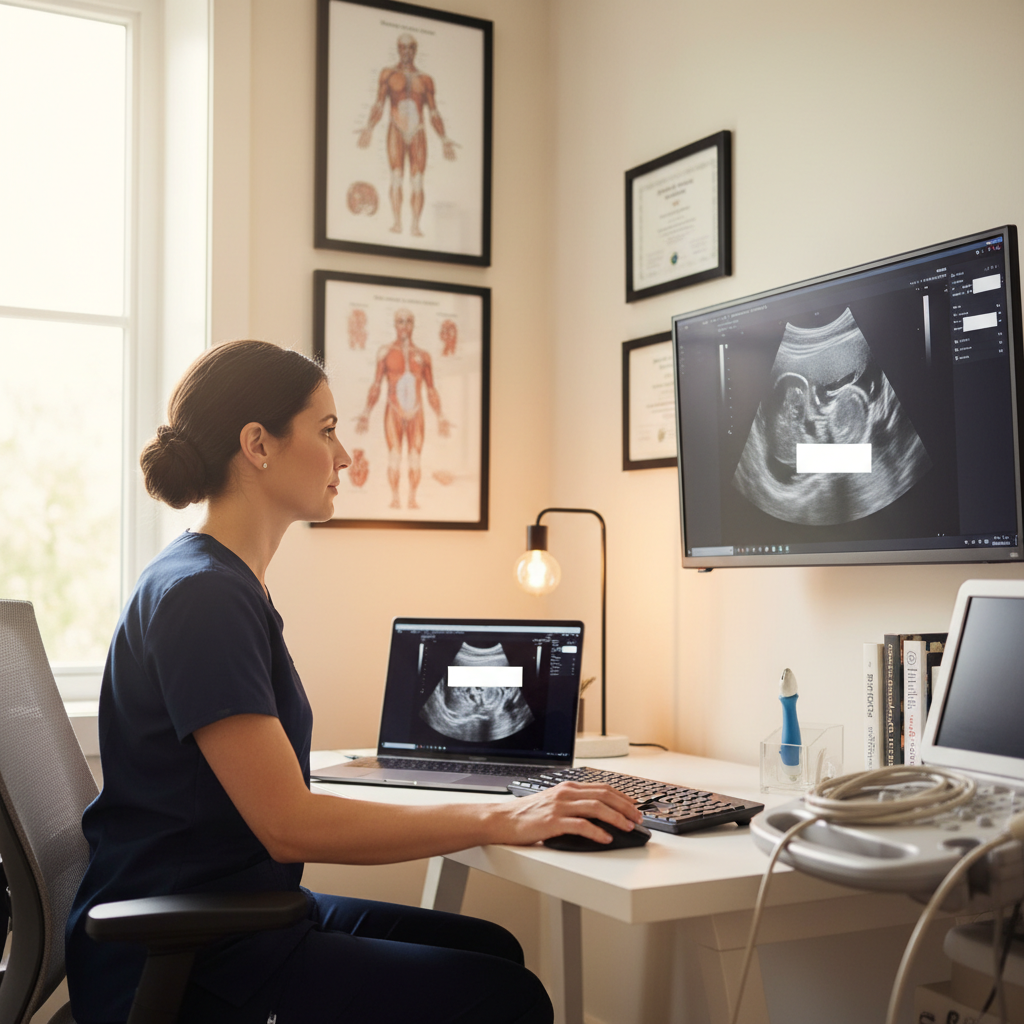
You have captured thousands of beautiful diagnostic images throughout your sonography career. Crisp fetal profiles. Perfectly windowed cardiac views. That textbook gallstone study your preceptor raved about. Now you are ready for your next ultrasound tech job, and hiring managers want to see proof of your technical skill.
But here is the challenge: how do you showcase your best work without violating HIPAA or putting patient privacy at risk? Building a sonographer portfolio requires more than just saving your favorite scans. It demands a thoughtful, compliant workflow that protects every patient while highlighting your expertise.
Let's walk through exactly how to create a portfolio that opens doors — safely and professionally.
Why Sonographers Need a Portfolio in Today's Job Market
The ultrasound field has become increasingly competitive. With specialized modalities from vascular to musculoskeletal to advanced OB, hiring managers need to assess technical proficiency quickly. A resume lists your certifications and years of experience, but a well-curated portfolio proves you can actually produce diagnostic-quality images.
Many imaging directors now request work samples during the interview process, especially for roles requiring advanced skills like nuchal translucency measurements, echocardiography, or interventional guidance. A HIPAA-safe portfolio demonstrates three things simultaneously: your technical capability, your attention to image quality, and your understanding of patient privacy regulations.
Travel sonography positions and per-diem roles particularly benefit from portfolio presentations. When facilities need to onboard quickly, seeing your actual work reduces their perceived risk and speeds up hiring decisions.
The Non-Negotiable Rule: Complete De-Identification
Before we discuss what to include, let's be crystal clear about what HIPAA requires. Any protected health information (PHI) must be completely removed before an image leaves your facility or appears in your portfolio. This is not optional, and “blurring” patient names is not sufficient.
PHI includes 18 specific identifiers, and all must be stripped from portfolio images:
- Patient names, initials, and medical record numbers
- Dates (including exam dates, birth dates, and any calendar dates)
- Geographic data smaller than a state (facility name, city, ZIP codes)
- Phone numbers, email addresses, and account numbers
- Device identifiers and serial numbers
- Facial photographs or any identifying images
- Any other unique identifying characteristic
Most modern ultrasound systems include de-identification tools in their software. Use them. Manually cropping or editing screenshots is risky and often misses embedded metadata. Work with your facility's compliance officer or IT department to establish an approved workflow before you begin building your portfolio.
What to Capture: Building Your Best Work Collection
A strong sonographer portfolio should demonstrate breadth and depth across the modalities you practice. Aim for 15 to 25 high-quality images that showcase different anatomical structures, pathologies, and technical skills.
Focus on images that highlight:
- Technical excellence: Proper depth settings, gain optimization, clear anatomical landmarks, correct labeling and measurement techniques
- Diagnostic value: Pathology when appropriate (masses, stones, abnormal Doppler flow), normal variants, challenging anatomy successfully visualized
- Range of difficulty: Routine studies done well, plus technically difficult cases (obese patients, bowel gas interference overcome, deep structures clearly visualized)
- Specialized skills: 3D/4D reconstructions if applicable, elastography, contrast-enhanced studies, or any advanced techniques relevant to your target positions
Organize your portfolio by body system or modality. If you work in multiple areas — say, general abdomen, OB, and vascular — create separate sections. This helps hiring managers quickly locate the skills most relevant to their open position.
What NOT to Include
Resist the temptation to pad your portfolio with marginal images. Quality always trumps quantity. Avoid including:
- Suboptimal image quality (poor resolution, artifacts, incorrect settings)
- Redundant examples (you do not need five liver images unless each demonstrates something distinctly different)
- Images where anatomy is unclear or measurements are questionable
- Any study you did not personally perform
- Anything that makes you uncomfortable from a privacy standpoint — trust your instincts
The HIPAA-Safe Workflow: Step by Step
Establishing a compliant process protects you, your patients, and your facility. Here is a practical workflow many sonographers use successfully:
Step one: Obtain written permission from your employer. Some facilities have formal policies allowing portfolio creation; others require individual approval. Get it in writing. Never assume permission.
Step two: Use your facility's approved de-identification process. This typically means using the ultrasound system's built-in anonymization feature, which strips PHI from DICOM headers and on-screen text. Do not take phone photos of your monitor.
Step three: Export de-identified images to approved media. Follow your facility's data security protocols. Many organizations require IT involvement to ensure proper anonymization and secure transfer.
Step four: Double-check every image before adding it to your portfolio. Look for patient names in corners, dates in headers, facility identifiers in footers. Check the image properties and metadata. If you find any PHI, do not use that image.
Step five: Store your portfolio securely. Use password-protected files. If creating a digital portfolio, consider platforms designed for healthcare professionals with HIPAA-compliant features.
Document your compliance process. Keep records of employer permission, IT involvement, and your de-identification checklist. If questions ever arise, you will have proof of your diligence.
Presenting Your Portfolio Effectively
Once you have your HIPAA-safe image collection, presentation matters. Hiring managers review many applications; make yours easy to navigate and professionally formatted.
Consider creating both a PDF version for email submission and a digital portfolio for in-person interviews. Include brief captions that provide context without violating privacy: “Abdominal aortic aneurysm, transverse view, demonstrating proper measurement technique” or “Fetal nuchal translucency at 12 weeks, within normal limits.”
Avoid overly technical jargon in captions unless applying for highly specialized roles. The person screening applications may be an HR professional, not a fellow sonographer. Clear, confident descriptions serve you better than showing off vocabulary.
Update your portfolio regularly. As you master new techniques or modalities, retire older examples in favor of your best current work. Your portfolio should represent where your skills are today, not where they were five years ago.
Moving Forward with Confidence
Building a sonographer portfolio takes time and attention to detail, but the investment pays dividends throughout your career. You are not just collecting pretty pictures — you are creating a professional tool that demonstrates your value to potential employers while honoring your ethical obligation to patient privacy.
The ultrasound tech job market rewards professionals who can prove their skills quickly and compliantly. A thoughtfully curated, HIPAA-safe portfolio sets you apart from candidates who rely on resumes alone. It shows hiring managers that you understand both the technical and ethical dimensions of diagnostic imaging.
As you prepare your next career move, remember that the Intuites Recruiting Team works with imaging professionals every day. Whether you are exploring travel sonography opportunities, seeking a permanent position, or navigating a career transition, we understand what facilities are looking for — and we can help you present your skills effectively. Reach out anytime at contact@intuites.healthcare or visit intuites.healthcare to connect with recruiters who speak your language. ✨
#SonographerPortfolio #UltrasoundTech #SonographyHIPAA #DiagnosticImaging #MedicalImaging #UltrasoundCareers #HIPAACompliance #RadiologyCareers #HealthcareJobs #ImagingTech #SonographyLife #TravelSonographer #UltrasoundJobs #MedicalPortfolio #ImagingCareers
Looking for a healthcare team that truly sees your value?
The Intuites Recruiting Team is here to listen, support your career, and connect you with roles across the USA — when you're ready.