
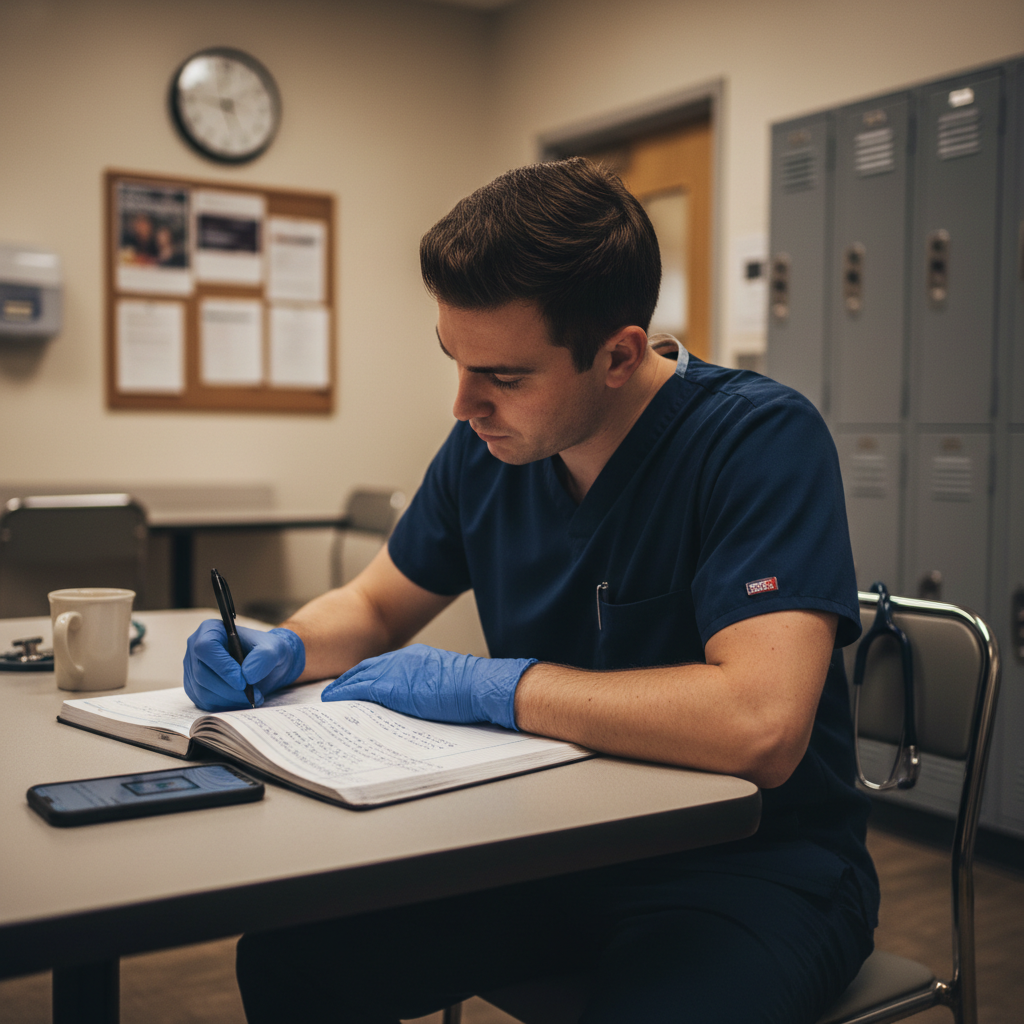
You just closed on a complex ortho case — three hours at the table, flawless instrument passes, zero breaks in sterile technique. The surgeon nods as you break down the field. Great work.
But if you don't log that case properly in the next 24 hours, it might as well not have happened when your next credentialing committee asks for proof.
Whether you're working toward your CST certification, applying for a new facility, or preparing for recredentialing, your surgical tech case log is your professional passport. Here's how to build documentation systems that actually hold up under scrutiny.
Why Your Case Log Matters More Than You Think
Credentialing bodies, hospitals, and surgery centers don't just want to see a number. They want verifiable proof that you've scrubbed the types of cases you claim on your resume.
The National Board of Surgical Technology and Surgical Assisting requires specific case minimums for initial certification. Most facilities hiring surgical techs want to see case diversity — proof you can handle everything from routine appendectomies to complex cardiovascular procedures.
A weak or incomplete surgical tech case log can delay your application by weeks, cost you job offers, or force you to scramble for supervisor signatures months after the fact. The professionals who track meticulously from day one never face these problems.
What Credentialing Committees Actually Want to See
Before we talk about systems, let's clarify what makes scrub tech documentation credible. Your case log needs to include:
- Date of surgery — exact date, not “sometime in March”
- Patient identifier — usually initials or medical record number (follow your facility's HIPAA policy)
- Procedure name — use the proper CPT terminology when possible
- Your role — first scrub, second assist, etc.
- Supervising surgeon — full name, exactly as it appears on their credential
- Facility name — especially important if you work at multiple sites
- Case category — general, ortho, neuro, cardiac, etc.
Some credentialing applications also ask for case start and end times, anesthesia type, or whether the case was emergent. If your facility uses an electronic OR management system, many of these fields auto-populate — but you still need a personal record.
Three Systems That Actually Work
The best surgical tech case log is the one you'll actually maintain. Here are three approaches that experienced CSTs swear by:
The Daily Spiral Notebook
Old school, but bulletproof. Keep a dedicated pocket notebook in your locker. At the end of every shift — before you change out of your scrubs — jot down the day's cases with all required fields. On your days off, transfer entries into a spreadsheet or app.
Pros: No tech failures, no login required, fast capture in the moment. Cons: You have to digitize eventually, and handwriting needs to be legible for your future self.
The Smartphone Documentation App
Apps like Case Logger, ScrubTrack, or even a simple note-taking app with templates let you log cases between rooms. Set up a template with all required fields, then fill it in during turnover.
Pros: Always with you, easy to search and export, some apps generate PDF reports for credentialing. Cons: Battery dies, you might forget your phone in your locker, some ORs restrict personal devices.
The End-of-Week Spreadsheet Ritual
Block 30 minutes every Friday afternoon. Pull up your facility's OR schedule (if you have access) or reference your assignment sheets, then populate a master Excel or Google Sheets file with the week's cases.
Pros: Clean data from the start, easy to sort by procedure type or surgeon, simple to back up. Cons: Requires discipline, and memory fades fast — details from Monday are fuzzy by Friday.
Many surgical techs use a hybrid: quick notes during the day, formal entry at week's end. Find your rhythm, but make it non-negotiable.
Common Mistakes That Sink Credentialing Applications
Even diligent loggers stumble. Watch out for these pitfalls:
Vague procedure names. “Knee surgery” doesn't cut it. Was it a total knee arthroplasty? ACL repair? Meniscectomy? Use the language your OR schedule uses.
Missing supervisor signatures. Some credentialing bodies want a supervisor or surgeon to sign off on case totals periodically — quarterly or at the end of a rotation. Don't wait until you've left the facility to ask for signatures.
No backup. Your phone gets stolen, your notebook falls out of your bag in the parking lot, your laptop crashes. Keep at least two copies of your surgical tech case log: cloud storage, email to yourself, printed binder at home.
Inconsistent formatting. If you log Dr. Smith as “J. Smith” one week and “Smith, John” the next, credentialing staff may flag it. Pick a format and stick with it.
How to Catch Up If You're Behind
Maybe you're six months into a job and just realized you should have been logging all along. Don't panic.
Start today — log every case going forward. Then, reconstruct what you can. If your facility uses an OR management system, ask your manager or clinical educator if you can access your historical assignments. Many hospitals keep these records for at least a year.
Talk to the surgeons and charge nurses you've worked with regularly. A brief email explaining you're updating your professional case log for CST credentialing often gets you the details you need. Be specific: “I scrubbed with you on a lap chole on March 14th — do you recall the patient's initials or MRN?”
It's harder than real-time logging, but it's doable. And the lesson sticks: you'll never let your log lapse again.
Make Documentation Part of Your Professional Identity
The surgical techs who advance fastest — who land the best travel contracts, who get called for high-acuity cases, who move into leadership — treat their case log like a living resume. It's not paperwork. It's proof of your expertise.
When you walk into an interview and hand over a meticulously organized surgical tech case log with 200+ documented cases across six specialties, you're not just meeting a requirement. You're showing you're the kind of professional who takes ownership, follows through, and values precision.
That's the scrub tech every OR director wants on their team.
Whether you're prepping for your first CST credentialing application or you're a seasoned tech exploring new opportunities, the Intuites Recruiting Team works with surgical techs at every career stage. If you'd like to talk through your next move — or just want a second set of eyes on your case log strategy — reach out anytime at contact@intuites.healthcare or visit intuites.healthcare. We're here to help you build the career you deserve. 🤍
#SurgicalTech #CSTCredentialing #ScrubTech #SurgicalTechnology #CaseLog #ORLife #HealthcareDocumentation #SurgicalServices #AlliedHealth #MedicalCredentialing #ORNurse #SurgicalTeam #HealthcareCareers #TravelSurgicalTech #PerioperativeServices
Looking for a healthcare team that truly sees your value?
The Intuites Recruiting Team is here to listen, support your career, and connect you with roles across the USA — when you're ready.