
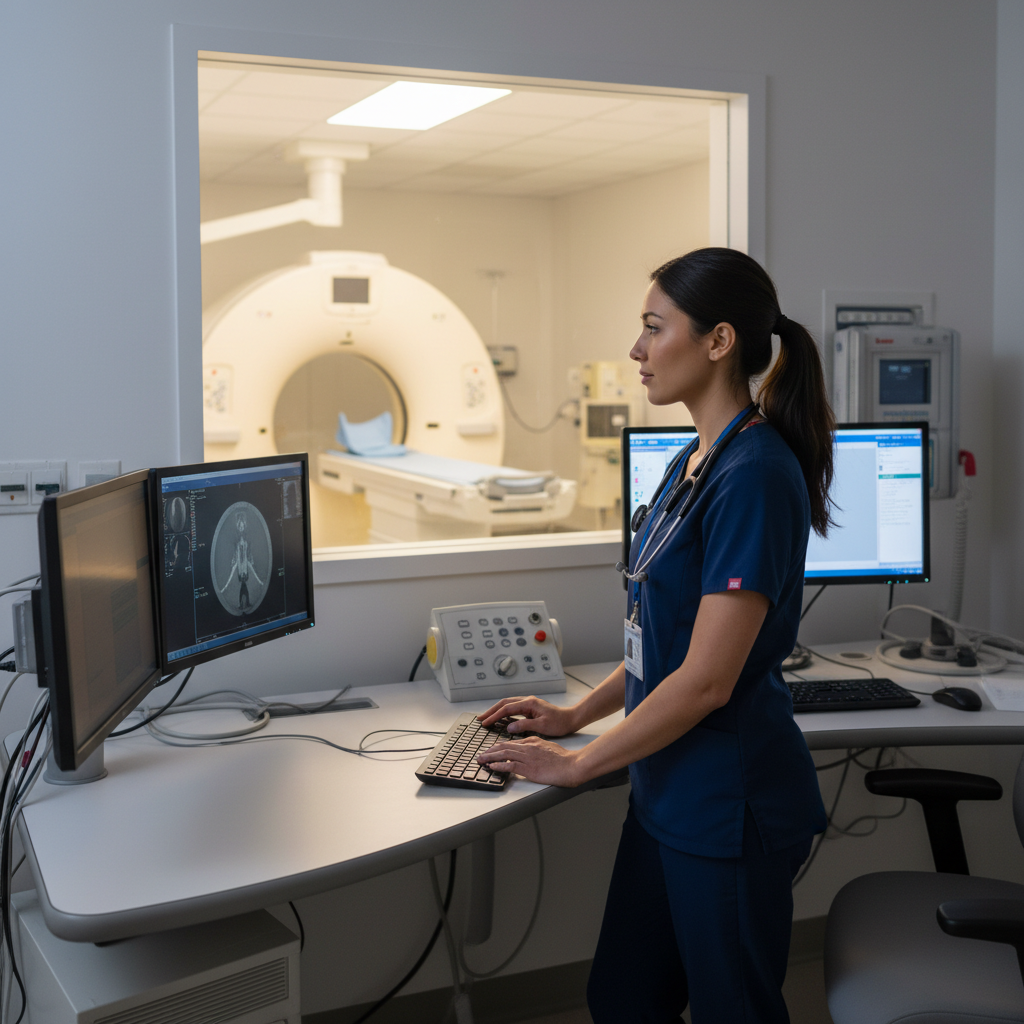
You are halfway through your shift when you glance at the next order. The name stops you cold.
It is someone you know. Not a celebrity or a distant acquaintance—someone real. Your coworker from another department. Your neighbor who waves every morning. The parent of your kid's best friend. And now they are your patient.
This is one of those moments they do not quite prepare you for in school. The protocols are clear, the imaging parameters are routine, but your hands feel different on the console. Because this time, it is personal.
The Moment You Recognize the Name
Most imaging techs will tell you: it happens more than you would think. Healthcare is a small world, especially in tight-knit communities or smaller metro areas. You scan hundreds of patients a month, and eventually, the schedule will hand you someone whose face you know outside these walls.
The first reaction is usually shock. Then comes the mental scramble—Can I do this? Should I do this? Is there someone else who can take this exam?
The answer depends on your facility's policy, the urgency of the exam, and the relationship. But even when policy says you can proceed, the emotional weight does not automatically lift. You are still a professional. You are also still human.
The Ethics Are Not Always Black and White
HIPAA is non-negotiable. Scope of practice is non-negotiable. But the ethical landscape of imaging someone you know lives in more nuanced territory.
Here is what most radiology ethics guidelines agree on:
- Immediate family: You should not scan your spouse, parent, child, or sibling if it can be avoided. The emotional involvement compromises objectivity, and even excellent technique can be second-guessed later.
- Close friends: Use judgment. If you are too emotionally invested to maintain professional detachment, speak up. It is not weakness—it is integrity.
- Acquaintances or coworkers: Often acceptable, but communicate. A simple ‘I know this might feel awkward, but I will take excellent care of you’ can ease the tension for both of you.
- When in doubt: Ask your lead tech or supervisor. Most managers would rather reassign an exam than have you work through distress that could affect care or your own well-being.
There is no shame in stepping back. In fact, recognizing when a situation is too close is a mark of professional maturity.
What It Feels Like in the Room
If you do proceed—and many of us have—the exam itself becomes a strange dance of familiarity and formality.
You know their voice, but now you are asking them to hold still, to breathe, to wait. You have seen them laugh at a backyard barbecue, and now you are seeing their anatomy on your monitor. You want to reassure them, to say something comforting, but you also cannot overstep the clinical boundary. So you stay kind, stay clear, stay present.
One CT tech shared this with me: ‘I scanned my son's soccer coach after a car accident. I kept my voice steady, walked him through every step, but inside I was praying the images would be clean. When they were, I had to wait until I clocked out to let myself feel the relief.’
That is the duality. You hold space for their fear while managing your own. You deliver excellent care while carrying the weight of connection.
The Aftermath: What Happens Next
The scan finishes. You help them off the table, give the standard post-exam instructions, and watch them leave. And then you are alone with the images and your thoughts.
You cannot discuss what you saw. Not with them, not with mutual friends, not even in vague terms over coffee. The results belong to the radiologist and the ordering physician. Your job is done the moment you send the study.
But the emotional residue does not always clear as quickly.
Some techs describe a lingering heaviness—especially if the images revealed something serious. Others feel a quiet pride in having been able to serve someone they care about with skill and compassion. Both responses are valid.
If the emotional aftermath lingers or feels unmanageable, reach out. Talk to a colleague you trust, your manager, or your facility's employee assistance program. Radiology ethics are not just about patient rights—they also include your right to process difficult experiences.
Building Your Own Boundaries
Over time, most imaging techs develop a personal framework for these situations. Here are a few approaches that work:
- Know your facility's policy in advance. Do not wait until the moment of crisis to find out whether you are allowed to decline an exam involving someone close to you.
- Practice the conversation. Have a few calm, professional phrases ready. ‘I want to make sure you get the best care, and I think it would be better if another tech handles this.’
- Separate the roles. When you are in the room, you are the technologist. When you leave, you can be the friend or neighbor again—but never at the same time.
- Debrief when you need to. Do not carry it alone. Find a trusted peer or mentor who understands the unique emotional labor of this work.
You will not always get it perfect. None of us do. But the fact that you are thinking about it, that you care enough to wrestle with the tension, means you are doing this work with heart. 🤍
You Are Not Alone in This
If you have ever had to scan someone you know—or if you are dreading the day it happens—you are part of a quiet fellowship of imaging professionals who have navigated this same terrain. We do not talk about it enough, but it is one of the most emotionally complex parts of the job.
You bring precision and compassion to every exam. You uphold radiology ethics even when it costs you emotionally. And you show up, shift after shift, for patients who are sometimes strangers and sometimes not.
That is not just technical skill. That is courage.
If you are looking for a staffing partner who understands the real, human challenges of imaging work—not just the credentials and certifications—the Intuites Recruiting Team is here. We place rad techs, CT techs, MRI techs, and ultrasound professionals in environments that respect both your expertise and your humanity. Reach out anytime at contact@intuites.healthcare or visit intuites.healthcare. We would be honored to support your next step. ✨
#ImagingTechStories #RadiologyEthics #RadTechEmotional #TechnologistReflection #CTTech #MRITech #RadiologicTechnologist #HealthcareEthics #ImagingProfessionals #RadTechLife #DiagnosticImaging #MedicalImaging #HealthcareHumans #RadTechCommunity #RealTechStories
Looking for a healthcare team that truly sees your value?
The Intuites Recruiting Team is here to listen, support your career, and connect you with roles across the USA — when you're ready.