
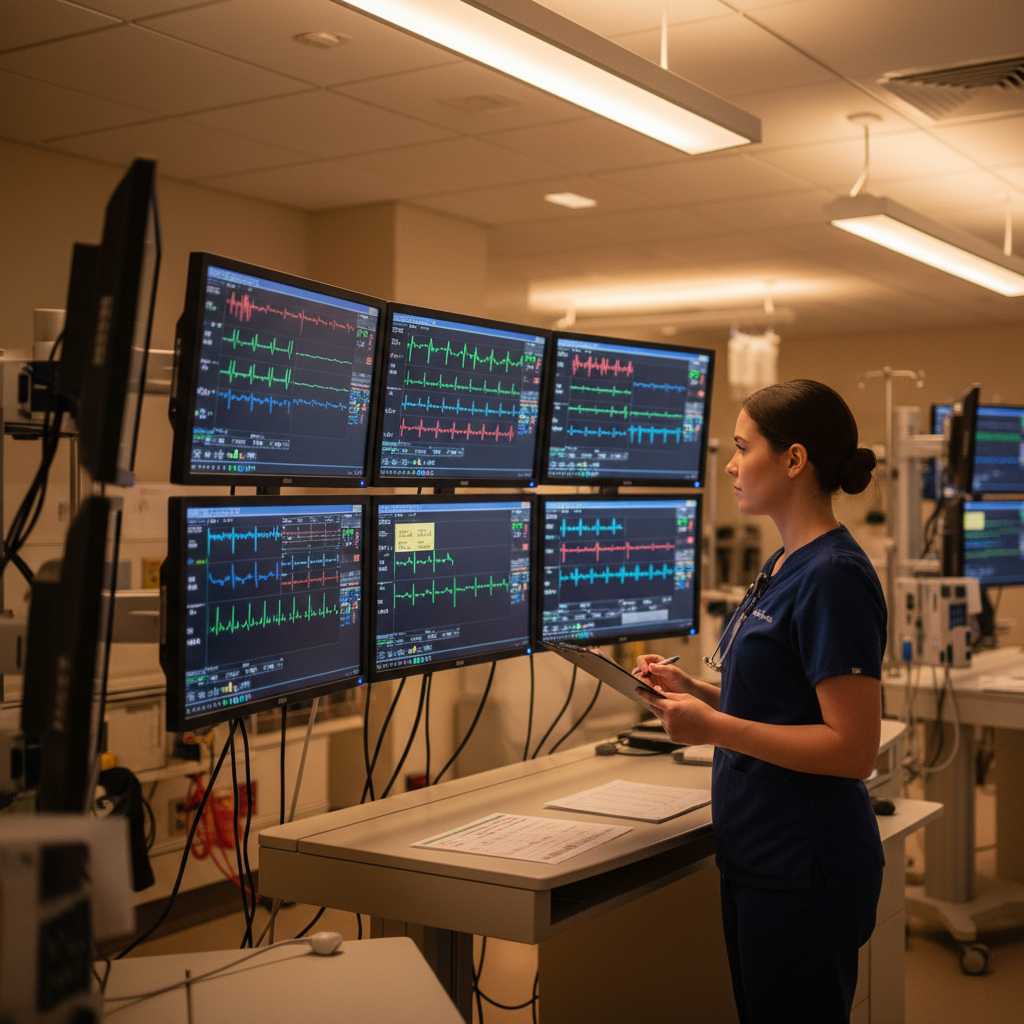
If you have been working as a CNA for a while, you have probably noticed colleagues who handle telemetry monitoring — watching those cardiac rhythm screens, calling out abnormal readings, and earning a bit more per hour for the responsibility.
The good news? CNA telemetry training is one of the most accessible cross-training paths in healthcare, and it can open doors to higher pay, more specialized roles, and a resume that stands out when you are ready for your next move.
Let us walk through exactly how to add tele monitor skills this fall — and how to make sure your paycheck reflects the upgrade.
What Does a Tele Monitor Tech Actually Do?
Before you commit to CNA cross training, it helps to understand what the role looks like day to day.
A telemetry monitor technician (often called a tele tech) watches real-time cardiac rhythms for multiple patients on a centralized bank of screens. You are looking for arrhythmias, changes in heart rate, or alarm conditions that need immediate nurse attention.
You are not diagnosing or treating — you are the early warning system. When you spot something abnormal, you notify the bedside nurse or charge nurse right away.
Most tele techs work in a dedicated monitoring room on a cardiac or step-down unit, though some hospitals use a roving model where you split time between monitoring and direct patient care.
The role requires focus, pattern recognition, and the ability to stay calm when alarms go off. If you enjoy detail work and like the idea of contributing to patient safety without being at the bedside every minute, tele monitoring can be a great fit.
Why Pursue CNA Telemetry Training Now?
Timing matters. Fall is an ideal season to start cross-training because:
- Many hospitals launch internal training cohorts in September and October, aligning with fiscal-year budgets.
- You can complete a short course before the holiday staffing crunch, making yourself more valuable when schedules get tight.
- Annual performance reviews often happen in Q4 or Q1 — finishing training beforehand gives you concrete leverage for a raise or title change.
From a career perspective, tele monitor experience makes you more competitive for RN programs, telemetry nursing roles, and specialty units like ICU or cardiac care. It is a skill that travels well if you ever consider travel assignments or agency work.
And yes, there is usually a CNA pay boost attached. Depending on your facility and region, tele monitor techs typically earn $2 to $4 more per hour than standard CNA rates. In some markets, that adds up to $4,000 to $8,000 extra per year.
Step-by-Step: How to Get Tele Monitor Training
Here is the clearest path forward, whether your hospital offers internal training or you need to go outside.
Option 1: Internal Hospital Training
Most mid-sized and large hospitals run their own telemetry training programs for current employees. These are usually free and last two to four weeks, combining classroom EKG basics with supervised monitoring shifts.
To get in:
- Ask your nurse manager or unit educator if your facility has a tele monitor training program.
- Express interest during your next one-on-one or performance review.
- If there is a waiting list, get your name on it early — cohorts often fill months in advance.
- Be flexible about schedule. Training may require day shifts even if you normally work nights.
Internal programs are the gold standard because they are paid, you learn your facility's specific equipment and protocols, and you often transition directly into a monitor tech position after graduation.
Option 2: External EKG / Telemetry Course
If your hospital does not offer training — or you want to be more marketable before asking — you can complete an EKG interpretation course independently.
Look for programs that cover:
- Basic cardiac anatomy and physiology
- EKG waveform components (P wave, QRS complex, T wave)
- Common arrhythmias (atrial fibrillation, ventricular tachycardia, heart blocks)
- Lead placement and troubleshooting
- Documentation and communication protocols
Reputable online options include community colleges, the American Heart Association, and dedicated EKG training platforms. Expect to pay $200 to $500 for a quality course. Many finish in four to six weeks if you study part-time.
Once you complete the course, bring your certificate to your manager and ask about tele monitor openings or cross-training opportunities. Having the credential in hand shows initiative and makes it easier for leadership to say yes.
Option 3: Shadow and Learn on the Job
Some facilities allow informal cross-training where you shadow the current tele tech during overlapping shifts, gradually taking on monitoring responsibilities under supervision.
This works best if:
- You already have a strong relationship with your unit leadership.
- Your facility is short-staffed in the monitor room and needs coverage.
- You are willing to start slowly, learning one skill at a time over several months.
Even informal training should come with clear expectations, a documented competency checklist, and a timeline for when you will be considered fully trained (and eligible for the pay increase).
How to Negotiate the CNA Pay Boost
Getting the training is step one. Making sure your paycheck reflects it is step two.
Here is how to approach the pay conversation:
Timing: Bring it up before you start training if possible. Ask, “What is the hourly rate for tele monitor techs, and when would I be eligible for that rate once I complete the program?” Get it in writing if you can.
Benchmarking: Research what other facilities in your area pay for monitor techs. Websites like Glassdoor, Indeed, and Salary.com can give you a range. If your facility is below market, you have data to support your request.
Framing: Position it as a win-win. “I am excited to take on telemetry monitoring, and I want to make sure we are aligned on compensation. I have seen similar roles in the area paying $X to $Y per hour. What can we do to get me to that range once I am fully trained?”
Fallback options: If an immediate raise is not possible, ask about:
- A pay bump after a 90-day probationary period in the new role
- Shift differentials for nights or weekends in the monitor room
- A title change (CNA II, Monitor Technician) that reflects your expanded scope
- Tuition reimbursement or continuing education funds for future certifications
Remember, the tele monitor role often comes with different responsibilities — you may have less direct patient contact but more autonomy and focus time. Make sure the trade-offs work for your career goals and personal work style.
What Happens After You Are Trained?
Once you complete CNA telemetry training and start working as a tele monitor tech, you will likely spend the first few weeks building confidence and speed. It takes time to recognize patterns and distinguish true alarms from artifact.
Most new tele techs work closely with a preceptor or experienced colleague for at least a month. Do not hesitate to ask questions — cardiac monitoring is high-stakes, and nobody expects you to know everything on day one.
From there, the role can be a launching pad:
- Some tele techs stay in monitoring long-term, enjoying the focus and predictability.
- Others use it as a bridge to RN school, especially if they are interested in cardiac nursing.
- A few move into clinical informatics, helping hospitals optimize alarm settings and telemetry workflows.
No matter where you take it, the EKG interpretation and critical-thinking skills you build are yours to keep — and they make you a stronger candidate for just about any nursing role down the line.
Ready to Take the Next Step?
CNA cross training is not just about adding a line to your resume. It is about expanding what you are capable of, increasing your earning potential, and positioning yourself for the career you want — not just the job you have today.
If you are exploring new opportunities, considering travel assignments, or wondering how tele monitor experience might open doors at other facilities, the Intuites Recruiting Team is here to help. We work with CNAs, LPNs, and RNs across the country to find roles that match their skills and goals. Reach out anytime at contact@intuites.healthcare or visit intuites.healthcare to start a conversation. 🤍
#CNATelemetryTraining #TeleMonitorTech #CNACrossTraining #CNAPayBoost #EKGTraining #CardiacMonitoring #HealthcareCareers #CNAJobs #NursingAssistant #TelemetryTech #HeartMonitoring #CNASkills #HealthcareTraining #NursingCareer #IntuitesCareers
Looking for a healthcare team that truly sees your value?
The Intuites Recruiting Team is here to listen, support your career, and connect you with roles across the USA — when you're ready.