
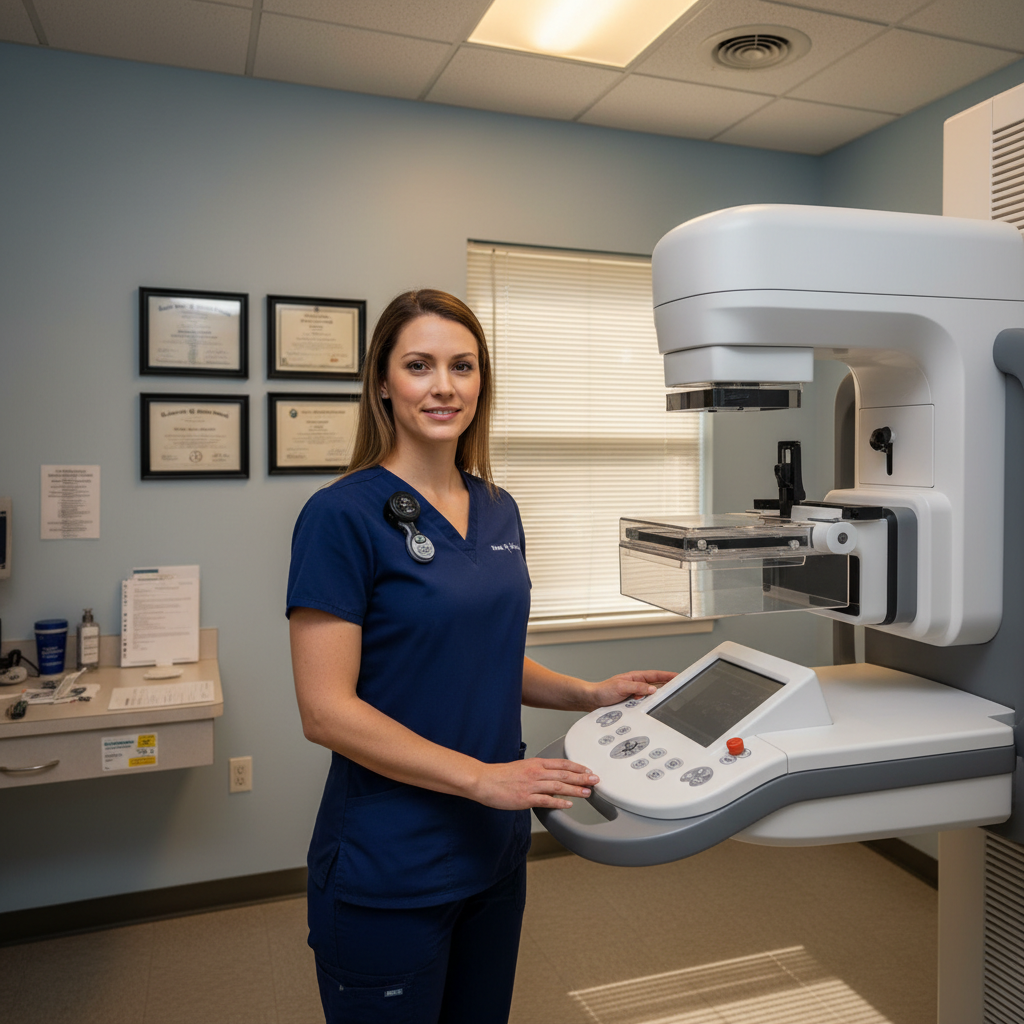
If you are working toward your radiography credentials—or already have them—and considering mammography as your specialty, you are looking at one of the most stable, rewarding paths in diagnostic imaging. Mammography technologists combine technical precision with patient advocacy every single day, and the career progression is both clear and achievable.
This article maps out a realistic seven-year journey from initial certification through lead technologist responsibilities. We will cover ARRT-M requirements, MQSA compliance milestones, salary benchmarks, and the leadership skills that separate good techs from great ones.
Let's walk through it year by year. ✨
Year One: Building Your Foundation (ARRT-R and Clinical Exposure)
Most mammography tech careers begin with a solid radiography credential. You will earn your ARRT-R (Radiography) certification first—typically through an accredited two-year associate degree program that includes clinical rotations. During this phase, you are learning positioning, radiation safety, patient communication, and the fundamentals of image quality.
If your program offers a mammography elective or rotation, take it. Even a few weeks of exposure will help you understand whether this specialty resonates with you. You will see firsthand how different mammography is from general X-ray: the positioning is more nuanced, the patient interaction is more emotionally charged, and the attention to detail is unforgiving.
By the end of year one, your goal is simple: pass your ARRT-R exam and secure an entry-level radiography position that offers some exposure to women's imaging, even if it is just cross-training opportunities.
Year Two to Three: Earning Your ARRT-M Certification
Once you have at least one year of clinical experience as a registered radiographer, you become eligible to pursue the ARRT-M (Mammography) certification. This is the credential that opens the door to dedicated mammography roles.
Here is what ARRT-M certification requires:
- Primary pathway: Current ARRT-R credential in good standing
- Structured education: 16 category A continuing education credits specific to mammography topics (breast anatomy, positioning, quality control, patient care)
- Clinical competency: Documentation of performed exams under supervision, including various projections and special views
- Examination: Pass the ARRT Mammography exam (covers physics, instrumentation, procedures, and quality standards)
Many hospitals and imaging centers will support your ARRT-M pursuit if you express interest. Some will pay for your coursework and exam fees; others will provide on-the-job training hours that count toward your clinical competency requirement.
During years two and three, you are splitting your time between general radiography duties and mammography training. You are learning how to position for MLO and CC views, how to handle callbacks with empathy, and how to troubleshoot image artifacts. You are also becoming fluent in MQSA regulations—the federal quality standards that govern every mammography facility in the United States.
Salary at this stage typically ranges from $54,000 to $65,000 annually, depending on your region and facility type.
Year Four to Five: Gaining MQSA Compliance Experience
With your ARRT-M in hand, you are now a credentialed mammography technologist. Your next career milestone is building deep expertise in MQSA (Mammography Quality Standards Act) compliance and quality control protocols.
MQSA compliance experience is what separates entry-level mammo techs from candidates who can step into lead roles. You will need to demonstrate proficiency in:
- Daily, weekly, and quarterly QC tests (phantom imaging, darkroom fog tests, processor quality control)
- Equipment performance monitoring and documentation
- Radiation dose optimization and ACR accreditation readiness
- Medical physicist collaboration during annual surveys
- Audit trail management and regulatory inspection preparation
This is also the phase where you start mentoring newer techs. You are the person who can troubleshoot a positioning challenge, explain why a repeat rate matters, or walk someone through a difficult patient interaction. These informal leadership moments are building blocks for formal lead roles.
By year five, you should be earning between $62,000 and $74,000, with higher ranges in metropolitan markets or facilities that offer shift differentials for evening or weekend coverage.
Year Six to Seven: Stepping Into Lead Technologist Responsibilities
Lead mammography tech roles typically open up around the five-to-seven-year mark for techs who have demonstrated both technical excellence and leadership readiness. The title varies—Lead Mammo Tech, Mammography Supervisor, QC Coordinator—but the responsibilities are consistent.
As a lead, you will be responsible for:
- Quality assurance oversight: Ensuring all MQSA and ACR standards are met, managing QC documentation, and serving as the primary contact during inspections
- Staff scheduling and training: Coordinating coverage, onboarding new techs, and maintaining continuing education compliance for the team
- Equipment liaison: Working with service engineers, radiologists, and administrators to maintain and upgrade imaging systems
- Protocol development: Standardizing positioning techniques, callback procedures, and patient communication scripts
- Performance metrics: Monitoring repeat rates, patient satisfaction scores, and throughput efficiency
Lead mammo techs earn between $72,000 and $95,000 annually, with the upper end reflecting high-cost-of-living areas, large hospital systems, or roles that include supervisory responsibility for multiple modalities.
This is also where your imaging career growth becomes truly flexible. Some lead techs move toward management (Imaging Director, Women's Health Coordinator). Others specialize further (breast MRI, stereotactic biopsy, tomosynthesis). Still others become educators, training the next generation of mammography technologists.
Skills That Accelerate Your Mammography Tech Career
Technical competency gets you in the door, but these skills will move you up faster:
- Empathy under pressure: Mammography patients are often anxious. Your ability to provide calm, compassionate care during a screening—or especially during a diagnostic callback—sets you apart.
- Attention to detail: A missed tissue fold or a poorly positioned MLO can mean a callback or a missed finding. Perfectionism is an asset here.
- Regulatory fluency: Knowing MQSA inside and out makes you indispensable. Facilities need techs who can keep them compliant.
- Continuous learning: Tomosynthesis (3D mammography) is now standard in many centers. Contrast-enhanced mammography and AI-assisted reading are emerging. Stay current.
- Communication: You will work closely with radiologists, surgeons, patient navigators, and anxious patients. Clear, professional communication is non-negotiable.
If you invest in these skills alongside your technical training, you will reach lead-level responsibilities faster—and you will be a stronger candidate when you are ready to make your next move.
Your Career, Your Timeline
Seven years is a realistic timeline, not a rigid rule. Some techs reach lead roles in five years if they are in high-volume centers with strong mentorship. Others take eight or nine years while balancing family responsibilities or part-time work. Both paths are valid.
What matters most is that you are intentional. Pursue your ARRT-M as soon as you are eligible. Volunteer for QC duties. Ask to shadow your lead tech during inspections. Take the tomosynthesis training when it is offered. These small decisions compound into career momentum.
And if you are exploring your next step—whether that is your first mammo role, a lead position, or a travel opportunity that lets you build experience in multiple settings—the Intuites Recruiting Team is here to help. We specialize in imaging placements and understand the nuances of mammography careers. Reach out anytime at contact@intuites.healthcare or visit intuites.healthcare to see what is available. We would love to be part of your journey. 🤍
#MammographyTech #ARRTCertification #ImagingCareers #MammographyLead #DiagnosticImaging #RadiologyCareers #WomensHealthImaging #MQSACompliance #MedicalImagingJobs #HealthcareCareers #RadTechLife #ImagingCareerGrowth #MammographySpecialist #LeadTech #IntuitesCareers
Looking for a healthcare team that truly sees your value?
The Intuites Recruiting Team is here to listen, support your career, and connect you with roles across the USA — when you're ready.