
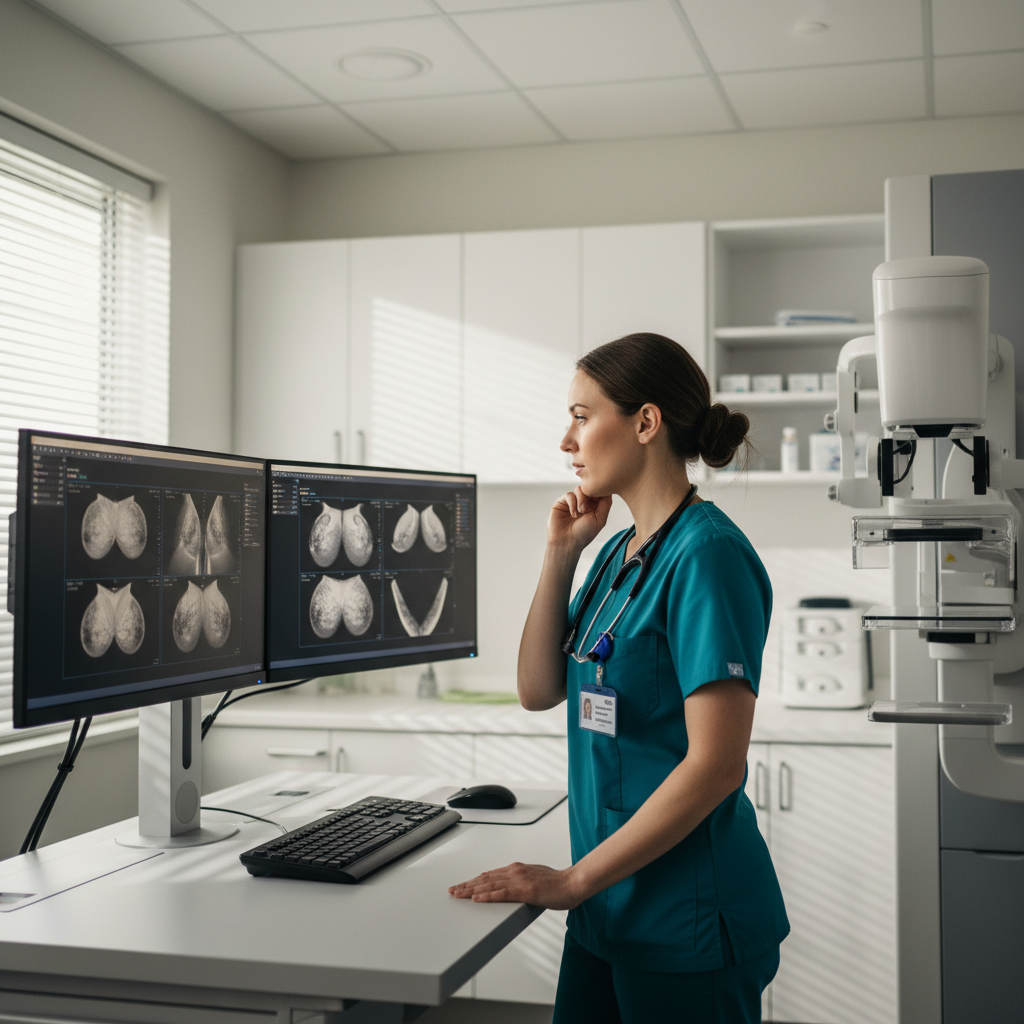
I remember the first time I saw something I didn’t want to see.
It was a Tuesday afternoon. The patient was kind, chatty, relaxed. She’d been coming in for routine screenings for years. We talked about her daughter’s college search while I positioned her for the CC view. She told me about weekend plans. I smiled and said the radiologist would review everything soon.
Then I looked at the images on my screen.
The Moment You Notice
There are findings you expect. Benign calcifications. Dense tissue. Things you’ve seen a hundred times that the radiologist will note and move on from.
And then there are the ones that make your stomach drop.
A new mass. An architectural distortion. A cluster that wasn’t there last year. Your eyes go back to it. You zoom in. You check the prior images again, hoping you’re wrong. But you’re not wrong. You’ve done this long enough to know.
In that moment, you carry something the patient doesn’t know yet. And you can’t say a word.
This is the part of the mammography tech story that doesn’t make it into the job description. The imaging emotional labor that lives in the space between what you see and what you’re allowed to communicate. The pause before the radiologist speaks — and the weight you hold during it.
What We’re Trained to Do (and Not Do)
Our scope is clear. We acquire the images. We ensure proper positioning, adequate compression, optimal technique. We follow protocol. We document. We do not interpret. We do not diagnose. We do not tell the patient what we think we see.
That boundary exists for good reason:
- Only radiologists are trained and credentialed to interpret diagnostic findings
- What looks suspicious may be benign; what looks benign may need follow-up
- Premature or incorrect information can cause unnecessary panic or false reassurance
- Liability and legal standards require clear lines of responsibility
- Patients deserve accurate, complete information from the physician who can answer their questions
So we stay quiet. We say, ‘The radiologist will review everything and your doctor will get the results.’ We keep our faces neutral. We maintain professional composure.
But inside, we’re human. And we feel it.
The Quiet Weight of Radiology Human Moments
She asked me if everything looked okay as she got dressed.
I gave her the answer I always give: ‘The radiologist will take a close look at everything, and your doctor will follow up with you about the results.’
She smiled. Said thank you. Walked out into the rest of her Tuesday.
I sat at my console and paged the radiologist. Marked the area for immediate review. Filled out the paperwork. My hands were steady. My documentation was thorough. I moved on to the next patient.
But a part of me stayed in that pause.
This is what makes mammography different from other imaging modalities. It’s screening. Most of the time, we’re delivering good news by proxy — normal studies, stable findings, see you next year. We’re part of the prevention story, the early detection story, the ‘we caught it in time’ story.
But we’re also there for the moment when the story shifts. When a routine appointment becomes a callback. When a year of normal becomes a biopsy. When everything changes, and we saw it first.
What Helps (When the Pause Gets Heavy)
Over the years, I’ve learned a few things about carrying this quietly:
Debrief with your team. Not about specific patient details, but about the emotional experience of the work. Your colleagues understand the pause. They’ve sat in it too. Naming it helps.
Trust the process. The system is designed the way it is for a reason. The radiologist will do their job. The patient will get accurate information. Your role is essential, and so are your boundaries.
Remember the good outcomes. Many suspicious findings turn out to be benign. Many early detections lead to successful treatment. You are part of a system that saves lives, even when individual moments feel heavy.
Give yourself permission to feel. You’re not a robot. You’re a skilled professional who cares about people. The fact that you feel the weight means you’re doing this work with your whole heart. That matters.
Why We Keep Showing Up
A few weeks later, I saw her name on the schedule again. Callback for additional views and possible ultrasound.
My heart sank. But I also knew: she was in the right hands. The system was working. Early detection is the whole point.
She came in scared this time. I couldn’t tell her it would be okay — I still didn’t know. But I could be calm, kind, and competent. I could position her carefully. I could make sure every image was perfect. I could be the steady presence in her uncertainty.
That’s the mammography tech story that doesn’t always get told. We live in the pause. We hold the space between suspicion and certainty. We see things first, and we carry them quietly, and we show up the next day and do it again.
Because somewhere in that pause, we’re also holding hope. Hope that we caught it early. Hope that the system works. Hope that our eyes, our technique, our care makes a difference in someone’s story.
It’s not easy. But it’s worth it. 🤍
You’re Not Alone in This Work
If you’re a mammography tech — or any imaging professional — navigating the emotional weight of this work, know that your feelings are valid. The pause is real. The quiet responsibility is real. And you don’t have to carry it alone.
At Intuites Healthcare Staffing, we work with imaging professionals every day who understand the human side of this work. Whether you’re looking for a new opportunity, exploring travel imaging roles, or just want to talk with a recruiter who gets it, we’re here. Reach out anytime at contact@intuites.healthcare or visit intuites.healthcare. We see you. ✨
#MammographyTech #ImagingLife #RadiologyCareers #HealthcareHeroes #MedicalImaging #DiagnosticImaging #MammogramResults #RadTechLife #WomenInHealthcare #HealthcareStories #ImagingProfessionals #RadiologyTech #EmotionalLabor #HealthcareStaffing #IntuitesCareers
Looking for a healthcare team that truly sees your value?
The Intuites Recruiting Team is here to listen, support your career, and connect you with roles across the USA — when you're ready.