
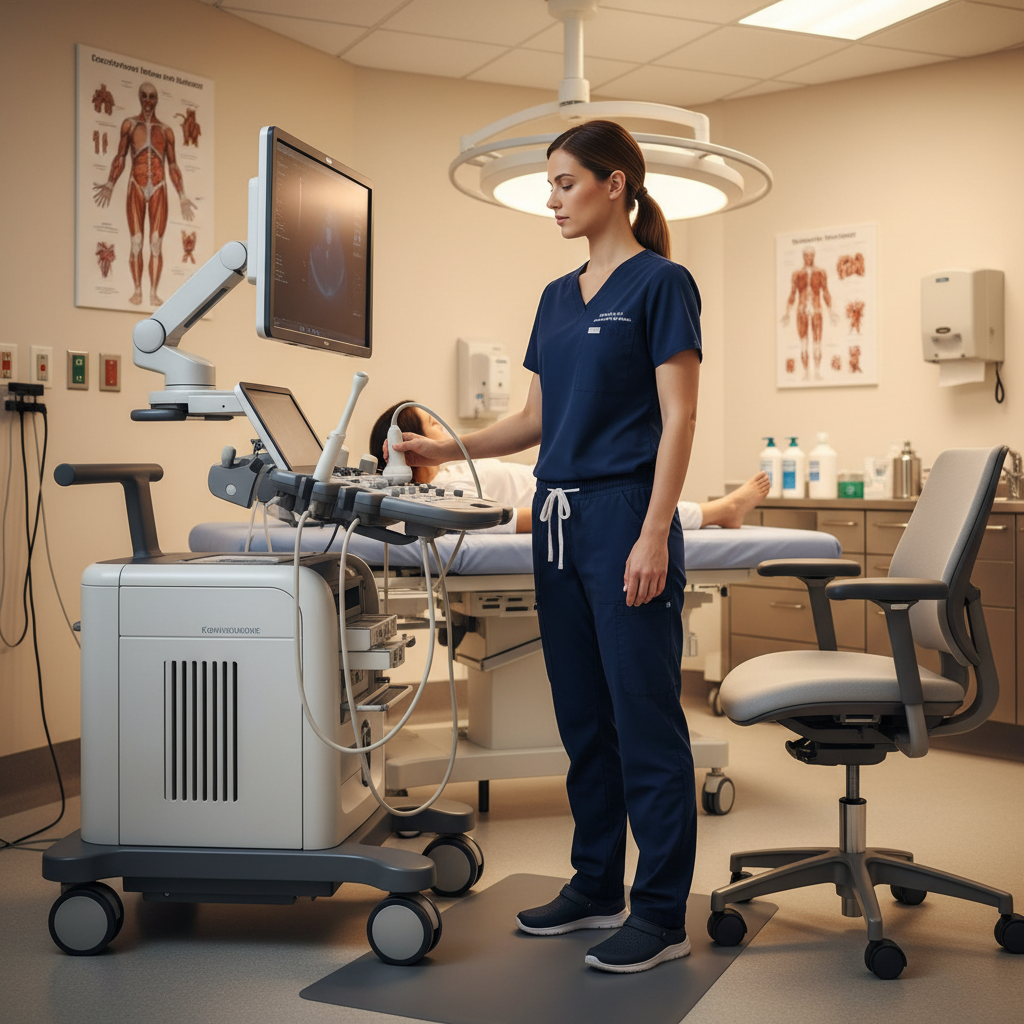
If you've been scanning for more than a few years, you already know the truth: shoulder pain isn't a badge of honor. Neither is wrist stiffness, neck tension, or that nagging ache between your shoulder blades at the end of a busy shift. Work-related musculoskeletal disorders — WRMSDs — affect up to 90% of sonographers at some point in their careers, according to industry research. But here's the good news: most of these injuries are preventable.
Building a consistent ergonomics routine isn't about working less or scanning slower. It's about working smarter, protecting the body that makes your career possible, and ensuring you can keep doing the work you love for decades to come. Let's walk through a practical, evidence-based approach to sonographer injury prevention that you can start using tomorrow.
Understanding WRMSD Risk in Ultrasound
The Society of Diagnostic Medical Sonography (SDMS) has been sounding the alarm on ergonomic injuries for years, and their standards provide the foundation for safer scanning practices. Unlike many healthcare roles, sonography demands sustained static postures, repetitive hand movements, and continuous application of pressure — often in awkward positions.
The most common injury sites for ultrasound techs include:
- Shoulder and rotator cuff (from abduction and reaching)
- Wrist and thumb (from gripping the transducer and applying pressure)
- Neck and upper back (from monitor positioning and head rotation)
- Lower back (from prolonged standing and patient transfers)
The cumulative nature of these injuries means that small ergonomic compromises today can become career-threatening conditions five or ten years down the line. That's why an intentional ergonomics routine matters — not just for comfort, but for career longevity.
Optimize Your Scanning Posture
Proper scanning posture starts before you even pick up the transducer. Your foundation is everything.
Neutral spine positioning: Whether you're standing or sitting, maintain the natural curves of your spine. Avoid twisting at the waist to reach the patient or monitor. If you need to adjust your angle, move your feet — not just your torso. Think of your spine as a stable column that moves as one unit.
Shoulder position: This is where most sonographers run into trouble. Your scanning arm should stay close to your body, with your elbow at or below 90 degrees. Abducting your shoulder (lifting your elbow away from your body) dramatically increases strain on the rotator cuff. If you find yourself reaching or lifting your elbow to get the right angle, adjust the patient position or bed height instead.
Wrist and hand mechanics: Hold the transducer with a relaxed grip — you shouldn't see white knuckles. Your wrist should remain in a neutral position, not bent or extended. When applying pressure, use your body weight and larger muscle groups rather than squeezing harder with your hand. The SDMS recommends varying your grip and hand position throughout the exam to distribute stress across different muscle groups.
The scanning-arm solution: Consider using your non-dominant hand for certain views or exams. Cross-training both arms not only reduces repetitive strain on your dominant side but also gives you flexibility when positioning becomes challenging.
Adjust Your Equipment (Every Single Time)
Your ultrasound machine isn't one-size-fits-all, and neither is your patient. Equipment adjustment is non-negotiable for injury prevention, yet it's often the first thing dropped when the schedule gets tight.
Bed height: Adjust the exam table so the patient's anatomy is at your elbow height when your arm is relaxed at your side. This varies depending on whether you're sitting or standing and which body part you're scanning. Yes, it takes an extra 15 seconds. Yes, it's worth it.
Monitor position: Your primary monitor should be directly in front of you at eye level, about an arm's length away. You shouldn't have to turn your head more than 30 degrees or tilt your neck up or down. If you're using multiple monitors, position the one you reference most frequently in the center.
Keyboard and controls: Keep frequently used controls within easy reach so you're not stretching or reaching across your body. Your keyboard should allow your elbows to rest comfortably at your sides.
Chair selection: If you scan while seated, use a chair with adjustable height, good lumbar support, and wheels that move easily. An adjustable backrest that supports your lower back in neutral position is essential. Some sonographers prefer saddle stools for certain exams, which can promote better pelvic positioning.
Build Micro-Breaks Into Your Workflow
You can't prevent WRMSD with perfect posture alone. Your body needs movement and recovery, even during busy shifts.
The 20-20-20 rule adapted: Every 20 minutes, take 20 seconds to change position, stretch, or reset your posture. This doesn't mean stopping an exam — it means consciously relaxing your shoulders, shaking out your hands, or adjusting your stance between images.
Between-patient resets: Use the transition time between patients to do quick stretches. Shoulder rolls, neck stretches, and wrist extensions take less than a minute but provide crucial recovery time. Some departments post stretch sequences in the scanning rooms as visual reminders.
Strategic scheduling: When possible, vary your exam types throughout the day. Alternate between sitting and standing exams, or between upper-body and lower-body studies. This distributes physical demands across different muscle groups.
The power of the pause: If you feel pain or strain during an exam, pause and adjust. Pushing through discomfort doesn't make you tougher — it makes you injured. Take a moment to reposition the patient, adjust your equipment, or switch hands.
Strengthen and Protect Off the Clock
Your ergonomics routine doesn't end when you clock out. What you do outside of work directly impacts your resilience during scanning.
Targeted strengthening: Focus on exercises that build rotator cuff strength, scapular stability, and core support. Resistance band exercises, yoga, and Pilates are particularly effective for sonographers. Even 10-15 minutes three times per week makes a measurable difference.
Flexibility work: Tight muscles are more prone to injury. Regular stretching — especially for your chest, shoulders, and hip flexors — helps maintain the range of motion you need for safe scanning positions.
Recovery practices: Ice after particularly demanding shifts, use foam rollers or massage tools for myofascial release, and prioritize sleep. Your body repairs itself during rest, and chronic sleep deprivation impairs tissue recovery.
Know when to seek help: Don't wait until pain becomes severe. Early intervention with occupational health, physical therapy, or sports medicine can prevent minor issues from becoming chronic conditions. Many facilities offer ergonomic assessments — take advantage of them.
Creating a Sustainable Career
Sonographer ergonomics isn't about perfection. It's about consistency, awareness, and making small adjustments that add up to a big difference over time. The scanning posture you practice today protects the career you want to have in 20 years.
Start with one change this week. Maybe it's adjusting your monitor height, or committing to shoulder rolls between patients, or finally using that adjustable stool that's been sitting in the corner. Build from there. Your future self — the one still scanning with strong shoulders and healthy wrists — will thank you.
If you're exploring new opportunities that prioritize clinician wellness and ergonomic support, the Intuites Recruiting Team would love to connect. We partner with facilities that invest in their imaging teams' long-term health. Reach out anytime at contact@intuites.healthcare or visit intuites.healthcare to learn more. ✨
#SonographerErgonomics #UltrasoundTech #WRMSDPrevention #ImagingCareers #ScanningPosture #SonographerHealth #DiagnosticImaging #HealthcareErgonomics #InjuryPrevention #RadiologyLife #UltrasoundCareers #MedicalImaging #HealthcareCareers #ImagingTech #SonographyLife
Looking for a healthcare team that truly sees your value?
The Intuites Recruiting Team is here to listen, support your career, and connect you with roles across the USA — when you're ready.