
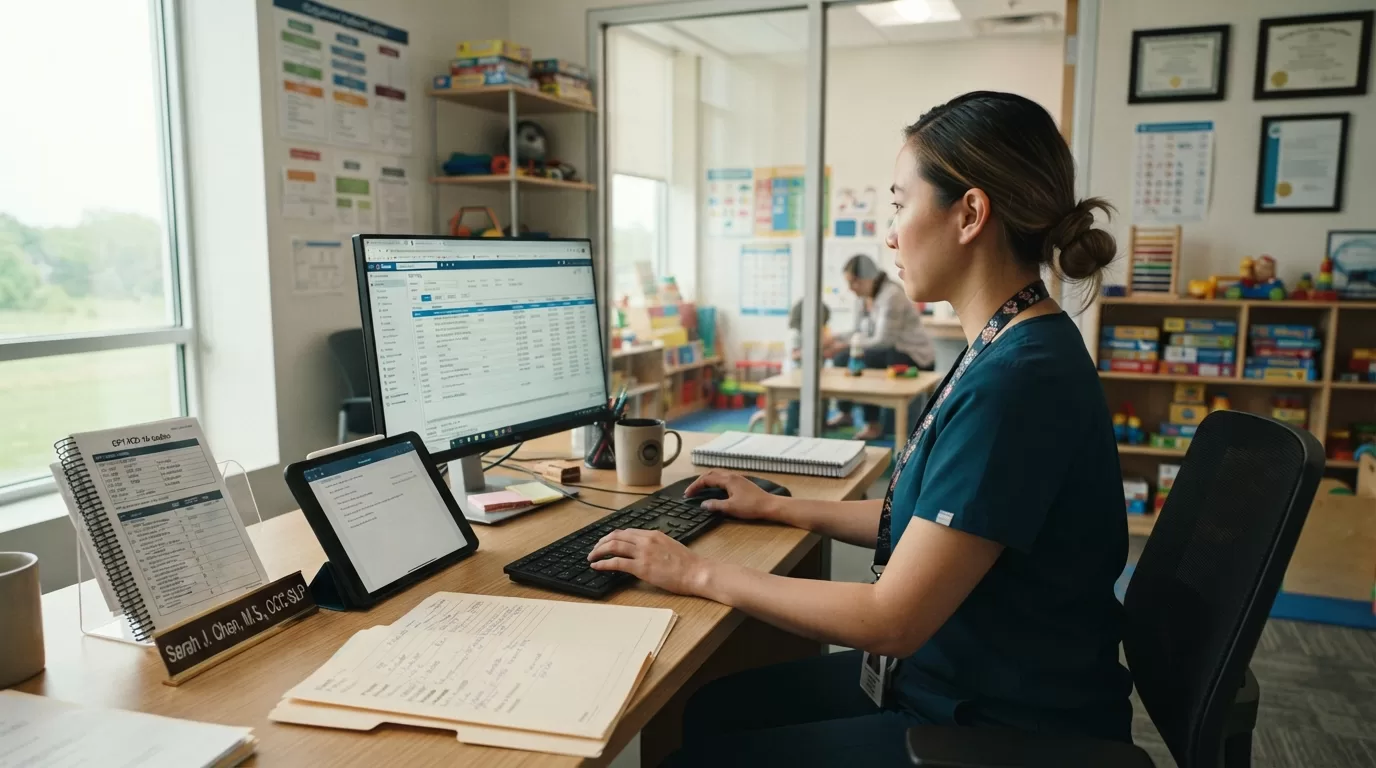
If you submitted a claim in early January 2026 using code 92507 for speech therapy treatment, you likely saw it denied within days. You are not alone. The American Speech-Language-Hearing Association estimates that more than 18,000 individual treatment claims were rejected in the first two weeks of the year because clinicians had not updated their billing software to reflect the CPT code changes that took effect January 1.
The 2026 CPT code revisions for speech-language pathology services represent the most significant billing update in nearly a decade. These changes affect how you document treatment time, how you report group versus individual sessions, and how you code certain evaluation procedures. Getting them right is not optional — payers are rejecting claims immediately when outdated codes appear, and resubmissions can delay your reimbursement by 30 to 45 days.
Here is exactly what changed, what you need to do differently, and how to avoid the most common denial triggers as an SLP working in hospitals, schools, skilled nursing facilities, or outpatient clinics across the United States.
The Big Code Swap: 92507 Is Now 92526
The most widespread change affects individual speech therapy treatment sessions. Code 92507, which SLPs have used for years to bill individual treatment regardless of time spent, was deleted effective December 31, 2025. In its place, the American Medical Association introduced code 92526 specifically for individual speech therapy services delivered face-to-face.
What makes this swap tricky is not just remembering the new number. Code 92526 comes with stricter documentation requirements than 92507 ever did. According to the Centers for Medicare & Medicaid Services 2026 Physician Fee Schedule final rule, you must now document the following elements for every session billed under 92526:
- Exact start and stop times for the treatment session
- Specific therapeutic techniques used during that session
- Measurable progress or regression observed
- Mode of delivery (in-person, synchronous telehealth, or hybrid)
- Medical necessity justification tied to the patient's current plan of care
Many SLPs have reported that their electronic health record systems were not updated in time, leaving templates that still auto-populate 92507. Double-check every claim before submission, even if your software vendor promised an update. One Missouri-based travel SLP discovered her facility's EHR had rolled out the update only to inpatient modules, leaving outpatient clinics using the deleted code until mid-February.
Time-Based Coding Now Required for Cognitive Services
Another major shift affects how you bill cognitive-linguistic therapy. Previously, you could report a cognitive therapy session as a single unit regardless of whether you worked with a patient for 20 minutes or 50 minutes. Starting in 2026, cognitive therapy services fall under time-based coding using 15-minute increments.
The new structure works like this: Code 92523 now represents cognitive-linguistic treatment in 15-minute units. If you provide 38 minutes of cognitive therapy, you bill two units of 92523 (because 38 minutes equals two full 15-minute increments, with the remaining 8 minutes falling below the threshold for a third unit). The eight-minute rule still applies — you need at least 8 minutes of direct treatment time to bill a single unit, and at least 23 minutes to bill two units.
This change creates new documentation pressure. You must track time precisely, and your clinical notes need to reflect what therapeutic activities occurred during each 15-minute segment. Payers are scrutinizing time documentation more closely in 2026, and vague entries like “cognitive therapy provided” will not survive an audit. Be specific: “15 minutes of memory strategy training using spaced retrieval technique; 15 minutes of attention tasks with visual scanning exercises.”
For SLPs who split sessions between cognitive work and another therapy type — say, 20 minutes of cognitive therapy followed by 25 minutes of articulation drills — you will bill 92523 for one unit (the 20-minute cognitive portion) and the appropriate code for the articulation work. Make sure your documentation clearly separates the two activities by time and therapeutic goal.
Group Therapy Reporting Gets a Modifier
Group therapy codes themselves did not change, but how you report them did. Effective January 1, 2026, any speech therapy service delivered in a group setting must include modifier 96 on the claim line.
Modifier 96 is not new to healthcare billing, but it is new to routine SLP claims. It tells the payer that the service was provided to two or more patients at the same time. Without it, the claim may process as if you delivered individual treatment, which can trigger overpayment flags during post-payment audits and result in recoupment demands months later.
The American Speech-Language-Hearing Association clarified in February 2026 guidance that “group” means any session where you are simultaneously treating two or more individuals, even if they are working on different goals. If you run a language therapy group for three stroke survivors in a skilled nursing facility, append modifier 96 to the group therapy CPT code on each patient's claim line. If your billing software does not automatically add the modifier, create a manual check in your workflow until the system is updated.
One important note: modifier 96 does not reduce your reimbursement rate for group services in most contracts, but it does make the group nature of the service transparent. Some Medicaid plans in states like Texas and Ohio have separate fee schedules for group versus individual therapy, so confirm your contracted rates before assuming payment will remain unchanged.
Telehealth Mode Documentation Is Now Mandatory
Telehealth billing for speech therapy became widely accepted during the public health emergency, and most payers continued coverage into 2026. However, the CPT code updates added a documentation requirement that catches many clinicians off guard: you must now explicitly state the mode of service delivery in your clinical note for any therapy session, whether in-person or virtual.
CMS's 2026 Physician Fee Schedule final rule specifies that the medical record must indicate if the service was delivered via synchronous audio-video telehealth, in-person at a clinic or facility, or in the patient's home. This is separate from the place-of-service code on your claim form. Your narrative note needs a clear sentence like, “Session conducted via HIPAA-compliant video platform with patient located at home,” or “In-person treatment provided in hospital room 412.”
The reason for this new standard is audit defense. Payers want to verify that telehealth services genuinely occurred via real-time video and met the clinical standards for direct patient interaction. Notes that omit mode of delivery are being targeted in random audits, and if the payer cannot confirm telehealth occurred, they may retroactively reclassify the claim and demand repayment at a lower rate or deny it entirely.
If your facility uses telehealth frequently, consider adding a required field in your documentation template so you cannot close a note without selecting in-person, telehealth, or hybrid. This small workflow change can prevent a costly audit finding six months down the road.
Evaluation Code Changes You Might Have Missed
While treatment code changes grabbed most of the attention, two evaluation codes also shifted. Code 92521, which covered evaluation of speech fluency, was replaced with a more detailed code set that separates initial evaluations from re-evaluations. If you work with patients who stutter or have fluency disorders, verify that your billing staff knows to use the new codes rather than the deleted 92521.
Similarly, code 92626 for evaluation of auditory rehabilitation status was retired. Services previously billed under 92626 should now be reported using 92633, but only when specific auditory processing or auditory rehabilitation evaluation procedures are performed. If you occasionally evaluate post-cochlear-implant patients or assess central auditory processing, confirm with your billing department that 92626 is no longer active and claims should route to 92633 instead.
These evaluation code changes are less common in day-to-day practice for many SLPs, but they matter if you work in a specialty clinic or a pediatric setting where fluency and auditory processing evaluations occur regularly. One overlooked code can delay an entire claim batch.
Action Steps to Protect Your Reimbursement
The best time to update your billing practices was December 2025. The second-best time is today. Here is what to do right now to avoid denials and audit trouble:
- Audit your last 20 claims to confirm no deleted codes (92507, 92521, 92626) were submitted after January 1, 2026.
- Update any paper superbills or charge-capture sheets you use to reflect the new codes.
- Add a template field for mode of delivery in your documentation system.
- Review your EHR's time-tracking functionality for cognitive therapy to ensure 15-minute increments are captured accurately.
- Confirm with your billing team or clearinghouse that modifier 96 is appending automatically to all group therapy claims.
- Schedule a quick check-in with your facility's compliance officer or coding specialist to verify you are aligned with their updated policies.
If you are a travel SLP moving between contracts, ask each new facility during onboarding whether their billing system has been updated for 2026 CPT changes. Do not assume. One week of incorrect coding can create a resubmission headache that follows you even after you have moved to your next assignment.
Why This Matters Beyond the Claim
Billing codes might feel like paperwork removed from patient care, but they directly affect your ability to keep working. Denied claims mean delayed pay for contract SLPs whose agencies process reimbursement on a per-visit basis. For facility-employed SLPs, repeated claim rejections can trigger performance reviews or scrutiny from administration, especially if your denial rate is higher than your colleagues who updated their practices in January.
More broadly, accurate coding protects the integrity of speech therapy as a reimbursable service. When payers see high denial rates or frequent audit flags in SLP claims, they may tighten coverage policies or reduce fee schedules in future contract negotiations. Clean claims with proper documentation make the case that speech-language pathology services are well-managed, medically necessary, and worth paying for.
The 2026 changes are here to stay. Take an hour this week to review your documentation habits, update your templates, and confirm your next set of claims reflects the current CPT structure. Your reimbursement timeline — and your peace of mind — will thank you. ✨
If you have questions about how these billing changes affect travel or contract SLP roles, or if you want to explore opportunities at facilities with strong coding support, email our team at contact@intuites.healthcare with “SLP billing 2026” in the subject line.
Sources
Ready for your next allied health assignment?
Browse open allied health jobs across the US — weekly pay, stipends, and a recruiter who reads every application.