
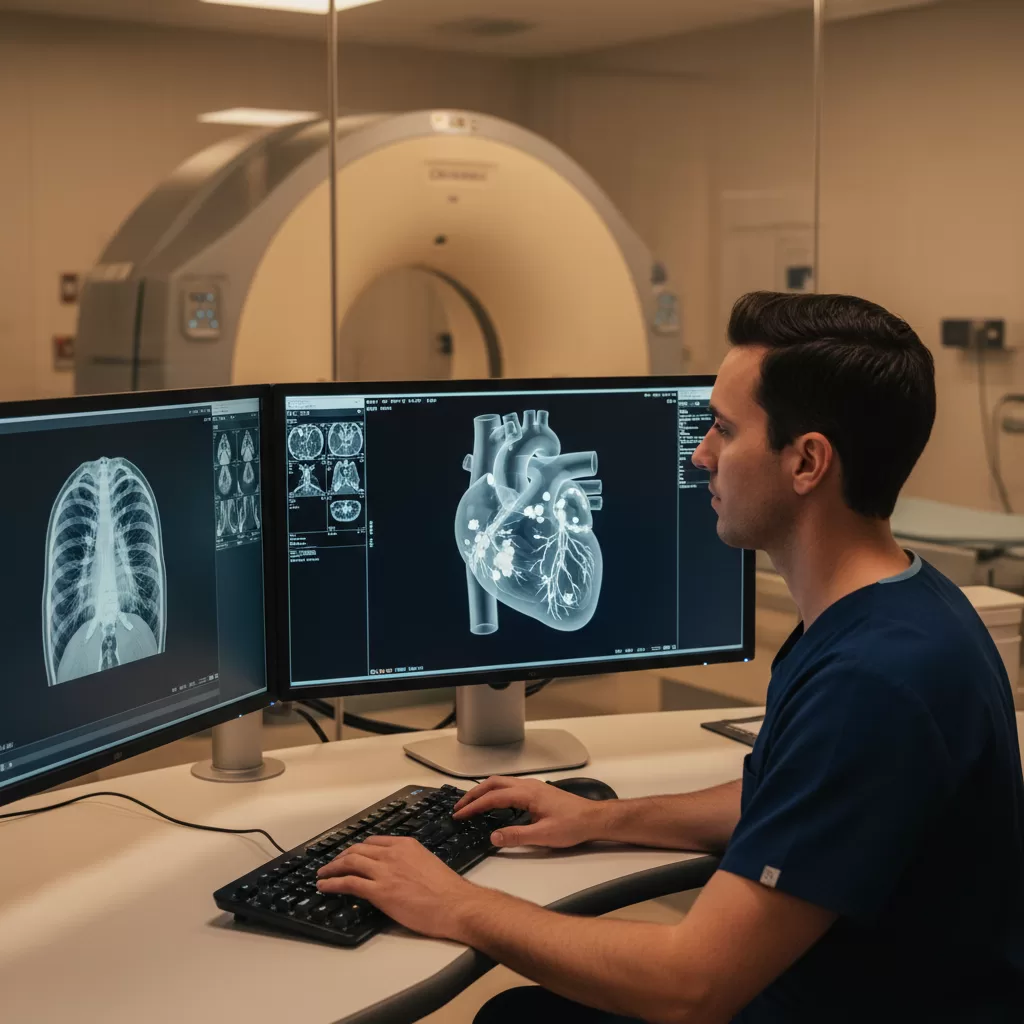
If you've been working as a general CT technologist for a year or more, you've probably noticed the steady stream of cardiac CT job postings — and the pay premiums attached to them. Coronary calcium scoring is no longer a niche subspecialty. It's become a core competency that can open doors to higher-paying contracts, more flexible scheduling, and roles in top-tier cardiovascular centers.
Adding cardiac CT scoring to your resume doesn't require going back to school full-time, but it does require intentional steps. Let's walk through exactly what it takes, what you'll learn, and how it impacts your earning potential and career trajectory in 2026.
Why Cardiac CT Scoring Matters Now
Coronary calcium scoring — a non-contrast CT scan that quantifies calcified plaque in the coronary arteries — has become a frontline tool for cardiovascular risk assessment. Cardiologists use the Agatston score to stratify patients and guide preventive treatment, and as awareness grows, so does scan volume.
For CT techs, that means opportunity. Facilities need technologists who can:
- Position patients correctly for cardiac-gated acquisitions
- Optimize protocols to minimize radiation dose while capturing diagnostic-quality images
- Recognize and troubleshoot motion artifacts, arrhythmias, and acquisition errors
- Communicate clearly with patients who may be anxious about heart health
Because cardiac CT requires precision and speed — scans are often completed in under 10 minutes, but the setup and patient education are critical — facilities are willing to pay a premium for techs who can do it well.
Prerequisites: What You Need Before You Start
Most cardiac CT training programs and employers expect you to have a solid foundation in general CT first. Here's the typical baseline:
- ARRT (CT) certification — This is non-negotiable. You need to be a registered CT technologist.
- At least one year of clinical CT experience — You should be comfortable with scanner operation, contrast protocols, and patient positioning across a range of body regions.
- Basic EKG knowledge — You don't need to interpret rhythms like a cardiologist, but you should understand heart rate, R-wave triggering, and how arrhythmias affect gating.
- Current BLS certification — Standard for any imaging role, but especially important in cardiac imaging where patients may have underlying cardiovascular disease.
If you're still in your first year post-registry, focus on building confidence with your scanner's full capability set, mastering dose optimization, and seeking out any cardiac cases that come through your department. Shadow a senior tech if your facility already performs cardiac studies.
Training Pathways: CE Courses and Advanced Certification
Once you meet the prerequisites, you have two main pathways to formalize your cardiac CT skills.
Structured Continuing Education
Several organizations offer focused CE courses in cardiac CT, ranging from 8 to 16 contact hours. These typically cover:
- Cardiac anatomy and coronary artery distribution
- EKG-gated acquisition techniques and retrospective vs. prospective gating
- Calcium scoring protocols (including the Agatston method)
- Dose reduction strategies specific to cardiac imaging
- Quality control and common artifacts
Look for courses accredited by the ARRT or ASRT. Many are available online, but hybrid programs that include hands-on scanner time are ideal if you can access them. Budget around $400–$800 for a comprehensive course.
ARRT Advanced Certification in Cardiac-Interventional Radiography
For techs who want to go deeper — and signal to employers that they're serious — the ARRT offers an advanced certification in Cardiac-Interventional Radiography. This credential requires 16 Category A CE credits specifically in cardiac or vascular imaging, plus passing a 150-question exam.
The exam covers cardiac anatomy, physiology, pathology, imaging procedures (including calcium scoring, CT angiography, and interventional cath lab work), patient care, and radiation safety. It's a broader scope than calcium scoring alone, but earning it makes you competitive for a wider range of cardiac imaging roles, including hybrid OR and cath lab positions.
The application fee is $200, and the exam itself is $200. Many techs spread their CE credits over 12–18 months while working, then sit for the exam once they feel prepared.
What the Pay Bump Looks Like
Let's talk numbers. Adding cardiac CT scoring to your skill set typically translates to a $3–$7 per hour increase over base CT tech pay, depending on geography and facility type.
In 2026, general staff CT techs in mid-sized markets earn roughly $32–$42/hour. Cardiac CT techs in the same markets often see $38–$48/hour, with premiums climbing higher in metropolitan areas or facilities with high cardiac case volumes.
Travel and per diem contracts show even more dramatic differences. A 13-week travel CT assignment might offer $2,200–$2,500/week taxable + housing stipend. A cardiac CT travel role in the same region often starts at $2,600–$3,000/week taxable, plus the same stipend. Over a year of travel contracts, that difference can mean an additional $20,000–$30,000 in gross income.
Beyond base pay, cardiac CT roles frequently include:
- Call and weekend differentials — Cardiac emergencies don't wait for business hours, and facilities pay accordingly.
- Shift flexibility — Many cardiac CT programs run extended hours or offer early/late shifts to accommodate outpatient scheduling, which can align better with your life outside work.
- Professional development budgets — Hospitals investing in cardiac imaging often support continuing education, conference attendance, and additional certifications.
Building Experience: Where to Start
If your current facility doesn't perform cardiac CT, you have a few options to gain hands-on experience:
Cross-train within your health system. If your hospital has a dedicated cardiac imaging center or a sister facility that does, ask about a rotation or temporary assignment. Even a few weeks of supervised scanning builds real competency.
Seek out a per diem role. Many imaging centers that specialize in preventive cardiology hire per diem techs specifically for calcium scoring shifts. These are often weekend or evening slots, which you can pick up alongside your full-time job while you're building skills.
Take a short-term travel contract. Some agencies place CT techs in cardiac-focused roles for 8- or 13-week assignments. This is a faster way to immerse yourself in the workflow, and the pay usually offsets any learning curve.
Once you have 50–100 cardiac CT scans under your belt, you'll feel confident discussing your experience in interviews and negotiating for cardiac-specific contracts.
What Comes After Calcium Scoring
Coronary calcium scoring is often the entry point into a broader cardiac CT career. Once you're comfortable with scoring, the natural next step is coronary CT angiography (CCTA), which uses contrast and requires even more precise timing and technique.
CCTA opens the door to roles in comprehensive cardiovascular imaging centers, where you might also cross-train in cardiac MRI, nuclear cardiology, or even hybrid cath lab procedures. These multidisciplinary roles command the highest pay and offer the most career stability, because you become difficult to replace.
But you don't have to pursue every subspecialty. Many techs find that cardiac CT scoring alone — combined with general CT competency — gives them exactly the career mobility and income boost they were looking for, without the pressure of on-call cath lab work.
If you're ready to explore travel or per diem contracts that value cardiac CT skills, or if you have specific questions about building this competency in your region, reach out to our team at contact@intuites.healthcare — we work with imaging departments across the country and can point you toward the right next step for your timeline and goals.
Ready for your next imaging assignment?
Browse open imaging jobs across the US — weekly pay, stipends, and a recruiter who reads every application.