
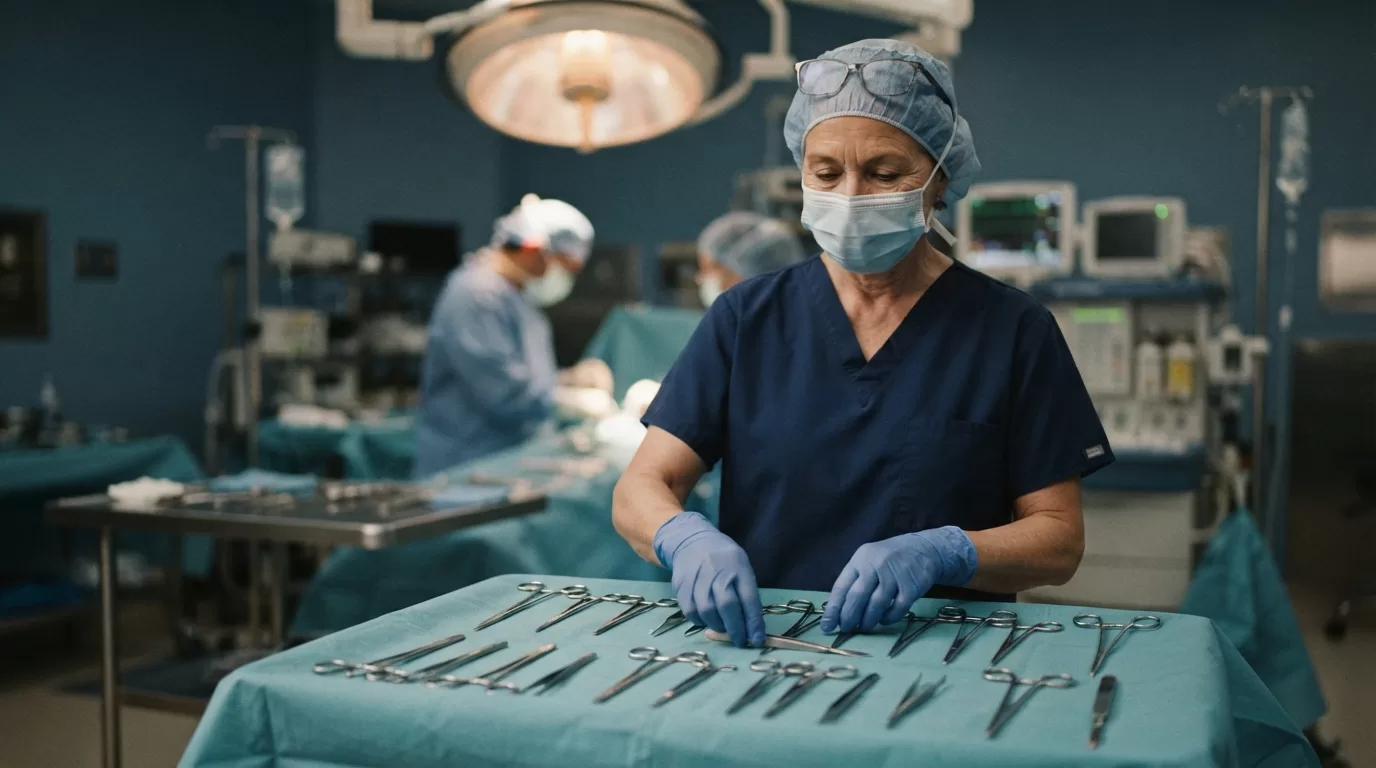
You remember your first case like most people remember their wedding day. The nerves. The scrub sink ritual you practiced at home in your kitchen. The moment the surgeon asked for a knife and your hand moved—muscle memory you didn't think you had yet—and placed it perfectly in their palm.
You remember your hundredth case because you celebrated it. Your five hundredth because your preceptor told you that's when it clicks. Your thousandth because the whole OR team brought cupcakes.
But somewhere between case 9,847 and case 10,213, you stopped counting altogether. Not because the work stopped mattering. Because you finally understood what a surgical tech career actually is.
The Math Nobody Warns You About
The Bureau of Labor Statistics tracks salary data and job growth projections for surgical technologists—they predict 6% growth through 2031, faster than average for all occupations. But the BLS doesn't measure the thing that defines OR veterans: volume.
A full-time surgical tech averaging four cases per day, five days per week, works roughly 1,000 cases per year. Factor in call shifts, add-ons, and trauma activations, and that number climbs. Do the math over a 20-year career, and 10,000 becomes conservative. Some ortho and general surgery techs hit 15,000. Cardiovascular specialists working open-heart programs can reach 12,000 to 14,000 pump cases alone.
The invisible mastery lives in those numbers. After your first 500 laparoscopic cholecystectomies, you stop thinking about trocar placement. After 1,000 total knees, your hands know the difference between a size 3 and size 4 femoral component by weight. After 3,000 C-sections, you can read a obstetrician's body language and have the next suture loaded before they finish the previous layer.
You don't count anymore because the counting was never the point. The point was becoming someone the team doesn't have to explain things to twice.
What 10,000 Cases Teaches You
There's a moment—it happens differently for everyone, but it happens—when you realize you've stopped performing the job and started inhabiting it. The work becomes less about the checklist and more about the rhythm.
Here's what two decades in the OR actually teaches:
- Surgeons have bad days, and your ability to anticipate their next three moves matters more on those days than on the smooth ones
- The scrub tech who stays calm during a bleeder is worth five techs who panic when the suction clogs
- Preference cards are guidelines; real preference is watching how a surgeon holds their hand when they want something they haven't asked for yet
- New grads will ask you questions that sound basic, and how you answer them determines whether they stay in the field or burn out by year two
- The surgeon will get the credit, the nurse will get the recognition, and you will get the quiet knowledge that the case ran perfectly because you made it invisible
That last one takes the longest to accept. Recognition in surgical tech work is scarce. The Joint Commission's standards for surgical services mention the role exactly twice in their 200-page manual—once in staffing ratios, once in sterile processing workflow. You're essential and overlooked in the same breath.
But OR veterans know something the outside world doesn't: the pride isn't in the applause. It's in the suite running so smoothly that nobody has to think about why.
The Cases That Stay With You
After 10,000, you'd think they'd blur together. Mostly, they do. But certain cases etch themselves into your muscle memory in ways that have nothing to do with the procedure.
You remember the first time a surgeon let you close skin. You remember the trauma activation on Christmas Eve when the attending said “thank God you're here” and meant it. You remember the day you trained the new grad who's now the lead tech on your service line. You remember the case where everything went wrong—the equipment failure, the delayed pathology, the conversation you weren't supposed to hear—and you stayed an extra two hours to make sure the next case had everything it needed.
You remember the patient who wrote a thank-you card to “the kind person in the blue scrubs who held my hand before I went to sleep.” They didn't know your name. They didn't know you'd been doing this for 18 years. But they remembered you made them feel safe.
Those are the cases you count. The ones that remind you why you walked into an OR in the first place.
What Career Longevity Actually Looks Like
The BLS reports the median surgical tech salary at around $53,000 annually, but that figure doesn't capture the full picture of a 20-year career. OR veterans in high-acuity specialty programs—cardiac, neuro, trauma—often earn $65,000 to $80,000 with differentials, call pay, and certification premiums. Travel surgical techs with specialized skills can command $2,000 to $2,800 per week on 13-week contracts.
But money isn't what keeps people in the field for two decades. Longevity in surgical tech work comes from something harder to quantify: finding your fit.
Some techs thrive in the controlled chaos of Level I trauma centers, where no two days look alike. Others find their rhythm in orthopedics, where the cases are predictable and the instruments are heavy and the surgeons want the same setup every single time. Cardiovascular techs talk about the intensity of open-heart cases the way some people talk about mountain climbing. Ophthalmic surgical techs describe the precision of micro-instruments with a jeweler's reverence.
Career longevity peaks when you stop trying to prove you can do everything and start leaning into what you're genuinely good at. The 20-year veterans aren't the ones who can scrub every service. They're the ones who became indispensable in their corner of the OR—and then stayed long enough to teach the next generation how to own theirs.
The Quiet Pride You Don't Talk About
Nobody throws a party for your 10,000th case. There's no certificate, no bonus, no hospital-wide email. You finish the case, break down the field, restock your cart, and move to the next suite. The work continues because the work always continues.
But somewhere in the locker room, pulling off your scrubs at the end of a 12-hour shift, you catch yourself in the mirror. Your back aches. Your feet are numb. You've got that groove in your forehead from 10 hours under a bouffant cap. And you think: I'm good at this.
Not “good” in the way people mean when they're being polite. Good in the way that matters. Good in the way that means three surgeons specifically request you for their complex cases. Good in the way that means the new orientee shadows you because the educator knows you'll teach them right. Good in the way that means you can walk into any OR in your facility and know where everything is, who to call, and how to fix it before it becomes a problem.
That's the pride surgical tech reflections always come back to. Not the glory. Not the recognition. The simple, unshakable knowledge that you showed up, you stayed sharp, and you made a difference in a way most people will never see.
What Comes After 10,000
Some OR veterans stay at the table for another decade. Others transition into education, teaching the next cohort of surgical tech students at community colleges or hospital-based programs. A handful move into sterile processing leadership, instrument sales, or OR management roles where their floor experience becomes institutional knowledge.
But many stay exactly where they are—scrubbed in, hands steady, doing the work they've always done. Because after 10,000 cases, you finally understand the thing nobody tells you in school: this was never about building a resume. It was about building a craft.
The cases stop feeling like a count and start feeling like a conversation. You and the surgeon. You and the instruments. You and the 18-year-old version of yourself who walked into an OR for the first time and thought, Maybe I can do this.
You did. You're still doing it. And somewhere around case 10,001, you stopped needing anyone to tell you that mattered. ✨
If you're a surgical tech looking for your next role—whether it's your 50th case or your 5,000th—email contact@intuites.healthcare with your specialty and the OR environment where you do your best work, and we'll help you find the assignment that fits.
Sources
Ready for your next allied health assignment?
Browse open allied health jobs across the US — weekly pay, stipends, and a recruiter who reads every application.