You have heard the buzz. AI is coming for radiology. AI will replace radiologists. AI will make imaging techs obsolete.
Here is what is actually happening in October 2026: AI tools are running in the background of your PACS right now, and instead of replacing you, they are changing what your day looks like. Not in five years. This month.
If you are a diagnostic imaging tech — CT, MRI, X-ray, ultrasound, mammography, nuclear med — your role is expanding, not shrinking. But the workflow is different, the protocols have new steps, and the techs getting premium travel contracts are the ones who know how to work alongside these tools. Let us walk through what is real, what is hype, and where you fit in the imaging AI story of 2026.
What AI Radiology Tools Actually Do in Your Workflow
The Food and Drug Administration’s database lists 692 cleared AI and machine learning devices for radiology and imaging as of October 2026, according to the FDA’s publicly available AI/ML-enabled medical device list. Most of them do not read images the way a radiologist does. They do narrow, repeatable tasks.
The most common AI tools in diagnostic imaging right now include:
- Auto-segmentation and measurement tools for tumor tracking, stroke volume calculation, and cardiac function analysis
- Image quality checks that flag motion artifacts, incomplete anatomy coverage, or technical errors before the scan leaves your department
- Triage and worklist prioritization systems that move suspected PE, intracranial hemorrhage, or pneumothorax cases to the top of the radiologist’s queue
- Protocol selection assistants that recommend scan parameters based on patient history and ordering indication
- Dose optimization algorithms that adjust technique factors in real time
Notice what is missing from that list: “replaces the radiologist.” The AI is not writing reports. It is preprocessing, flagging, measuring, and organizing. And someone has to manage that workflow. That someone is you.
Your New Responsibilities as Imaging AI Goes Live
In 2024, most radiology techs ran the scanner and sent images to PACS. In 2026, your scope includes quality-checking what the AI produces.
A survey of 340 imaging centers by the American College of Radiology found that 64 percent now assign technologists to review AI preprocessing outputs before images reach the radiologist. That means you are checking segmentation boundaries, confirming the AI identified the correct anatomy, and re-running studies when the algorithm fails.
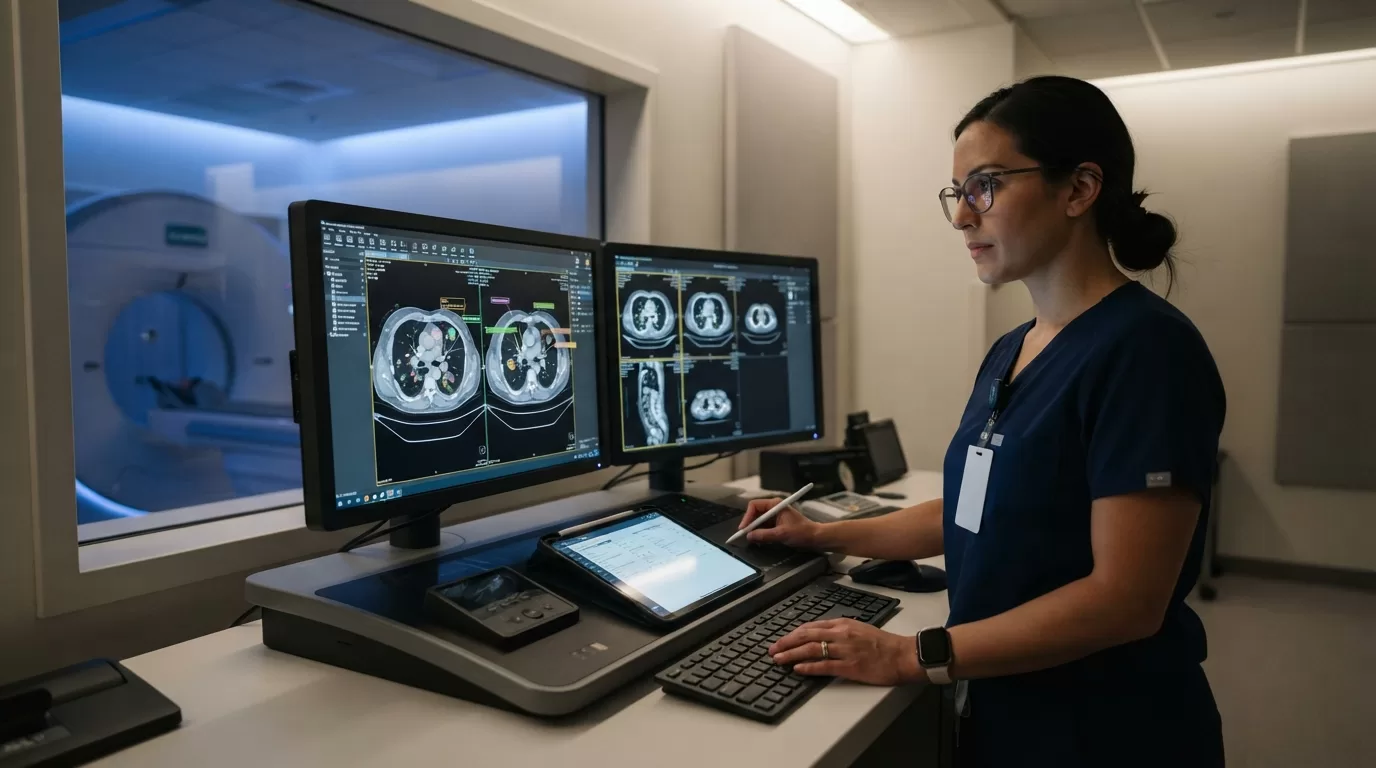
Here is what that looks like on a Tuesday morning in CT. You scan a pulmonary embolism rule-out. The AI tool auto-segments the pulmonary arteries and flags a possible filling defect in the right lower lobe. Before the study goes to the reading radiologist, you verify the segmentation captured all relevant vessels, check that the contrast bolus timing was adequate for the AI analysis, and document in the tech notes that AI preprocessing was applied. If the segmentation missed a vessel or the contrast timing was off, you re-run the sequence or flag the study for manual review.
Some states have updated their radiology tech scope-of-practice rules to explicitly include AI quality assurance. California, Texas, and New York amended their licensing board regulations in 2025 to add “verification of artificial intelligence preprocessing outputs” to the list of duties a licensed rad tech may perform under a radiologist’s supervision. Other states are following. If you hold a multi-state ARRT credential and travel across state lines, check your destination state’s board rules — scope varies.
Protocol Tweaks You Need to Know
AI tools work best when you feed them consistent inputs. That has driven protocol standardization across health systems faster than any accreditation mandate ever did.
If your facility uses an AI lung nodule detection tool, your chest CT protocol now probably specifies exact slice thickness, reconstruction kernel, and window settings — because the algorithm was trained on those parameters. Deviate, and the AI might miss a nodule or throw false positives. Same story in mammography with CAD systems, cardiac CT with automated calcium scoring, and neuro MRI with lesion tracking tools.
Travelers see this when they move between contracts. One hospital’s stroke protocol uses a specific MRI sequence order because their AI perfusion analysis tool requires it. Another facility’s pneumonia chest X-ray workflow includes a mandatory second image at a different angle to improve AI sensitivity. These are not suggestions. They are now part of the protocol, and skipping steps breaks the AI chain.
The Training Gap and Why It Matters for Your Next Contract
Most diagnostic imaging programs graduated techs in the past five years without a single lecture on AI workflow integration. The technology moved faster than the curriculum.
Facilities know this. They are writing training requirements into job descriptions and paying premiums for techs who already know the systems. A 13-week CT travel contract in Phoenix that requires experience with a specific AI triage platform might pay eight to twelve percent more than the same role without the AI requirement, based on October 2026 rate data from multi-specialty staffing firms operating in the Southwest market.
If you want those rates, you need hands-on experience, not just a webinar certificate. Here is how to build it:
- Ask your current facility if you can shadow the lead tech during AI quality-check workflows, even if it is not your assigned duty yet
- Take the free online modules offered by your PACS vendor — most now include AI preprocessing training specific to their platform
- Volunteer for any pilot programs or new AI tool rollouts at your site; early adopters get the deepest training
- Join the ARRT’s continuing education courses on AI in medical imaging — these count toward your credential renewal and add resume weight
Document every AI system you have used by name and vendor. “Experience with AI tools” means nothing on a resume. “Proficient in Aidoc triage platform for CT stroke protocol and RapidAI NCCT workflow” gets you the interview.
Radiologist Shortages and the Tech Opportunity
The U.S. Bureau of Labor Statistics projects a need for 2,400 additional radiologists by 2032 to meet imaging demand, but radiology residency slots are not growing fast enough to fill the gap. Meanwhile, imaging volumes keep climbing — up 4.1 percent year-over-year for outpatient advanced imaging in the first half of 2026, according to the latest Medicare Part B claims data published by the Centers for Medicare & Medicaid Services.
AI is not solving the radiologist shortage. It is buying time by making existing radiologists more efficient. And it is creating space for techs to take on higher-level responsibilities that were once reserved for physicians.
Some academic medical centers are piloting “advanced practice imaging technologist” roles where experienced techs handle protocol optimization, AI output verification, and preliminary image quality consultations with ordering providers — all under radiologist supervision, but with more autonomy than traditional tech roles. These positions pay closer to what you would see in a lead or supervisor role, but without the administrative headaches.
Travelers are not seeing those titles widely yet in 2026, but the contract descriptions are shifting. Look for language like “AI workflow coordinator,” “imaging informatics tech,” or “quality assurance specialist — AI systems.” Those are the roles where your diagnostic skills and tech expertise combine into something hospitals will pay more to fill.
What About Job Security?
The question every imaging tech asks: will AI eventually do my job?
No credible workforce forecast says that. The BLS projects 6 percent employment growth for radiologic and MRI technologists from 2022 to 2032, which is faster than the average for all occupations. The bureau explicitly notes that while AI will assist in image analysis, “technologists will still be needed to operate imaging equipment and ensure image quality.”
What is changing is not whether the job exists — it is what the job includes. In 2016, you positioned the patient, ran the scan, and moved on. In 2026, you also verify the AI did its preprocessing correctly, troubleshoot when it fails, and adjust protocols to keep the algorithms fed with clean data. That is a different skill set, and it is a more valuable one.
The techs who will struggle are the ones who refuse to learn the new tools. The ones who thrive will be the techs who see AI as an extension of the scanner — another piece of equipment you need to understand, maintain, and use effectively. Hospitals are not replacing you with software. They are asking you to manage the software.
Travel Contracts and Market Demand in the AI Era
Diagnostic imaging travelers are seeing strong demand in October 2026, and AI adoption is part of the story. Facilities rolling out new AI platforms need experienced techs who can hit the ground running, learn the system fast, and train the permanent staff.
High-demand markets right now include the Sun Belt states — Texas, Arizona, Florida, Nevada — where population growth is driving imaging center expansions and new hospital construction. These facilities are installing AI-enabled PACS from day one, and they need travelers to staff the departments while they recruit permanent hires.
CT and MRI techs with AI workflow experience are particularly sought after for contracts in large metro systems where imaging volumes are high and turnaround time expectations are tight. A busy Level I trauma center in Dallas or Phoenix is running its stroke protocol AI triage 24/7, and if the tool flags a bleed at three in the morning, someone needs to verify that finding and get the images to the on-call radiologist immediately. Travelers fill those gaps.
Rates are holding steady or edging up in most imaging specialties. Mammography and interventional radiology see the tightest supply, but CT and MRI are close behind. If you are credentialed in multiple modalities and you can document AI system experience, you have leverage to negotiate.
One caution: some contracts now include mandatory AI platform training as part of orientation, and that training might not be paid separately. Read your contract. If the facility requires 16 hours of vendor-led AI onboarding before you touch a patient, clarify whether those hours count as paid orientation or unpaid preparation.
Where This Goes Next
Imaging AI in 2026 is early innings. The tools are useful but narrow. They flag, measure, and organize. They do not diagnose, and they do not replace clinical judgment.
Over the next two to three years, expect AI to move deeper into workflow automation — auto-populating reports with measurements, suggesting follow-up protocols, and integrating with EHR systems to pull patient history automatically. Techs will spend less time on repetitive documentation and more time on complex problem-solving when scans do not go as planned.
The role is not disappearing. It is professionalizing. And if you are willing to learn the new tools, document your experience, and seek out the contracts that value those skills, you are positioning yourself in the strongest part of the imaging labor market.
If you are ready to explore travel contracts in diagnostic imaging — especially CT, MRI, or mammography roles where AI workflow experience is valued — reach out to our imaging placement team at contact@intuites.healthcare with your current credentials and the modalities you are interested in. We will walk you through what is available and what the AI requirements actually mean before you commit to a contract.
Sources
Ready for your next imaging assignment?
Browse open imaging jobs across the US — weekly pay, stipends, and a recruiter who reads every application.