
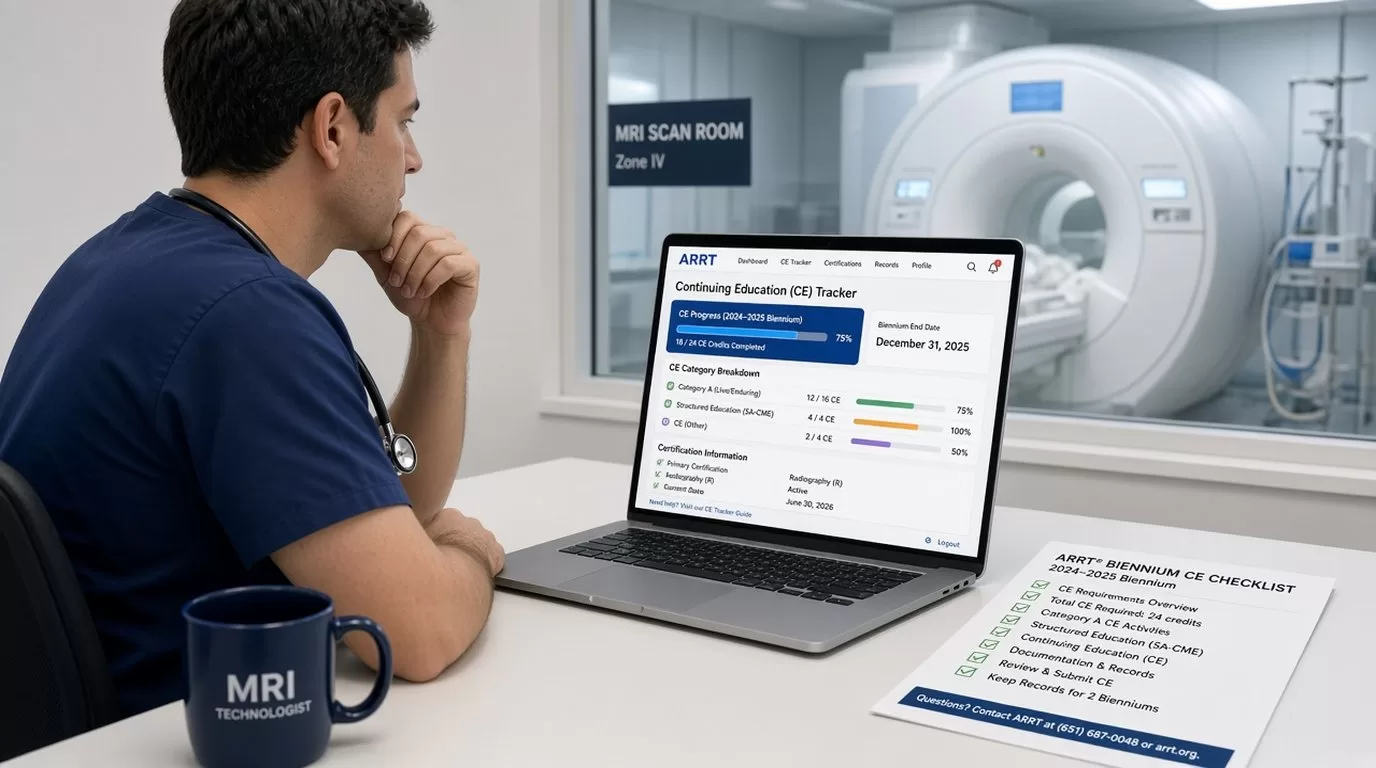
If you hold CT or MRI credentials from the American Registry of Radiologic Technologists, you already know that your biennium clock is ticking. But if you are still treating the Structured Self-Assessment as a box to check in December of year two, you are risking more than a scramble — you are risking a lapse that shows up on verification requests from hospitals and travel agencies.
The ARRT introduced the SSA requirement to raise the bar on professional development, and for good reason. CT and MRI modalities evolve fast: iterative reconstruction algorithms, contrast protocols, and safety screening workflows change year over year. The SSA is designed to expose knowledge gaps before they become patient-safety issues. But the requirement also trips up techs who wait too long, choose the wrong category, or assume a general radiology SSA will satisfy a CT or MRI credential.
This guide walks you through the mechanics of ARRT structured self assessment planning, the category pitfalls that catch even experienced techs, and the verification steps that keep your profile clean for credentialing. Whether your biennium ends in 2026 or you are planning ahead for 2027, these steps apply.
Understanding the ARRT Structured Self-Assessment Requirement
Starting January 1, 2016, the ARRT mandated that every registered technologist complete at least one Structured Self-Assessment during each two-year biennium. That SSA counts as one continuing education credit toward your total 24 CE credits. The other 23 can come from traditional courses, but the SSA is non-negotiable.
Here is what makes an SSA different from a standard CE course. Instead of passively watching a lecture or reading a PDF, you answer a series of clinical-scenario questions drawn from your modality's content specifications. After each question, the SSA delivers immediate feedback: why the correct answer is correct, why the distractors are wrong, and which section of the ARRT exam blueprint that topic maps to. You can pause, review references, and return later — there is no pass-fail grade, and you can repeat questions. The goal is formative learning, not summative testing.
According to the ARRT's public CE requirements page, the SSA must cover a credential you currently hold. If you are registered in both CT and MRI, you can choose either modality for your SSA in a given biennium — but you cannot substitute a Radiography SSA and call it done. The ARRT's system flags mismatches, and compliance staff catch them during random audits.
Why the SSA Exists
The ARRT rolled out the SSA after feedback from program directors and clinical managers who saw knowledge drift among techs who had been out of school for a decade or more. MRI safety screening protocols, for example, changed significantly after high-profile projectile incidents, and some techs never updated their workflows. The SSA keeps foundational knowledge fresh and gives you a roadmap for additional study if you score poorly in a content area.
Mapping Your 2026 Biennium Timeline
Your ARRT biennium starts on your birthday in year one and ends on your birthday in year two. If you were born in March, your current biennium might run March 2025 to March 2027. The ARRT requires you to complete all 24 CE credits — including the SSA — by the last day of your birth month in year two. Miss that deadline, and your registration goes into a suspended status.
Here is the timeline mistake that costs techs the most: waiting until November or December of year two to start the SSA. The ARRT system can experience high traffic near year-end, and technical glitches (login issues, payment processing delays, or course-access errors) can eat up the days you thought you had as buffer. Worse, if you discover mid-SSA that you chose the wrong category, you lose the time spent and have to start over.
Best practice: complete your ARRT structured self assessment no later than six months before your biennium close date. That gives you time to address any compliance issues, gather documentation for an audit, or retake an SSA if the first attempt revealed major knowledge gaps you want to shore up with targeted CE courses.
Example Timeline for a March Birth Month
- March 2025: Biennium begins. Log in to your ARRT account and confirm your current credentials and CE balance.
- September 2025 to March 2026: Complete 12 to 18 CE credits from traditional courses in CT or MRI topics (protocols, safety, contrast, artifacts).
- April to August 2026: Purchase and complete your CT or MRI SSA. Review the feedback report and identify weak areas.
- September 2026 to February 2027: Finish remaining CE credits, targeting the content areas flagged by the SSA.
- March 2027: Verify in your ARRT dashboard that all 24 credits (including the SSA) are posted and your compliance status is green.
This staggered approach also spreads out your CE budget and prevents the burnout that comes from cramming 24 credits in two months.
Choosing the Right SSA Category for CT and MRI Techs
The ARRT offers separate SSAs for each primary and post-primary credential. If you hold CT, you must complete a CT SSA. If you hold MRI, you must complete an MRI SSA. If you hold both, you choose one per biennium — but many techs prefer alternating (CT in one biennium, MRI in the next) to keep both skill sets sharp.
Here are the category pitfalls that generate the most compliance headaches:
Pitfall One: Substituting a Radiography SSA
Even if you started your career as a radiographer and added CT or MRI later, a Radiography SSA will not satisfy the requirement if CT or MRI is the credential you want to maintain. The ARRT's audit system cross-references the SSA category with your active registrations. If you submit a Radiography SSA but your employer verification request shows only CT on file, the mismatch triggers a compliance review.
Pitfall Two: Assuming “General” SSAs Count
Some CE providers market courses as “imaging SSAs” or “radiology professional development.” Unless the course is explicitly listed in the ARRT's Recognized Continuing Education Evaluation Mechanism (RCEEM) database as a Structured Self-Assessment for CT or MRI, it will not satisfy the requirement. Always verify the RCEEM number before purchasing.
Pitfall Three: Mixing Modalities in One Biennium
You can hold multiple credentials, but each biennium's 24 CE credits (including the SSA) should align with the credential you use most. If you work primarily in CT but complete an MRI SSA, you are technically compliant — but you miss the chance to refresh the knowledge base you use every shift. Some techs split their 24 credits evenly (12 CT, 12 MRI), which is fine, but the SSA should match your primary practice area for maximum clinical value.
How to Complete the SSA and Interpret the Feedback Report
Once you purchase an ARRT-approved SSA from a recognized provider (the ARRT itself offers them directly, as do several RCEEM-approved vendors), you will receive login credentials and access to the question bank. Most CT and MRI SSAs contain 60 to 100 questions divided into content categories that mirror the ARRT exam blueprint: patient care, safety, imaging procedures, and protocol optimization.
Plan to spend two to four hours on the SSA, though you can pause and resume. The system saves your progress. After you submit your final answers, the platform generates a feedback report that breaks down your performance by content category. If you scored 70 percent in MRI safety screening but 90 percent in sequence selection, you know where to focus your remaining CE credits.
Here is how to use that report strategically. First, download and save a PDF copy — the ARRT may request documentation during a random CE audit, and having your feedback report on hand speeds up the process. Second, cross-reference your weak categories with the ARRT's publicly available content specifications for CT tech CEUs or MRI tech biennium 2026 planning. Those specs list the exact tasks and knowledge statements tested. Third, search the RCEEM database for targeted CE courses in your gap areas. For example, if you struggled with contrast administration protocols, look for a 2-credit course on contrast safety and pharmacology.
Verification in Your ARRT Account
Within seven to ten business days of completing the SSA, the CE credit should post to your ARRT online account. Log in, navigate to your CE Transcript, and confirm that one credit appears with the SSA designation and the correct modality. If it does not post within two weeks, contact the CE provider first (they submit the completion record to the ARRT), then follow up with ARRT customer service if needed.
Do not assume silence means success. Techs who skip this verification step sometimes discover at renewal time that a technical glitch prevented the credit from posting, and by then the biennium has closed.
Coordinating CE Credits with Travel and Per Diem Contracts
If you work travel or per diem contracts, CE planning gets more complicated. You may start a 13-week CT contract in Utah, then move to an MRI contract in Florida, then pick up per diem shifts in California. Each facility will verify your ARRT credentials before your start date, and any lapse — even a temporary suspension due to late CE — can cost you the contract.
Here is the coordination strategy that works for mobile techs. First, complete your SSA early in the biennium, ideally before you accept your first contract of the year. That way, your compliance status is clean from day one. Second, front-load 12 to 18 CE credits in the first year, so you are not scrambling to find Wi-Fi in a hotel room during week twelve of a tough assignment. Third, keep a digital folder with copies of all CE certificates, your SSA feedback report, and your ARRT transcript. When a credentialing coordinator asks for proof of compliance, you can send it in minutes instead of days.
Some travel agencies offer CE reimbursement or stipends as part of the benefits package. If yours does, submit your SSA receipt along with your other CE invoices — the SSA typically costs 50 to 100 dollars, and every reimbursed dollar helps offset the cost of maintaining multiple state licenses and certifications.
Common Compliance Questions and Audit Triggers
The ARRT conducts random CE audits on a small percentage of registrants each year. If you are selected, you will receive an email requesting documentation for every CE activity you reported, including the SSA. You have 30 days to respond. Here is what auditors look for and how to stay audit-ready.
What Triggers an Audit?
Selection is mostly random, but the ARRT flags accounts that show patterns of late renewals, frequent credential changes, or CE submissions from providers not in the RCEEM database. If you have ever let a credential lapse and then reinstated it, your account may be on a watch list for extra scrutiny.
What Documentation You Need
For the SSA, you need proof of completion: either a certificate from the CE provider or a screenshot of your completion page showing the date, your name, and the RCEEM number. For traditional CE courses, you need certificates that include the provider name, course title, RCEEM number, number of credits, and completion date. Generic “attendance” certificates without a credit count will not pass.
How to Respond to an Audit
Log in to your ARRT account and upload the requested documents through the secure portal. Do not email them — the ARRT's compliance team only accepts uploads through the official audit response page. If you cannot locate a certificate, contact the CE provider and request a duplicate. Most providers keep records for at least five years. If a provider has gone out of business, explain that in writing and provide any alternative proof you have (a credit card statement showing the purchase, a confirmation email, a screenshot of the course page).
Planning Ahead for the 2027-2028 Biennium
Once you close out your 2026 biennium, your 2027-2028 cycle starts immediately. The techs who stay ahead of compliance treat CE as an ongoing habit, not a biennial sprint. Set a calendar reminder for the first week of your new biennium to review the ARRT's updated content specifications — the organization revises them periodically to reflect new technologies and practice standards. Then block out two or three months during year one to complete your next SSA, so you start year two with that requirement already behind you.
If you are considering adding a second modality (for example, you hold CT and want to add MRI), factor the CE load into your decision. Each credential requires 24 CE credits per biennium, but the cycles can run concurrently if your birthday stays the same. That means 48 credits every two years — manageable if you plan, but a burden if you procrastinate.
Next Steps
Log in to your ARRT account today and confirm your current biennium end date and CE balance. If your SSA is still pending, purchase it this week and schedule two uninterrupted hours to complete it. If you have questions about which SSA category aligns with your CT or MRI credential, email contact@intuites.healthcare and our credentialing team can walk you through the ARRT's requirements before you buy the wrong course.
Sources
Ready for your next imaging assignment?
Browse open imaging jobs across the US — weekly pay, stipends, and a recruiter who reads every application.