
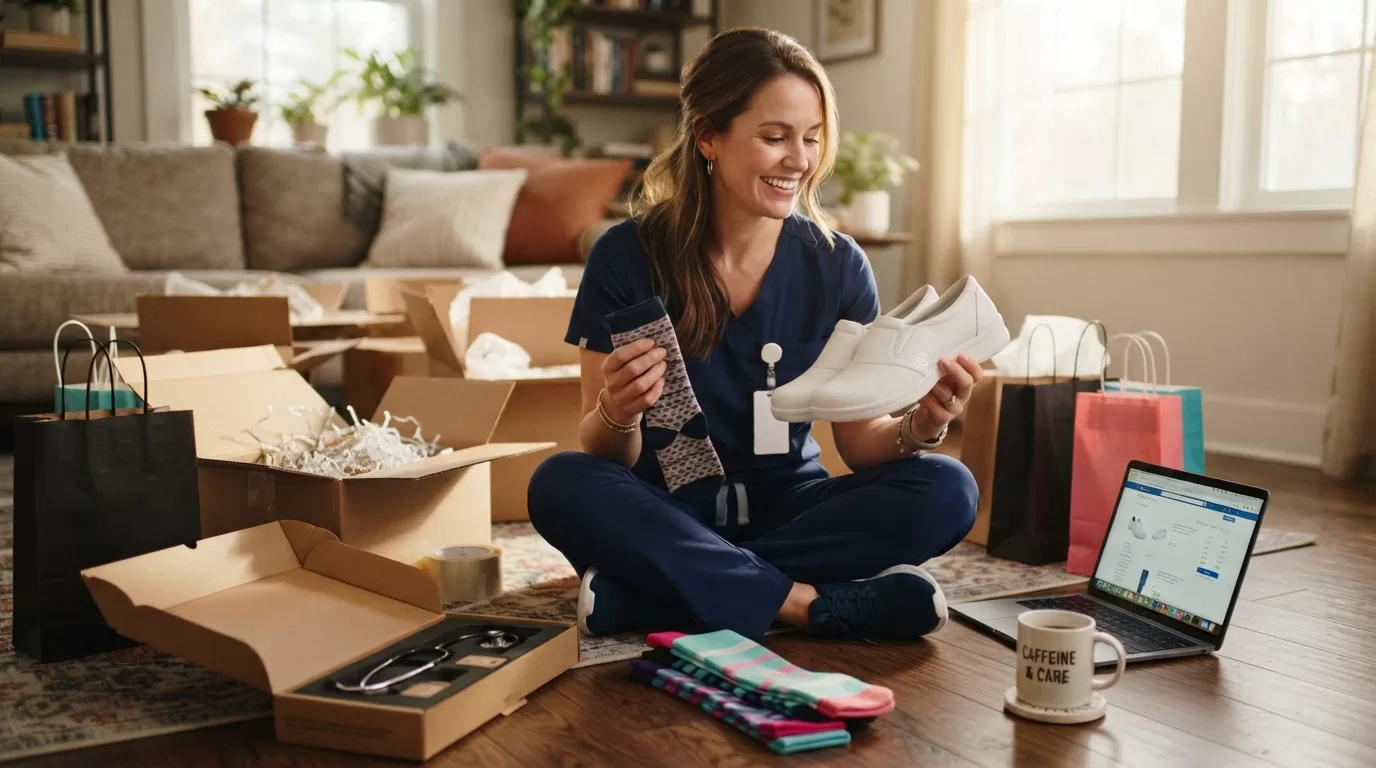
Your feet hurt. Your scrubs have that mystery stain that survived three washes. And your pen light died mid-shift last Tuesday.
Black Friday is coming, and for once, the deals actually matter. Because unlike that air fryer your cousin swears will change your life, nurse gear 2026 purchases are tools you use twelve hours at a stretch.
So let's talk about what's genuinely worth your money this year — and what you can scroll past without guilt.
The Shoes Conversation: When Cheap Actually Costs More
Here's the thing about nursing shoes: you're going to replace them anyway. The Bureau of Labor Statistics notes that registered nurses walk an average of four to five miles per shift, and that's not counting the sprints to rapid responses or the dance you do sidestepping call lights in the hallway.
That means your shoes take a beating no consumer product was really designed for.
The sweet spot for Black Friday nurse deals? Shoes in the seventy to one hundred twenty dollar range that drop to fifty to ninety dollars. Brands like Hoka, Dansko, and Brooks typically see legitimate discounts, not the “marked up then marked down” nonsense you'll find on cheaper models.
What to look for:
- Slip-resistant certification that meets ASTM F2913 standards — your hospital's risk management team cares about this, even if the product page buries it in fine print
- Removable insoles so you can swap in custom orthotics if needed
- Closed-toe and fluid-resistant uppers, because you know exactly why
- A return policy that lets you wear them for one shift and send them back if they're terrible
Skip the twenty-dollar lookalikes. They'll fall apart by February, and your knees will file a formal complaint long before that.
Real talk: replace your work shoes every six months or five hundred hours, whichever comes first. Mark it in your phone. Black Friday twice a year lines up pretty well with that schedule if you stagger a second pair in the spring.
Compression Socks: The Hype Is Real, But So Are the Dupes
Compression socks used to be something your clinical instructor mentioned once and you forgot about until your third year on the floor. Now they're everywhere, and the marketing has gotten aggressive.
The good news? They actually work. Graduated compression — tighter at the ankle, looser at the calf — helps venous return when you're standing for hours. The American Nurses Association has noted the occupational health benefits of compression wear for nurses, particularly for reducing leg fatigue and swelling.
The even better news? The fifteen-dollar pairs on Black Friday work about as well as the forty-dollar “premium” ones.
What matters:
- Graduated compression in the 15-20 mmHg range for general shift work (you don't need medical-grade 30-40 mmHg unless a provider tells you otherwise)
- Moisture-wicking fabric blends, because twelve-hour shifts in polyester socks are their own special misery
- Knee-high length — the ankle ones are cute but pointless for actual compression
- Multiple pairs so you can rotate them through the laundry
Buy six pairs. Seriously. They'll last you a year, and you'll stop doing that thing where you dig through the dryer at 5:30 a.m. looking for a matched set.
Stethoscopes: One Splurge That Pays for Itself
You can hear heart sounds with a cheap stethoscope. You can also technically cut your own hair with kitchen scissors, but there's a reason you don't.
Black Friday is when the Littmann Classic III — the gold standard for bedside nursing — drops from about one hundred ten dollars to eighty or ninety dollars. That's a legitimate discount, and it's the one piece of gear that will follow you through every unit, every shift, and every “can you just listen to this really quick” moment for the next five years.
Why the Classic III specifically? The tubing doesn't stiffen in six months. The diaphragm actually picks up subtle sounds. And when (not if) someone walks off with it, you're only replacing a ninety-dollar tool instead of a two-hundred-dollar Cardiology IV you bought in a fit of optimism.
Personalize it. Engrave your name on the chest piece, wrap the tubing in that hideous neon tape, tie a distinctive charm to the earpieces. It won't stop theft entirely, but it helps.
Skip the budget brands under forty dollars. They're fine for nursing school check-offs. They're frustrating on actual patients, especially older adults with quiet heart sounds or anyone with any kind of pulmonary issue.
The Stethoscope Accessories You Don't Need
Black Friday will try to sell you: decorative tubing covers, leopard-print diaphragms, LED lights that clip on the chest piece.
You need exactly none of that. Save the money for more compression socks.
Scrubs: Wait for January (Seriously)
Scrubs are always on sale somewhere, and Black Friday deals are rarely better than the January clearance events when brands rotate out old colors.
The exception: if you find a specific set you already know fits well and you're just stocking up. Sizes and cuts vary wildly between brands, and nothing's worse than realizing your “deal” scrubs have a crotch that sits two inches too low or pockets that can't hold a penlight.
If you do buy scrubs on Black Friday:
- Stick to brands you've worn before
- Check the fabric content — you want at least some cotton or modal; pure polyester traps every smell
- Read reviews about how they hold up in commercial laundry
- Make sure the return policy covers opened packages, because you won't know if they fit until you squat down in them
Avoid the ultra-cheap sets (two tops and two bottoms for thirty dollars). The fabric pills after ten washes, the drawstrings come out in the dryer, and the seams split when you bend over. You'll spend more replacing them than you saved.
The Gear That's Actually on Your List
Beyond the big three — shoes, socks, stethoscope — here's what's worth grabbing if the price is right:
Badge reels: Buy three. You'll lose two. The retractable ones with the alligator clip (not the flimsy plastic clip) last longest.
Penlight: The disposable ones are fine. Buy a ten-pack and keep extras in your locker, your car, and your bag. They're two dollars each and you'll leave one in a patient room every month.
Compression sleeves: If you already know you like compression socks, the calf sleeves are great for shifts when you want to wear your own socks but still get the circulation benefits.
A good work bag: Something that fits your lunch, your shoes, a change of clothes, and doesn't scream “medical professional with drugs in here” when you're walking to your car at 11 p.m. Black Friday is when the durable totes and backpacks actually go on real sale.
Portable phone charger: Your phone is your Voalte/communication device, your drug reference, your shift countdown timer, and your only link to the outside world on breaks. Keep it alive.
What to Skip Entirely
Smartwatches marketed to nurses: You'll either break it or get so many notifications you'll want to throw it at a wall.
Foot spas and massagers: Great in theory. Never actually used. They'll sit in your closet next to that yoga mat from 2023.
Cheap scissors and hemostats: They're fine until you actually need them to work. Buy decent ones once or use the hospital's supply.
Subscription boxes for nurses: You'll get one good item, two things you already have, and three items that belong in a gift shop. Save the fifty dollars a month.
Anything that says “nurse life” on it: You know who you are. You don't need a coffee mug to prove it.
The Real Strategy: Buy for the Year, Not the Season
Treat Black Friday like stocking up for twelve months of shifts. If you budget two hundred dollars, here's how it stretches:
- One good pair of shoes: eighty-five dollars
- Six pairs of compression socks: seventy dollars
- One Littmann Classic III: ninety dollars (if you need a new one)
That's two hundred forty-five dollars for gear that will carry you through most of 2027. Everything else is bonus.
And if you're between contracts or thinking about travel nursing? Investing in quality gear now means you're ready to work anywhere. You're not hunting for new shoes in an unfamiliar city during your first week at a new facility.
Speaking of travel contracts — if you're considering a move in 2027, now's a good time to review open positions while you're thinking about gear. Email contact@intuites.healthcare with your specialty and the states you're curious about, and we'll walk you through what's available.
Sources
Ready for your next nursing assignment?
Browse open nursing jobs across the US — weekly pay, stipends, and a recruiter who reads every application.