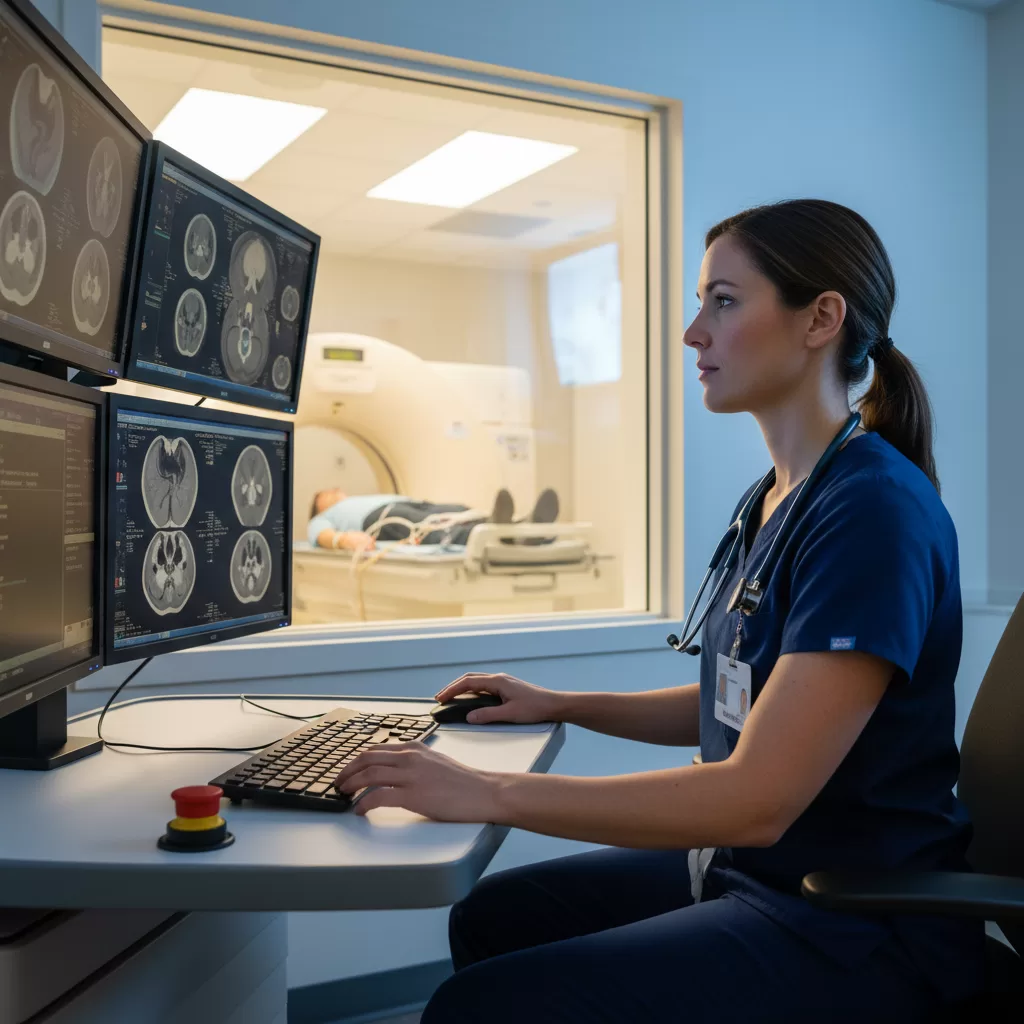
You’ve run thousands of contrast-enhanced CT scans. The protocol is muscle memory: check labs, verify allergy history, start the line, load the power injector, give your instructions.
Then you press ‘Scan.’
Most of the time, everything goes smoothly. But every CT tech knows that iodinated contrast carries risk — and when a CT contrast reaction starts, the first 90 seconds define the outcome. This is your console-side refresher on what to watch for, what to do, and how to stay calm when it matters most.
Why the First 90 Seconds Matter
Contrast reactions don’t always announce themselves with drama. Mild reactions might resolve on their own. But moderate and severe reactions can escalate fast — and your ability to recognize early signs and activate the right response can prevent a close call from becoming a code.
Most adverse reactions to iodinated contrast occur within five minutes of injection, and the majority of severe reactions happen in the first 90 seconds. That narrow window is when you’re still at the console, the patient is still on the table, and your eyes are the first line of defense.
Radiology safety protocols exist for exactly this reason. You’re not just acquiring images — you’re monitoring a patient during a physiologic challenge.
Recognizing the Red Flags
Contrast reactions fall on a spectrum. The American College of Radiology classifies them as mild, moderate, or severe. Your job at the console is to spot the early signs and escalate appropriately.
Mild Reactions
These are common and usually self-limiting:
- Nausea without vomiting
- Mild urticaria (hives) limited to one area
- Itching without rash
- Warmth or flushing
Mild reactions don’t require emergency intervention, but they do require observation. Stay on the intercom. Ask the patient how they’re feeling. Document everything.
Moderate Reactions
These need immediate attention and may require medication:
- Vomiting
- Widespread or progressive hives
- Facial or laryngeal edema (swelling)
- Bronchospasm or wheezing
- Dyspnea (shortness of breath)
Moderate reactions mean you call for help now. Hit your emergency button. Get a radiologist or physician to the scanner. Have your crash cart location memorized.
Severe Reactions (Life-Threatening)
These are rare but require a full code response:
- Hypotension or shock
- Respiratory arrest
- Cardiac arrest
- Seizures or altered mental status
- Severe laryngeal edema with stridor
Severe reactions are CT tech emergencies. You activate your facility’s emergency response, start timing, and prepare to assist with airway management and medications.
Your Console Playbook: The First 90 Seconds
Here’s what your response looks like in real time, from the moment you suspect something is wrong.
Seconds 0-15: Assess and Communicate
The scan finishes. You flush with saline. The patient shifts on the table or says something over the intercom.
Your move: Speak to the patient immediately. ‘How are you feeling? Any itching, nausea, trouble breathing?’ Watch their face on your monitor. Look for grimacing, scratching, or respiratory distress.
If they report anything beyond mild warmth, stand up and move toward the scan room. Do not wait to see if it resolves.
Seconds 15-30: Enter the Room and Triage
You’re now at the patient’s side. Do a quick visual check: skin color, breathing pattern, level of consciousness. Ask again: ‘What are you feeling right now?’
If you see hives spreading, hear wheezing, or notice swelling around the lips or eyes, this is moderate or worse. Hit your emergency call button or send your assistant to get help.
Seconds 30-60: Activate Your Protocol
Do not try to manage a moderate or severe reaction alone. Your facility has a protocol — follow it. Typical steps include:
- Call for the radiologist or ER physician
- Bring the crash cart to the scan room
- Position the patient supine if they’re hypotensive; upright if they’re dyspneic
- Maintain IV access (do not pull the line)
- Prepare to administer oxygen
If the patient is in respiratory distress, oxygen is your first-line support. If they’re hypotensive, legs elevated and IV fluids.
Seconds 60-90: Assist and Document
By now, help has arrived or is arriving. Your role shifts to assistance: hand over medications, relay the timeline (‘Contrast was given at 10:42, patient reported itching at 10:43, hives visible at 10:44’), stay calm, and follow orders.
Once the patient is stable, you’ll document every detail: time of injection, volume, lot number, symptom onset, interventions, and outcome. Radiology safety depends on accurate event reporting.
What About Premedication?
Some patients arrive already premedicated with steroids and antihistamines due to prior contrast allergy. Premedication reduces risk but does not eliminate it. Breakthrough reactions still happen.
If a premedicated patient has a reaction, treat it the same way. Do not assume the reaction will be mild just because they took prednisone the night before.
Staying Sharp Between Scans
Contrast reactions are low-frequency, high-stakes events. You might go months without seeing one — and then face a severe reaction on a random Tuesday morning.
That’s why regular simulation matters. Many imaging departments run annual contrast-reaction drills. If your facility doesn’t, ask your manager to schedule one. Walk through the steps with your team. Practice finding the epinephrine in the crash cart. Know who to call and how.
Muscle memory saves lives when adrenaline kicks in.
You’re the First Responder
CT techs don’t get enough credit for the clinical judgment they exercise every day. You’re not just button-pushers — you’re safety monitors, patient advocates, and often the first responder when something goes wrong.
The first 90 seconds of a CT contrast reaction are yours to manage. Stay calm. Trust your training. Speak up early. And remember: calling for help is never an overreaction when patient safety is on the line.
If you’re looking for your next imaging role — whether staff, PRN, or travel — and you want to work with a team that understands what you do every day, the Intuites Recruiting Team is here. We place CT techs, MRI techs, and diagnostic imaging professionals nationwide. Reach out anytime at contact@intuites.healthcare or visit intuites.healthcare. We’d love to hear from you. 🤍
Ready for your next imaging assignment?
Browse open imaging jobs across the US — weekly pay, stipends, and a recruiter who reads every application.