
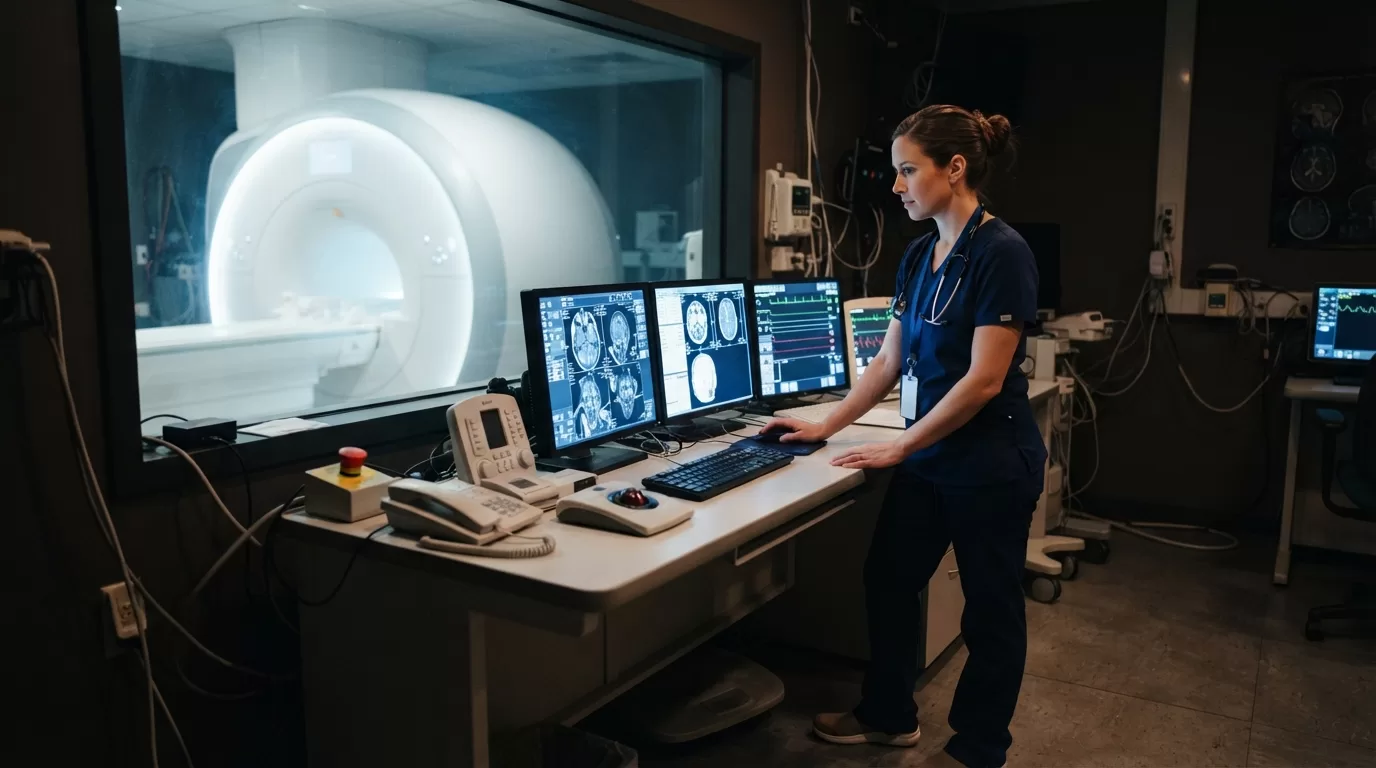
You have been running CT scans for five years. You know anatomy cold, you can troubleshoot contrast protocols in your sleep, and you have built a solid reputation in your department. But lately, you have been eyeing the MRI suite down the hall — the longer scan times, the physics challenges, the higher pay rates on travel contracts, and the chance to add a high-demand credential to your resume.
Switching from CT to MRI mid-career is absolutely doable, but it is not a weekend course. The American Registry of Radiologic Technologists has specific requirements, and most techs need nine to twelve months of structured training to sit for the MRI registry. If you are serious about making the modality switch, here is the realistic roadmap — the didactic hours, clinical competencies, and timeline you will actually need.
Why CT Techs Make the Switch to MRI
Before we dive into logistics, let us talk about why this cross-training path is so popular right now. MRI techs are in short supply nationwide, and the Bureau of Labor Statistics projects faster-than-average growth for all imaging modalities through 2032, with MRI leading the pack in specialized skills demand. CT to MRI cross training gives you leverage in a tight labor market.
Travel MRI contracts often pay fifteen to twenty percent more than comparable CT assignments, especially in rural markets where one tech needs to cover multiple modalities. Permanent roles benefit, too: many hospitals will sponsor your training if you commit to staying on staff for a set period after certification. And from a clinical perspective, MRI offers intellectual challenge — the physics are deeper, the protocols more variable, and the troubleshooting more complex than CT.
But the biggest reason techs switch is flexibility. Holding both CT and MRI credentials makes you nearly indispensable. You can float between departments, pick up extra shifts in either modality, and you become a much stronger candidate for lead or educator roles.
Understanding the ARRT MRI Pathway
The American Registry of Radiologic Technologists offers two routes to MRI certification: the primary pathway and the post-primary pathway. Since you already hold ARRT credentials in Radiography (and likely CT as a post-primary), you will follow the post-primary pathway for MRI. This route requires structured education and clinical experience, not just on-the-job scanning.
Here is what the ARRT requires for MRI tech certification under the post-primary pathway:
- Sixteen semester hours (or equivalent quarter hours) of didactic MRI coursework covering physics, safety, patient care, and imaging procedures
- One thousand documented clinical hours performing MRI exams under the supervision of a qualified MRI technologist
- Completion of specific clinical competencies across all major MRI sequences and anatomical regions
- Passing the ARRT MRI registry exam
The ARRT updated these requirements in 2017 to ensure that post-primary candidates receive the same depth of training as primary-pathway MRI students. That means you cannot just shadow in the MRI suite for a few months and sit for the exam — you need a structured program that meets ARRT standards.
Month 1–4: Didactic Coursework and Physics Foundation
Your first step is enrolling in an ARRT-recognized MRI didactic program. These are typically offered through community colleges, university extension programs, or online platforms approved by the ARRT. Expect to spend three to four months completing sixteen credit hours that cover MRI physics, safety zones, contrast agents, artifact recognition, and protocol optimization.
The physics component is where many CT techs hit a learning curve. MRI relies on magnetic resonance and radiofrequency pulses, not ionizing radiation, so the underlying science is fundamentally different. You will study T1 and T2 weighting, gradient echo versus spin echo sequences, and how changing TR and TE values affect image contrast. If you have not taken a physics course since your original radiography program, budget extra study time here.
Most programs require proctored exams and a minimum passing grade (usually seventy-five percent or higher) to earn the didactic credits. Online programs offer flexibility for working techs, but they still demand disciplined study — plan on ten to twelve hours per week for coursework, reading, and practice quizzes.
During this phase, start familiarizing yourself with MRI safety protocols. The American College of Radiology publishes detailed MRI safety guidelines, and many facilities require separate safety training before you can enter Zone IV. Understanding ferromagnetic hazards, implant screening, and quench procedures is non-negotiable.
Month 4–12: Clinical Competencies and Hands-On Scanning
Once you complete your didactic credits, you move into the clinical phase: one thousand documented hours performing MRI exams. This is not observation time — you must be the primary operator under direct supervision, selecting protocols, positioning patients, optimizing image quality, and troubleshooting artifacts in real time.
The ARRT requires competencies across multiple anatomical regions and MRI sequences. You will need to demonstrate proficiency in brain, spine, musculoskeletal, and body imaging, using both routine and advanced techniques. Each competency must be verified by a qualified MRI technologist (someone who already holds ARRT MRI certification), and your clinical site must maintain documentation that matches ARRT standards.
Here is the reality check: one thousand hours is roughly six months of full-time clinical work (forty hours per week), but most techs cross-training from CT cannot afford to stop working entirely. If you are doing MRI clinicals part-time — say, twenty hours per week while maintaining your CT shifts — expect this phase to take nine to twelve months.
Many hospital employers will create a hybrid schedule where you work three days in CT and two days in MRI training, or they may offer a formal cross-training program with dedicated clinical preceptors. Smaller imaging centers sometimes struggle to provide the volume and variety of cases needed to complete all competencies, so choose your clinical site carefully. You need access to multiple MRI sequences (T1, T2, FLAIR, diffusion-weighted imaging, gradient echo) and a steady patient load across all anatomical regions.
Navigating Employer-Sponsored Training vs. Independent Routes
How you fund and structure your MRI cross training depends on whether your current employer will sponsor the process. Many hospitals offer tuition reimbursement and paid clinical time in exchange for a one- to two-year commitment after you earn your MRI credential. This is the fastest, lowest-cost route — but it locks you into that facility.
If you go independent, you will pay out of pocket for didactic coursework (typically two thousand to four thousand dollars) and arrange your own clinical site through a partnering hospital or imaging center. Independent training gives you freedom to job-hunt immediately after certification, which can be valuable if you want to jump into a high-paying travel MRI contract right away.
A third option is employer-sponsored training at a facility where you do not currently work. Some large health systems recruit experienced CT techs specifically for MRI cross-training programs, offering relocation assistance and a training stipend. These programs are competitive, but they are worth exploring if you are open to moving for the right opportunity.
The ARRT MRI Registry Exam: What to Expect
Once you complete your didactic and clinical requirements, you are eligible to apply for the ARRT MRI registry exam. The exam has two hundred questions covering patient care, safety, image production, and procedures. You will have three and a half hours to complete it, and you need a scaled score of seventy-five to pass.
The MRI exam is harder than the CT registry for most techs because the physics questions dig deeper. Expect scenario-based questions that require you to troubleshoot artifacts, adjust pulse sequences, or identify safety violations. Many candidates use commercial review courses (MRI BootCamp and Mosby's review guides are popular) and practice exams to prepare.
Budget one to two months of dedicated exam prep after finishing your clinical hours. The ARRT releases a detailed content outline on their website, and you should map your study plan to that outline, focusing extra time on your weak areas. Most techs report that the safety and physics domains are the toughest sections.
Once you pass, your MRI credential posts to the ARRT registry within a few days, and you can start marketing yourself as a dual-certified CT/MRI tech. Many states require you to update your state radiologic technology license as well, so check your state board requirements.
Real-World Timeline: What Twelve Months Actually Looks Like
Let us put this all together into a realistic twelve-month roadmap for a full-time CT tech cross-training to MRI while continuing to work:
- Months 1–4: Enroll in ARRT-approved didactic program, complete sixteen credit hours of MRI coursework (evenings/weekends), pass all module exams, and apply for clinical site placement.
- Months 4–5: Complete facility-specific MRI safety training, obtain Zone IV access, and begin shadowing MRI techs to observe workflow and protocols before starting competencies.
- Months 5–12: Log one thousand clinical hours (averaging twenty-five hours per week in MRI while working reduced CT shifts), complete all required competencies across brain, spine, MSK, and body imaging, and document every case with qualified supervisor verification.
- Months 11–12: Submit clinical documentation to ARRT, receive authorization to test, complete two months of focused exam prep using review courses and practice tests, schedule and pass the ARRT MRI registry exam.
This timeline assumes no major disruptions — if you need to repeat a didactic module, if your clinical site has low patient volume, or if you fail the registry exam on your first attempt, add two to four months. But for motivated, organized techs with supportive employers, twelve months from enrollment to certification is achievable.
What Happens After You Earn Your MRI Credential
The week you pass the ARRT MRI exam, your job prospects expand significantly. Dual-certified CT/MRI techs are hot commodities, especially in travel nursing markets. Premium travel MRI contracts in high-demand states — think Montana, Wyoming, Alaska, and rural Texas — often pay thirty-five to forty-five dollars per hour for experienced techs, with tax-free housing stipends on top of that base rate.
Permanent roles benefit, too. Many imaging departments prefer to hire one dual-certified tech who can flex between modalities rather than maintaining separate CT and MRI staffing pools. This makes you more recession-proof: if census drops in one modality, you can shift to the other without losing hours.
And if you are entrepreneurial, holding both credentials opens doors to per-diem work, where you can build your own schedule across multiple facilities. Per-diem MRI rates in metro markets often hit fifty to sixty dollars per hour, and you control your availability.
From a career-ladder perspective, MRI certification strengthens your resume for lead tech, clinical coordinator, or applications specialist roles. Equipment manufacturers (Siemens, GE, Philips) often recruit experienced MRI techs into field service or training positions, and those roles can pay six figures with travel perks.
If you are ready to explore CT to MRI cross training, start by reviewing open imaging contracts that value dual credentials — or email contact@intuites.healthcare with your timeline and we will help you map out the smartest next step for your career goals.
Sources
Ready for your next imaging assignment?
Browse open imaging jobs across the US — weekly pay, stipends, and a recruiter who reads every application.