
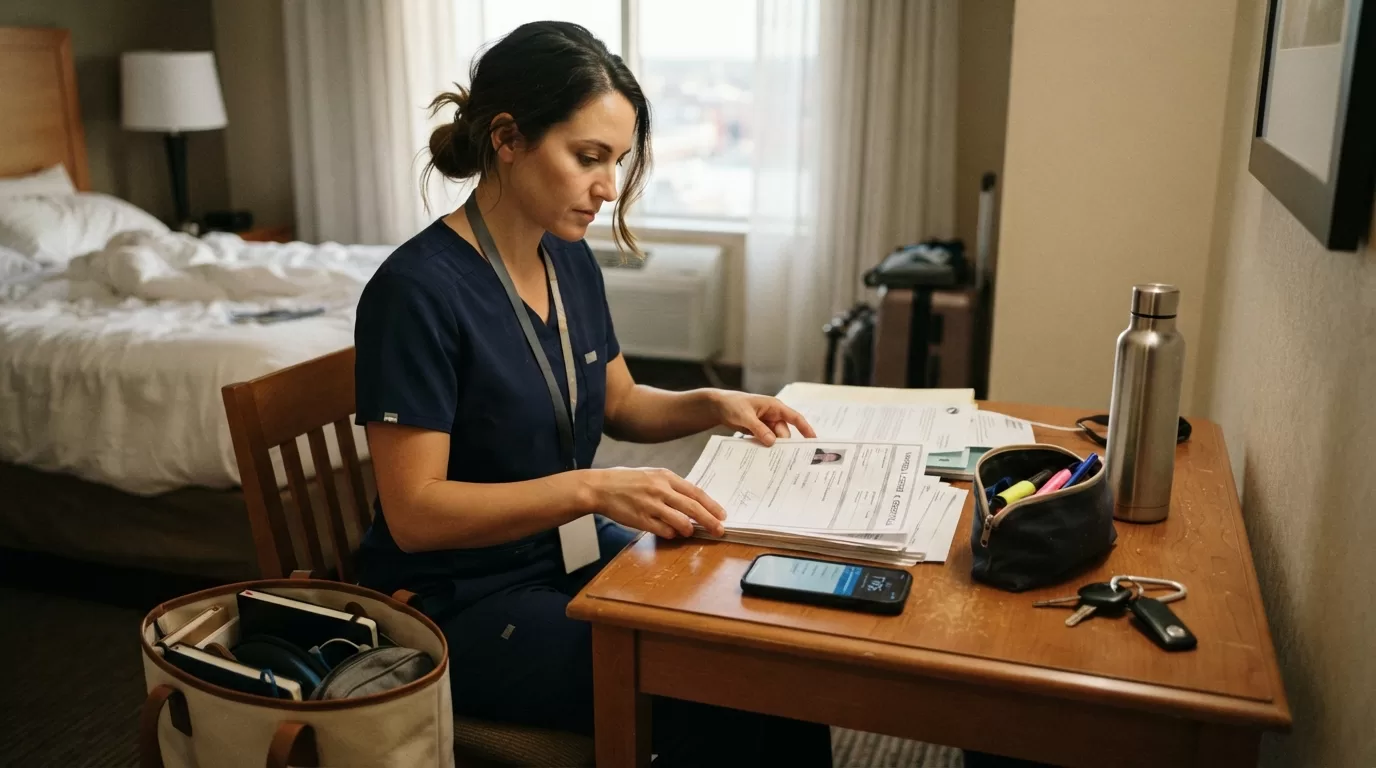
You have survived the credentialing gauntlet. You have signed the contract, booked the housing, and driven (or flown) to your new city. Tomorrow morning at 0700, you walk into a facility where nobody knows your name and the supply room is a mystery.
Day 1 of any travel contract is equal parts excitement and low-grade anxiety. You will meet your manager, sit through compliance modules, and — if you are lucky — shadow a preceptor who actually wants to show you around. But before any of that happens, you need to show up with the right things in your bag.
This is not a packing list for your entire thirteen-week assignment. This is the tactical, keep-it-in-your-tote checklist for orientation day itself. Miss one of these items and you may spend your lunch break running to FedEx or sitting in HR explaining why your immunization record is on your phone but not printed. Let us walk through the twelve essentials every travel RN should bring to Day 1, from the obvious to the things that only bite you once.
The Paper Trail: Licenses, Certifications, and Compliance Documents
Even though your recruiter uploaded everything during credentialing, facilities love redundancy. Bring two physical copies of each of the following, printed on clean white paper and stored in a labeled folder:
- Your current RN or LPN license for the assignment state
- Any compact licenses if you hold multistate privileges under the Nurse Licensure Compact (the National Council of State Boards of Nursing reports that thirty-nine states participate in the NLC as of 2026, but rules vary)
- BLS, ACLS, PALS, or any specialty certifications required by your contract
- Immunization records, including your most recent TB test or QuantiFERON Gold result
- A copy of your signed contract and the first-page summary that lists your start date, specialty, and shift
Why two copies? One set stays with HR or your unit educator. The second set is your insurance policy when someone in another department asks to see proof and the first set has not made it into the system yet. Redundancy is not paranoia in healthcare — it is professionalism.
Store these in a slim accordion folder or a plastic sleeve. Do not fold your licenses in half or stuff them loose in your scrubs pocket. You are a travel nurse, not a college sophomore with a crumpled resume.
Money Matters: Cash, Cards, and the Badge Deposit
Orientation day has a way of surfacing unexpected costs. Pack a small envelope with at least twenty dollars in ones, fives, and a ten. Here is why:
Many facilities charge a refundable deposit for your ID badge — anywhere from five to twenty dollars, and some units still prefer cash or check over a payroll deduction. Hospital parking may require payment at a kiosk before you have been issued your employee parking permit. The cafeteria might be cash-only for the day if their card readers are down (it happens more than you would think). And if orientation runs through lunch, you do not want to be the person asking a stranger to spot you because you left your wallet in the car.
Bring at least one major credit card and your debit card as backup. Some facilities will ask for a card on file for uniform orders or continuing education fees. Do not bring your entire wallet if it is stuffed with personal cards, old receipts, and your Costco membership. Travel light, but bring liquid options.
The Parking Wild Card
Speaking of parking: find out in advance whether your facility offers free employee parking, a discounted monthly pass, or a pay-per-day structure. Your recruiter or the HR contact should be able to answer this during your pre-arrival call. If parking is not free, budget accordingly — some urban hospitals charge ten to fifteen dollars per shift, which adds up over thirteen weeks. And yes, bring cash for Day 1 parking even if you plan to buy a pass later. Meters and kiosks do not care that you are new.
Tech Stack: Phone, Passwords, and the Apps You Will Actually Use
Your phone is not just a phone anymore — it is your facility directory, your schedule portal, your time clock, and your backup brain. Before you walk in the door, make sure you have done the following:
Download any facility-specific apps your HR contact mentioned in the welcome email. Many hospitals use apps like Workday, UKG, or custom platforms for scheduling, time entry, and internal messaging. Set these up the night before so you are not fumbling with app store passwords during your thirty-minute lunch.
Bring a portable charger or charging cable. Orientation days are long, and you will be pulling up documents, taking notes, and possibly scanning QR codes for compliance training. A dead phone at 1400 when you need to clock out is not a good look.
Use a password manager. You will be issued at least three new logins on Day 1: electronic health record (EHR), email, and intranet. Write them down in a secure app like 1Password or Bitwarden, not on a sticky note that will end up in the laundry. If you prefer paper, bring a small notebook dedicated solely to work logins and keep it in a locked bag.
Save your recruiter's cell number and your agency's after-hours line in your phone favorites. If something goes sideways — your manager was not expecting you, your unit is overstaffed and sending you home, or the dress code is different than you were told — you need to reach your agency fast. Do not assume you will remember the main office number under stress.
Wardrobe and Gear: What to Wear and What to Stash in Your Car
Most facilities will tell you in advance whether orientation is business casual or scrubs. If they did not specify, ask your recruiter two days before. When in doubt, wear clean scrubs in a neutral color (navy, ceil blue, black) with closed-toe shoes that pass hospital standards. Leave the fun prints and embroidered tops for Week 2 when you know the culture.
Even if orientation is business casual, pack a spare set of scrubs in your car. Some facilities will surprise you by moving directly into unit shadowing after the morning compliance session, and you do not want to trail a preceptor through the ICU in khakis and flats. Throw in an extra pair of socks, because hospital HVAC is unpredictable and your feet will thank you.
Bring your own stethoscope, penlight, and a handful of black pens. Yes, the unit will have supply closets full of pens that walk away every shift. Bring your own anyway. It signals that you take the work seriously, and you will not waste time hunting for a working clicker pen when you need to chart a med pass at 0900.
Skip the large tote bag full of snacks, makeup, and three novels. Orientation spaces often have limited locker access, and you do not want to babysit a giant bag through six hours of sitting. A small crossbody or drawstring backpack is enough for your wallet, phone, keys, and documents.
The Forgotten Essential: A Refillable Water Bottle
Hydration is not glamorous, but it matters. Orientation involves a lot of sitting, a lot of talking, and sometimes a long stretch between breaks. Bring a refillable water bottle — preferably one with a lid that seals tightly, because you will be setting it on tables near computers and paperwork. Many hospitals have bottle-fill stations. If yours does not, fill it before you leave your housing and top it off in the break room.
The Extras That Separate Good Days from Rough Ones
These last few items are not deal-breakers, but they are the difference between feeling prepared and feeling like you are improvising all day.
Pack a small snack that does not require refrigeration. A protein bar, a baggie of almonds, or a pack of crackers will carry you through if orientation runs late or the cafeteria is across campus. Do not rely on vending machines — they are either out of stock or full of options you would not eat on a normal day.
Bring a light jacket or cardigan. Hospital temperatures swing wildly depending on the unit, and orientation rooms are often freezing because they are located in older conference spaces with aggressive AC. Layering is not optional — it is survival.
Carry a small notepad and pen separate from your phone. Some facilities prohibit phones during certain training sessions, and you will want to jot down unit-specific details like the break room code, the name of the charge nurse you will report to, or the extension for the pharmacy. Paper does not run out of battery.
Finally, bring a smile and a genuine willingness to learn names. Day 1 is your chance to make a solid first impression with your manager, your educator, and the nurses who will be your shift partners for the next three months. Confidence matters, but so does humility. You are walking into someone else's unit, and even if you have fifteen years of experience, you do not know their workflows yet. Ask questions. Say thank you. Remember that the unit secretary who badges you in on Day 1 is often the person who will save you in Week 6 when you need a same-day schedule change.
What Not to Bring
Let us close with a few things to leave at home. Do not bring your entire nursing school binder or a stack of reference books. The facility will provide access to policy manuals and clinical guidelines through their intranet. Do not bring your personal laptop unless you were explicitly told to do so for a specific training module — hospital WiFi is usually locked down, and you will not have time to use it anyway.
Skip the elaborate lunch unless you verified in advance that you will have access to a microwave and a full break. Orientation schedules are unpredictable, and you may end up eating at your desk between modules. Keep it simple.
And please, do not bring an attitude that Day 1 is beneath you because you have done this before. Every facility is different. Every EHR has quirks. Every unit has unwritten rules about how they run breaks, how they prefer handoff, and which attending physicians need their notes co-signed immediately. Orientation is not hazing — it is your chance to absorb the local culture before you are on your own. Take it seriously.
Walking into Day 1 with this checklist in hand will not eliminate every surprise, but it will eliminate the preventable ones. You will look prepared, you will feel confident, and you will spend less time scrambling and more time focusing on what matters: learning the unit, building rapport, and setting yourself up for a successful contract.
If you are comparing travel RN opportunities and want to work with an agency that respects your preparation, email contact@intuites.healthcare and let us know which specialties and markets you are exploring. We will walk you through what to expect before Day 1 ever arrives.
Sources
Ready for your next travel nursing assignment?
Browse open travel nursing jobs across the US — weekly pay, stipends, and a recruiter who reads every application.