
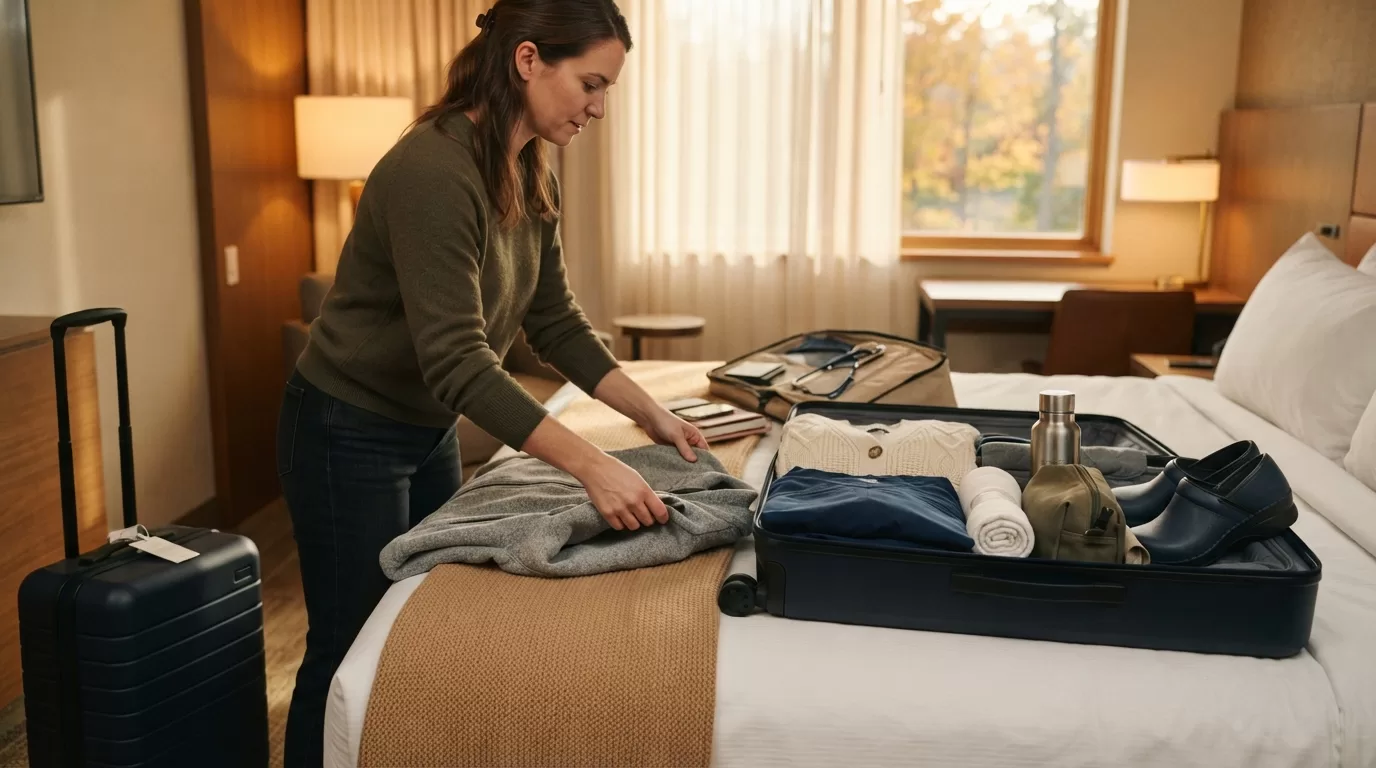
You accepted the contract. The rate looked good, the unit sounded solid, and someone on a Facebook group said the cafeteria makes killer breakfast burritos.
Now you're staring at your suitcase wondering how to pack for a state where “fall weather” could mean anything from Indian summer to surprise snow. And you already know — because you've worked healthcare — that the hospital thermostat operates on its own mysterious logic.
Welcome to the fall travel nurse packing list, decoded. This isn't your general-purpose capsule wardrobe guide. This is the stuff that actually matters when you're working twelve-hour shifts in a climate you don't live in, sleeping in temporary housing, and trying not to check a second bag.
The Layering System That Survives Hospital HVAC
Let's address the elephant in the break room: hospital temperature control is a choose-your-own-adventure novel where you never pick the right path.
The ICU runs cold enough to store vaccines. The step-down unit feels like a sauna. The hallway between them? Arctic wind tunnel. Your best defense is a layering strategy that doesn't require a degree in meteorology.
Start with your scrub tops as the base. Pack at least five solid-color sets — fall means you might be walking to your car in rain or early darkness, and having a rotation that dries overnight matters. Then add one thin, long-sleeve moisture-wicking shirt you can wear under scrubs on the coldest units. The kind marathon runners wear. It won't bulk up under your top, and you can peel it off mid-shift if you rotate to a warmer zone.
The real MVP? A cardigan or fleece jacket in a neutral color that lives in your work locker. According to the Bureau of Labor Statistics, registered nurses spend an average of 12.1 hours per shift on their feet, often moving between climate zones within the same building. That locker sweater means you're not hauling outerwear from the car every single day, and it's there when you need it for a chilly med room or a break outside.
One traveler trick: bring a scarf. Not a chunky knit situation, but a lightweight cotton or modal blend you can drape, wrap, or fold into your bag. It's the universal adapter of clothing. Chilly nurses' station? Scarf. Breezy walk to your car after night shift? Scarf. Forgot to pack a second pillowcase for your hotel? You see where this is going.
The One Jacket That Does Everything
Suitcase real estate is expensive. You don't have room for a rain shell, a fleece, a windbreaker, and a puffy coat. You need one jacket that can handle September in Denver, October in Portland, and November in Upstate New York.
Enter the waterproof soft-shell with a zip-out liner. Outdoor brands make them; you've seen them on every nurse practitioner who works in a hospital that makes staff park in Siberia. The outer layer blocks wind and rain. The inner layer adds insulation. Separately or together, they cover about 90% of fall weather scenarios, and the whole system packs down smaller than a pair of clogs.
Look for pit zips (ventilation matters when you're speed-walking across a parking lot between shifts) and pockets deep enough for your phone, badge, and car key. A hood is non-negotiable — not because you'll wear it often, but because the one time you need it, you really need it.
If you're heading somewhere that hits actual winter during your contract, add a packable down vest. It layers under the shell, works as a mid-layer for weekend hiking, and compresses into almost nothing. You're still only carrying two pieces instead of four.
Footwear: The Part Everyone Underestimates
Your work clogs are handled. You know your brand, you've broken them in, you're not experimenting thirteen weeks away from home. But what about everything else?
Fall travel nursing means you're walking on wet leaves, potentially icy sidewalks if your contract runs late, and doing all your errands in an unfamiliar town where “a quick walk” might mean half a mile in weather. You need one pair of real shoes that aren't clogs and aren't flip-flops.
Waterproof slip-on sneakers or ankle boots with good tread. Leather or synthetic uppers that won't soak through. Something you can wear to the grocery store, on a day hike, or to grab coffee without looking like you just left the unit. Bonus points if they have a removable insole so you can add your own orthotic support.
And here's the piece that gets left behind: a second pair of compression socks specifically for non-work walking. The National Council of State Boards of Nursing notes that nursing remains one of the most physically demanding professions, with prolonged standing and walking contributing to venous insufficiency risk over time. You're already wearing compression at work. On your days off, when you're exploring a new city or hiking a trail, that same support keeps your legs from staging a revolt. Pack two pairs of knee-highs in merino wool or a synthetic blend. They regulate temperature better than cotton, they don't stink after one wear, and they dry overnight on a hotel towel rack.
The Stuff Nobody Talks About (But Should)
Let's get into the miscellaneous category — the things that don't fit neatly into “clothing” but make or break a fall assignment.
- A reusable water bottle with a wide mouth. Hospital water fountains are fine, but fall air is dry, and you want something you can add electrolyte powder to or fill with hot tea between shifts. Wide-mouth means you can actually clean it without growing a science experiment.
- A compact electric kettle and your own tea or instant coffee. Hotel coffee is hotel coffee. If you're particular, a small kettle (the kind that collapses or fits in a shoe) and a box of your preferred caffeinated beverage will save you money and sanity. Bonus: instant oatmeal, ramen, or soup on a night you're too tired to find food.
- A headlamp or small book light. Fall means shorter days. If you're working nights, you might be getting home in the dark and trying not to wake a roommate. If you're working days and your apartment is unfamiliar, a hands-free light beats fumbling with your phone.
- A buff or neck gaiter. Underrated. It's a face covering for cold morning walks, a headband when your hair won't cooperate, a sweatband if you're running, and it packs into a pocket smaller than a pair of socks.
- Wool dryer balls. Seriously. Hotel and apartment complex dryers are chaos machines. Dryer balls cut dry time, reduce static, and you're not buying dryer sheets every two weeks. Toss in a few drops of essential oil if you want your scrubs to smell like something other than industrial detergent.
- A sunrise alarm clock or a small portable lamp. If you're in the northern half of the country, fall contracts mean you're losing daylight fast. Waking up in the dark before a shift messes with circadian rhythm. A light that gradually brightens helps, and the compact versions are TSA-friendly.
What You Can Skip (And Buy If You Actually Need It)
Packing light is part skill, part accepting that you're going to a place with stores. You don't need to bring your entire apartment.
Skip the bulky towels. Hotels provide them, and even bare-bones furnished housing usually includes two. If you hate the options when you arrive, buy one at a local Target and donate it when you leave. Same with extra blankets — wait and see what the heating situation is before you pack a duvet.
Skip the full-size anything in toiletries. Bring trial sizes for week one, then buy your actual shampoo, conditioner, and body wash locally. You're not checking bags just to haul a 32-ounce bottle of something you can get at any drugstore.
Skip the “just in case” formal outfit unless your contract specifically includes an event where you'll need it. You're not going to a gala. You're working, sleeping, and maybe exploring on your days off. If a wedding invitation materializes, you'll have time to shop.
And skip the anxiety about over-packing cold-weather gear if you're headed somewhere like North Carolina or Tennessee in September. These places have fall, but it's not Montana. Check the actual historical weather data for your assignment city (the National Weather Service archives are free and searchable), and pack for reality, not worst-case.
The Night-Before-You-Leave Checklist
You've done the research. You've made the list. Now it's 10 p.m. the night before you leave, and you're second-guessing everything. Here's what actually matters:
- Five sets of scrubs (you'll do laundry once a week; this is plenty)
- One cardigan or jacket that stays in your locker
- One waterproof outer layer with a liner
- Two pairs of non-work shoes: clogs for backup, and waterproof sneakers or boots
- Compression socks for work and off-duty
- A week of underwear and regular socks (because laundry)
- Two pairs of pants and three tops you can mix and match for days off
- Sleepwear, a lightweight robe if that's your thing
- Toiletries in trial sizes, plus your prescriptions and a basic first-aid kit
- Chargers, headphones, and one good book or e-reader
- That electric kettle, a mug, and tea or coffee
- Your nursing license, certifications, ID, and a printed copy of your contract
Everything else is either replaceable or not actually necessary. If you forget something, you'll survive. That's the whole point of travel nursing — you're adaptable.
Fall assignments are some of the best. The weather's good for exploring, the holidays are coming (which means interesting case mixes and staffing challenges that keep the work from getting boring), and you're building a skillset that makes you valuable anywhere. But it starts with a suitcase that doesn't fight you.
Pack the cardigan. Bring the compression socks. Double-check that your waterproof jacket actually has a hood. And if you're still on the fence about where to go next, browse the fall and winter openings in critical care, emergency, or med-surg — or email contact@intuites.healthcare with your specialty and the regions you're considering.
Sources
- Bureau of Labor Statistics — Occupational Outlook Handbook: Registered Nurses (bls.gov)
- National Council of State Boards of Nursing (ncsbn.org)
- National Weather Service (weather.gov)
Ready for your next travel nursing assignment?
Browse open travel nursing jobs across the US — weekly pay, stipends, and a recruiter who reads every application.