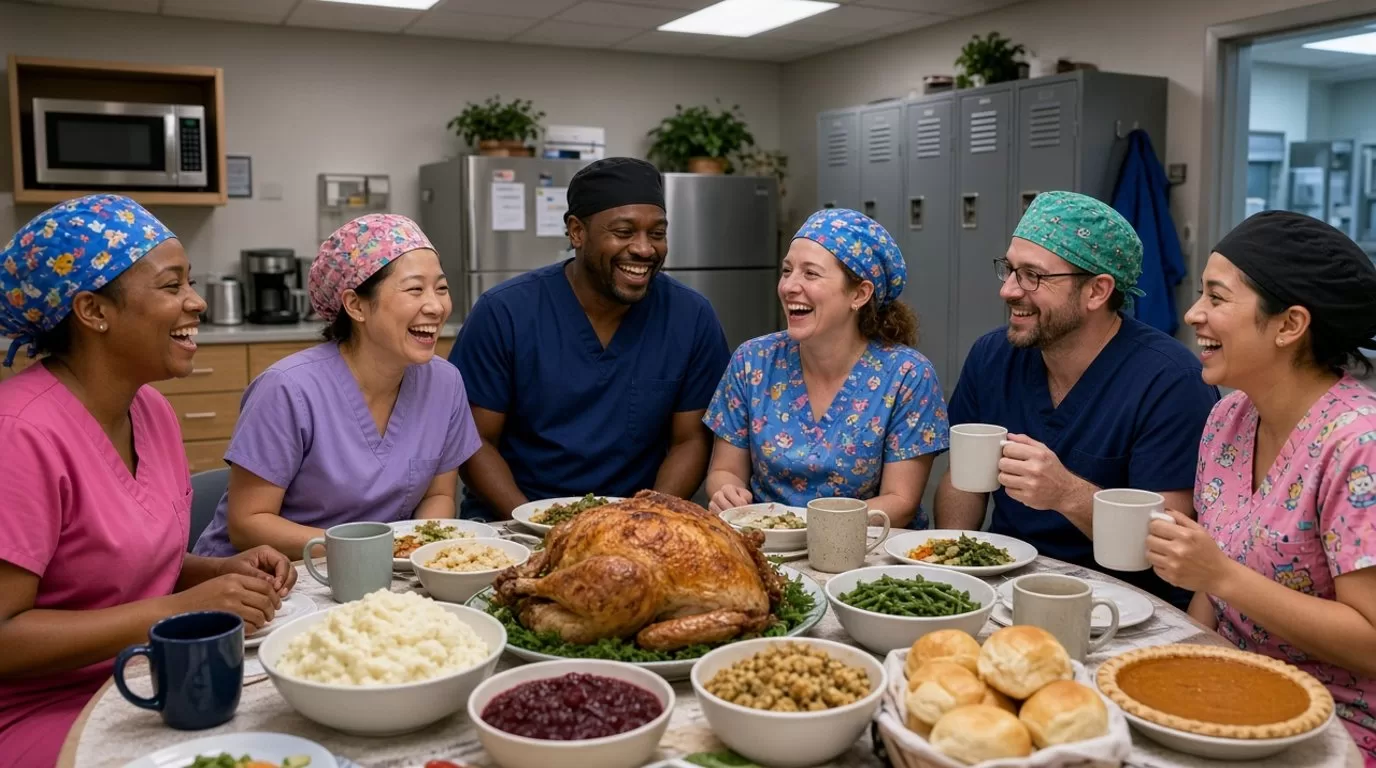
Thanksgiving is almost here, and if you work in healthcare, you know the holiday looks a little different when you're clocked in. The break room potluck becomes sacred. The turkey might be cold by the time you grab a plate. And somewhere between med passes and admits, you start wondering: if my unit were a Thanksgiving dish, which one would it be?
We asked ourselves the same question — and honestly, the answers came fast. Every hospital unit has its own flavor, its own texture, its own role in keeping the whole operation running. Some are the showstopper centerpiece. Others are the unsung heroes that make everything else better. A few are pure chaos in the best way possible.
So grab your favorite cafeteria coffee, settle in for a few minutes of well-earned fun, and let's carve up this Thanksgiving spread, hospital-style. Fair warning: by the end of this, you'll never look at cranberry sauce the same way again.
The ICU Is Definitely the Turkey
Let's start with the obvious one. The ICU is the turkey — the centerpiece, the main event, the dish that takes all day and all your focus. It's what everyone asks about first. It requires constant monitoring, precise timing, and a team effort to get it right. You can't just walk away and hope for the best.
Like a Thanksgiving turkey, the ICU demands your full attention. You're checking temps, adjusting settings, troubleshooting when things don't look quite right. One moment of distraction and suddenly you're dealing with a dry bird — or in ICU terms, a code you didn't see coming. The stakes are high, the pressure is real, and when it all comes together beautifully, there's nothing more satisfying.
ICU nurses know this rhythm intimately. According to the Bureau of Labor Statistics' Occupational Outlook Handbook, critical care nurses represent one of the most specialized segments of the nursing workforce, with training that can take years to fully develop. The turkey doesn't roast itself, and ventilators don't manage themselves either.
And just like that turkey, the ICU is what holds everyone's attention at the table. It's the standard by which the whole meal — or shift — gets judged. When the ICU runs smoothly, the whole hospital feels it. When it doesn't, well, everyone knows about that too.
The ER Is Cranberry Sauce — Sweet Chaos in a Can
If the ICU is the turkey, the ER is absolutely the cranberry sauce. Hear us out on this one.
Cranberry sauce is divisive. Some people love it, some people question why it's even on the table. It comes in bursts — sweet one second, tart the next, occasionally sliding out of the can in one wobbly cylinder that somehow holds its shape against all odds. Sound familiar?
The ER operates in controlled chaos. You've got your regulars who show up like clockwork. You've got the genuine emergencies that change the whole vibe of the shift in thirty seconds. You've got the moments that make you laugh, the ones that break your heart, and the ones that make absolutely zero sense but you roll with it anyway because that's the job.
ER staff are masters of the quick pivot. One minute you're triaging a stubbed toe, the next you're running a trauma. The pace is relentless, the variety is endless, and just when you think you've seen it all, someone walks in with something that makes the whole unit stop and say “how is that even possible?”
Like cranberry sauce, the ER is essential even when people don't fully appreciate it until it's not there. It's the safety net, the front door, the place that never closes and never says no. It holds its shape under pressure, slides into the holiday lineup without fail, and keeps things interesting from start to finish.
PACU Is Mashed Potatoes — Smooth, Comforting, and Absolutely Essential
Every Thanksgiving table needs mashed potatoes. They're the comfort food that makes everything else better, the smooth transition between the heavy hitters and the lighter sides. They're warm, reliable, and exactly what people need after a stressful experience — like, say, surgery.
PACU nurses are the mashed potatoes of the hospital. You come out of anesthesia disoriented, uncomfortable, maybe a little nauseous, and there they are: calm, competent, making sure you're warm enough, checking your vitals, explaining what just happened in a voice that doesn't make your head hurt worse.
The Post-Anesthesia Care Unit is all about smooth transitions. Patients arrive fresh from the OR, and PACU staff guide them gently back to consciousness and stability. It's a specialized skill set — managing pain, monitoring for complications, reassuring anxious family members, all while keeping a close eye on airways and hemodynamics.
Like good mashed potatoes, PACU care is deceptively simple-looking but requires real technique. Anyone can boil potatoes, but making them creamy, perfectly seasoned, and consistently excellent? That takes practice. PACU nurses make recovery look easy because they're that good at what they do.
And just like mashed potatoes anchor the whole plate, PACU anchors the surgical experience. Without that smooth, comforting middle step, the whole meal — or surgical journey — falls apart.
Med-Surg Is the Stuffing — It Literally Holds Everything Together
Here's the truth about stuffing: it's the unsung hero of Thanksgiving. It soaks up all the flavors, connects the protein to the sides, fills in the gaps, and somehow makes the whole plate feel complete. Take it away and suddenly nothing else makes sense.
That's Med-Surg in a nutshell.
Medical-surgical units are the workhorse floors of every hospital. They handle the breadth and depth of patient care — post-op recoveries, chronic disease management, acute medical issues, pre-procedure prep, everything in between. The patient load is high, the acuity varies wildly from room to room, and the skill set required is vast.
Med-Surg nurses are generalists in the best possible way. They need to know a little bit of everything because they see a little bit of everything. Cardiac issues? Check. Respiratory distress? Handled. Wound care, diabetes management, post-stroke rehab, ortho recovery? All in a day's work.
The American Nurses Association consistently highlights medical-surgical nursing as foundational training for the profession. It's where many nurses build the clinical judgment and time management skills that carry them through their entire careers, regardless of where they specialize later.
Like stuffing, Med-Surg holds the hospital together. It's adaptable, essential, and handles whatever gets thrown its way. It might not get the glamour spotlight, but try running a hospital without it. Spoiler: you can't.
Labor and Delivery Is the Pumpkin Pie — Sweet, Anticipated, and Full of Surprises
Pumpkin pie is the dessert everyone looks forward to. It's sweet, it's traditional, it arrives after everything else, and it makes people cry happy tears. Sometimes it comes out exactly as planned. Sometimes the crust gets a little burnt or the filling doesn't set quite right, but it's still beautiful and everyone still loves it.
That's Labor and Delivery.
L&D is where anticipation meets reality, where months of waiting culminate in a few intense hours, where plans go sideways and backup plans kick in and suddenly there's a new human in the world and everyone's crying. It's high-stakes, high-emotion, and incredibly rewarding when it all comes together.
Labor and Delivery nurses are part coach, part advocate, part crisis manager, part celebration coordinator. They support families through one of the most vulnerable moments of their lives. They stay calm when plans change. They know when to intervene and when to step back. They celebrate every safe delivery like it's their own family, because in those hours, it kind of is.
Like pumpkin pie, L&D is a beautiful mix of science and art. There's protocol and evidence-based practice, yes, but there's also intuition, experience, and the ability to read a room — or a contraction pattern — and know exactly what's needed next.
And just like pie, L&D reminds us why we do this work in the first place. It's sweet, it's meaningful, and even when it's messy, it's worth it.
The OR Is the Rolls — Precise, Timing-Critical, and Everyone Notices If They're Not Perfect
Let's talk about dinner rolls for a second. They seem simple, but they're actually one of the most timing-sensitive dishes on the table. Too early and they're cold by dinner. Too late and everyone's already eating. Overbaked and they're tough. Underbaked and they're doughy. When they're perfect — golden, warm, fluffy — everyone notices and appreciates them.
That's the Operating Room.
OR teams operate on precision. Sterile technique is non-negotiable. Timing is everything — from the first incision to the final count, every minute matters. The coordination required between surgeons, anesthesiologists, surgical techs, and circulating nurses is like a choreographed performance where everyone knows their cues and nobody misses a beat.
One missed step, one break in technique, one miscommunication, and the whole procedure can be compromised. But when it all flows smoothly? When the case wraps on time, the counts are correct, the patient is stable, and the team worked together seamlessly? That's the warm-rolls-fresh-from-the-oven feeling.
OR professionals take pride in that precision. According to The Joint Commission's ongoing patient safety initiatives, surgical teams use rigorous protocols — time-outs, checklists, standardized communication — to ensure every procedure meets the highest standards. Like baking perfect rolls, it's about following the recipe, timing it right, and caring enough to get every detail correct.
And just like rolls, the OR might not be the star of the show, but try having Thanksgiving dinner without them. Something essential is missing.
What's Your Unit's Thanksgiving Dish?
We've covered the big ones, but every hospital has specialties we didn't name. Is Radiology the green bean casserole — reliable, straightforward, always there when you need it? Is Psych the sweet potato casserole with the marshmallows on top — a little unexpected, surprisingly complex, definitely an acquired taste? Is Peds the mac and cheese — kid-focused, colorful, and requiring a completely different skill set?
The beauty of hospital humor is that it's deeply personal and universally understood at the same time. Every unit has its own culture, its own challenges, its own inside jokes. We all speak slightly different dialects of the same language, and moments like these remind us we're all part of the same meal.
Thanksgiving in healthcare is complicated. Some of us are working the holiday, some of us are finally off, some of us are picking up extra shifts to help colleagues see their families. But whether you're checking vitals at 6 a.m. or sitting down to cold turkey in the break room at 2 p.m., you're part of a team that shows up when it matters most.
So here's to every unit, every shift, every dish on the table. Here's to the organized chaos of the ER cranberry sauce and the steady reliability of PACU mashed potatoes. Here's to Med-Surg stuffing holding it all together and ICU turkey taking center stage. Here's to L&D pumpkin pie and OR rolls baked to golden perfection.
And here's to you — whatever your specialty, whatever your role — for showing up, contributing your unique flavor, and making the whole healthcare feast possible. If you're exploring opportunities in a new unit or a new facility this season, check out our open contracts in specialties from ICU to L&D, or email contact@intuites.healthcare with questions about what might be the right fit for your next chapter.
Sources
Ready for your next healthcare assignment?
Browse open healthcare jobs across the US — weekly pay, stipends, and a recruiter who reads every application.