
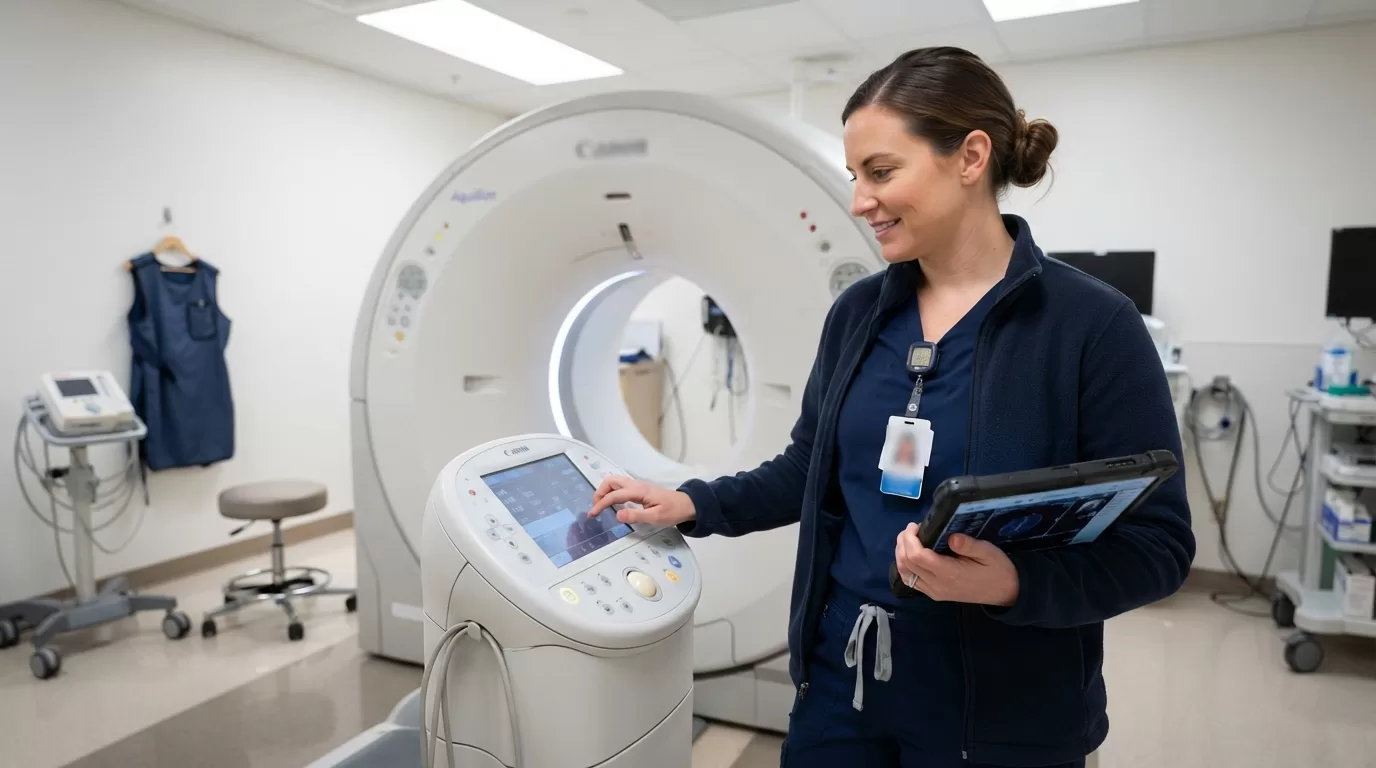
You've been running the same CT scanner in the same hospital for three years. You know every quirk of that machine, every radiologist's preference, every supply closet shortcut. And lately, you've been wondering: what would it be like to take those skills on the road?
That's the question we got from a reader last week, and it's one we hear all the time from imaging professionals who are curious about travel work but aren't sure where to begin. The good news? If you've got solid clinical experience and the right credentials, you can be working your first travel rad tech assignment within 90 days.
Here's the roadmap that gets you there.
Start With the One-Year Rule (and Why It Exists)
Almost every travel imaging job posting lists the same baseline requirement: one year of recent, full-time experience in your modality. That's not arbitrary. When a facility hires a traveling MRI tech or travel CT tech, they need someone who can walk into an unfamiliar department on day one and operate independently with minimal orientation.
According to the Bureau of Labor Statistics, radiologic and MRI technologists complete formal education programs that range from one to four years, but clinical competency takes time beyond graduation. Most hospitals and imaging centers budget only one to two shifts for traveler onboarding, compared to the multi-week orientation a permanent hire might receive. That's why the one-year benchmark matters: it signals you've moved past the new-grad learning curve and can troubleshoot protocols, handle difficult patients, and adapt to different equipment without constant supervision.
If you're at eleven months right now, use that final stretch to document your experience. Keep a running list of the exams you've performed, the equipment models you've operated, and any specialized protocols you've mastered. When you apply for imaging travel jobs in a few weeks, that detail will set your profile apart.
What Counts as ‘Recent’ Experience?
Most agencies and facilities define recent as within the past two to three years. If you've been out of clinical practice for longer than that, expect to complete a refresher or bridge program before you're assignment-ready. Some modalities are more forgiving than others — general X-ray tends to have the widest window, while MRI and nuclear medicine are stricter because of rapid technology changes and safety protocols.
Lock Down Your Credentials Before You Apply
Credentials are the gatekeeper for travel work, and missing even one can delay your start date by weeks. Here's what you need in place before you submit your first application.
ARRT certification. The American Registry of Radiologic Technologists is the gold standard. Most travel contracts require ARRT certification in your primary modality — R for radiography, CT for computed tomography, MR for magnetic resonance imaging, M for mammography, N for nuclear medicine, S for sonography. If you're cross-trained in multiple modalities, hold certifications for each one you plan to work. Facilities rarely make exceptions, even if your state doesn't mandate ARRT.
State licensure. Not every state requires imaging technologists to hold an individual license, but more than 30 do — and that number is growing. California, Texas, Florida, New York, and Illinois all have mandatory licensing. Check the American Society of Radiologic Technologists' state-by-state map to see what your target states require, and start applications early. Some boards take six to eight weeks to process out-of-state applications, especially if you need to submit fingerprints or additional documentation.
BLS and ACLS. Basic Life Support is universal. Advanced Cardiac Life Support is less common for imaging roles, but some ICU-based positions or cath lab hybrid roles require it. Renew both before they expire — a lapsed card will hold up your entire file.
Immunizations and titers. COVID vaccination, MMR, varicella, Tdap, hepatitis B, and a recent TB test or QuantiFERON are standard. Get titers for measles, mumps, rubella, and varicella if you don't have documentation of two doses. Keep digital copies in a folder you can upload quickly.
The First 30 Days: Build Your Profile and Interview
Once your credentials are in order, it's time to work with a recruiter. This is where many first-time travelers stumble — they treat the initial call like a formality, when it's actually the foundation of your entire travel experience.
A good recruiter will ask about your modality preferences, your comfort level with different equipment brands (Siemens vs. GE vs. Philips), your shift preferences, and your geographic wish list. Be specific. If you only want 13-week contracts in the Southeast, say so. If you're open to nights but refuse call shifts, make that clear. The more detail you provide, the better your recruiter can match you to openings that fit.
You'll also discuss pay structure during this conversation. Travel rad tech compensation typically includes a taxable hourly base rate plus non-taxable stipends for housing and meals. The stipends are governed by IRS rules and GSA per-diem rates, which vary by metro area. A contract in rural Montana will have a lower housing stipend than one in San Francisco, but the taxable hourly might be higher to offset the difference. Ask your recruiter to break down the total weekly take-home for each contract so you can compare apples to apples.
What to Expect in Your First Interview
Most facilities conduct a brief phone or video interview before offering a contract. They'll ask about your experience with specific procedures — trauma protocols for X-ray, contrast administration for CT, safety screening for MRI. They might describe their patient population, typical shift volume, and the equipment you'll be using. This is your chance to ask questions, too: What's the nurse-to-patient ratio? How much call is expected? Is there parking, or should I budget for transit?
These interviews are usually relaxed and conversational. The facility has already reviewed your credentials and knows you're qualified. They're confirming you're a good cultural fit and can handle their workflow.
Days 30 to 60: Accept Your First Contract and Prepare to Move
When you accept an imaging travel job, you'll receive a detailed contract that outlines your start date, guaranteed hours, pay breakdown, and cancellation terms. Read every line. The guaranteed hours are especially important — most contracts guarantee 36 or 40 hours per week, meaning if the facility cancels your shifts, you still get paid for those hours. Anything beyond the guarantee is usually available but not guaranteed.
Start planning your housing immediately. You have two main options: take the agency's provided housing (often a furnished apartment in a corporate housing complex) or decline agency housing and receive the full stipend as a taxable or non-taxable payment, depending on how it's structured. If you take the stipend and find your own place, you'll need to maintain a tax home — a permanent residence where you pay rent or a mortgage and return between assignments. The IRS is strict about this, and failing to meet the tax-home requirement can cost you thousands in back taxes and penalties.
Many first-time travelers choose agency housing for their inaugural assignment to simplify logistics. You can always switch to stipend-and-arrange-your-own for assignment number two once you understand the process.
Logistics Checklist
Here's what to handle in the 30 days before your start date:
- Submit your onboarding paperwork — skills checklists, reference checks, facility-specific certifications.
- Arrange travel to your assignment city. Most agencies offer a travel reimbursement or a one-time stipend.
- Research the area. Where's the nearest grocery store? Gym? Urgent care? Having these answers ahead of time reduces first-week stress.
- Set up mail forwarding if you're leaving your permanent address for an extended period.
- Notify your car insurance and health insurance of your temporary location change, if required.
Days 60 to 90: Start Your Assignment and Build Your Reputation
Your first day as a traveling CT tech or MRI tech will feel like controlled chaos. You'll get a brief facility orientation — badge pickup, parking pass, locker assignment — and then a quick tour of your department. Then you're on the schedule.
The best piece of advice for week one: ask questions and take notes. Every facility has its own quirks. Maybe they use a specific protocol name for chest CTs that you've never heard before. Maybe the radiologist wants the scout images sent separately. Maybe there's a particular way to log contrast in the EMR. Write it all down. Your coworkers will appreciate that you're trying to integrate smoothly, and you'll avoid repeating the same question three times.
By week three or four, you should feel comfortable with the workflow. That's when most travelers start to relax and enjoy the experience. You're getting a paycheck, exploring a new city, and adding a prestigious facility name to your resume. And if you love the assignment, many facilities will extend your contract for another 13 weeks — sometimes at an even higher rate.
What Happens After Your First Assignment?
Once you complete your first contract, you have options. You can extend at the same facility, move to a new assignment in a different state, or take a few weeks off between gigs. Some travelers work back-to-back year-round. Others prefer a seasonal rhythm — winter in Arizona, summer in the Pacific Northwest, and holidays at their permanent home.
The travel imaging world is smaller than you'd expect. Do good work, communicate clearly with your recruiter, and show up on time, and you'll build a reputation that opens doors. Facilities remember reliable travelers and request them by name for future openings. Agencies prioritize travelers who complete contracts without drama and don't cancel at the last minute.
Your first 90 days as a travel rad tech are a learning curve, but they're also the foundation of a career path that offers flexibility, higher pay, and geographic freedom that permanent roles simply can't match.
If you're ready to take the next step, email contact@intuites.healthcare and tell us which modality you work in and where you'd like to start traveling — we'll walk you through the credentialing process and show you what contracts are open right now for traveling MRI techs, travel CT techs, and every other imaging specialty.
Sources
Ready for your next imaging assignment?
Browse open imaging jobs across the US — weekly pay, stipends, and a recruiter who reads every application.