
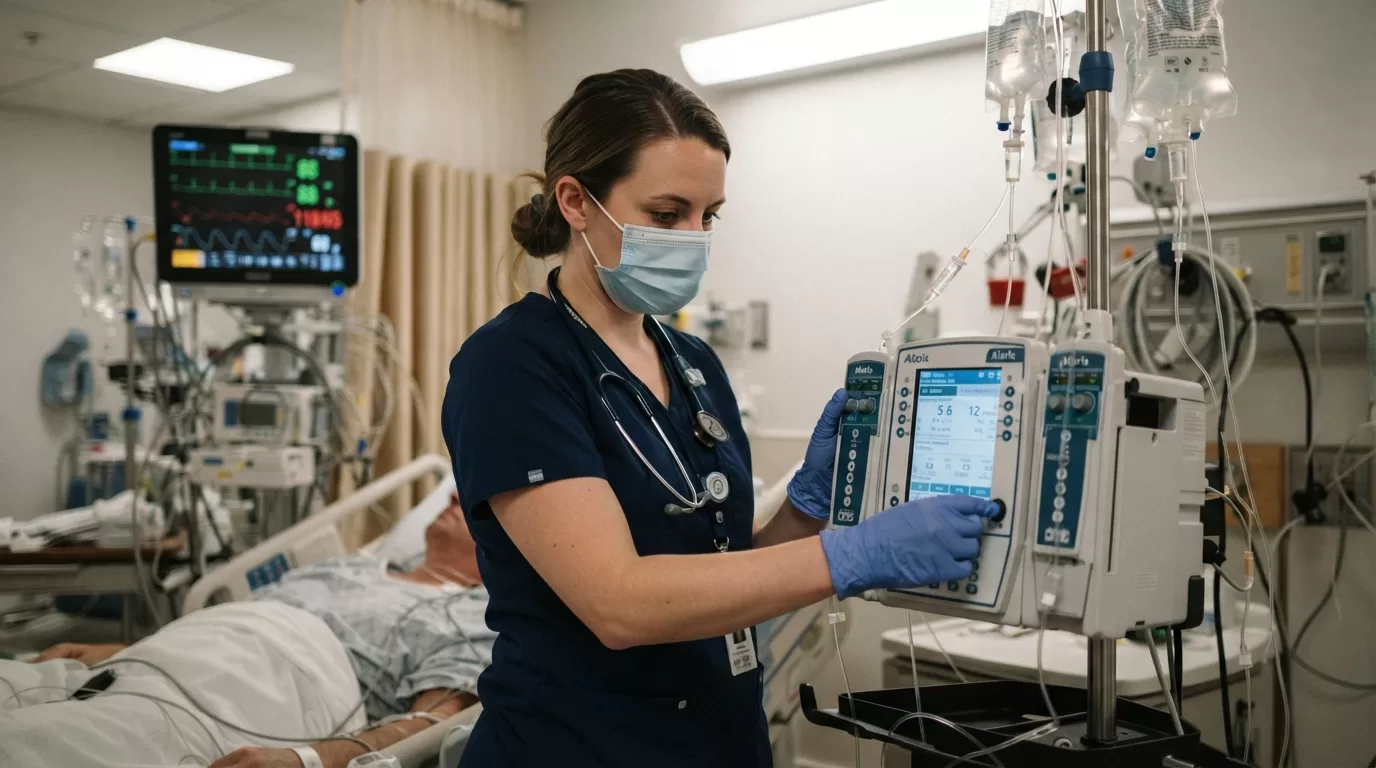
You are two hours into your night shift in the ICU when the attending calls from home: “Start norepi, target MAP sixty-five.” The patient — a sixty-eight-year-old with septic shock — is already on four liters of crystalloid, lactate climbing, and cold to the touch past the elbows. You hang the bag, program the pump, and start the infusion. But then the question hits: why norepinephrine and not dopamine? Why sixty-five and not seventy? And what happens if the MAP does not come up or the extremities get colder?
Protocol cards give you the recipe. But understanding the hemodynamic logic behind vasopressor choice — the why beneath the what — turns you from a task executor into a clinical thinker who can anticipate problems, speak up when something does not fit, and guide newer nurses through the nuances. This guide walks you through that decision tree.
The Hemodynamic Foundation: What Pressors Actually Do
Vasopressors raise blood pressure, but not all in the same way. Some squeeze the vessels (alpha agonists), some speed and strengthen the heartbeat (beta agonists), and some do both. The trick is matching the drug to the hemodynamic pattern you see in front of you — not just the diagnosis on the chart.
Start with the basics: mean arterial pressure equals cardiac output times systemic vascular resistance (MAP = CO × SVR). If your patient is hypotensive, one or both of those factors is too low. Your job is to figure out which one.
- Warm shock (sepsis, anaphylaxis): vessels dilated, SVR crashes, but heart often compensates with high CO. Skin warm, bounding pulses early on. You need a vasoconstrictor.
- Cold shock (cardiogenic): heart cannot pump enough volume, so CO drops. Vessels clamp down to try to compensate (high SVR), but it is not enough. Skin cold and mottled, weak pulses. You may need inotropic support, not pure constriction.
- Obstructive shock (PE, tamponade, tension pneumo): mechanical problem blocking flow. Pressors can temporize but will not fix the root cause — you are buying time for definitive intervention.
Hemodynamic monitoring helps: if you have an arterial line, watch the waveform quality and pulse-pressure variation. If a Swan-Ganz is in (rare now but still seen in some centers), you get actual CO and SVR numbers. But even without invasive lines, clinical gestalt — skin temperature, capillary refill, urine output, mentation — tells you a lot about perfusion.
First-Line Pressor: Why Norepinephrine Wins in Septic Shock
The Society of Critical Care Medicine guidelines — most recently reaffirmed in their 2021 Surviving Sepsis Campaign update — recommend norepinephrine as first-line for septic shock. Not dopamine, not phenylephrine, not vasopressin alone. Why?
Norepinephrine hits both alpha-1 receptors (vasoconstriction, raises SVR) and beta-1 receptors (modest positive inotropy and chronotropy, supports CO). In septic shock, where SVR tanks but the heart often still has reserve, that combination covers both bases without excessive tachycardia. Dopamine, the old standby, causes more arrhythmias — including atrial fibrillation — and was associated with higher mortality in the landmark SOAP II trial published in the New England Journal of Medicine back in 2010. Phenylephrine is pure alpha (no cardiac kick), so it raises pressure but can drop CO by reflex bradycardia; it is reserved for cases where tachycardia is already a problem or norepinephrine is temporarily unavailable.
Norepinephrine typically starts at 0.01 to 0.05 mcg/kg/min and titrates up. Most ICUs use weight-based dosing, but if your facility uses a flat rate, 2 to 12 mcg/min is the common range for a seventy-kilogram adult. You are aiming for a MAP of at least 65 mmHg in most patients; that threshold comes from studies showing adequate renal perfusion pressure starts there. But — and this is key — if your patient has chronic hypertension, their autoregulation curve is shifted right, and they may need MAP 70 to 75 to perfuse the kidneys and brain properly. Always ask about baseline BP.
When Norepinephrine Is Not Enough
If you are above 0.5 mcg/kg/min (or about 30 to 40 mcg/min in an average adult) and MAP is still low, it is time to add a second agent rather than push norepi into the stratosphere. High-dose single pressors increase the risk of digital or mesenteric ischemia without necessarily improving outcomes. The next move depends on what else is going on.
The Second Agent: Vasopressin, Epinephrine, or an Inotrope
Once norepinephrine alone is not cutting it, you have three main paths.
Vasopressin
Also called antidiuretic hormone, vasopressin works on V1 receptors in vascular smooth muscle — a completely different mechanism from catecholamines. In septic shock, endogenous vasopressin levels drop (relative deficiency), so replacing it physiologically makes sense. The VASST trial showed that adding low-dose vasopressin to norepinephrine did not reduce overall mortality but did allow norepi to be weaned faster and showed a mortality benefit in the less-severe shock subgroup.
Dosing: vasopressin is dosed as a fixed rate, not titrated. Standard is 0.03 to 0.04 units per minute. You do not go higher — above 0.04, you risk severe vasoconstriction, coronary ischemia, and skin necrosis. If 0.04 units/min plus norepinephrine is not enough, you add a third agent or reassess the whole picture (occult bleeding, adrenal insufficiency, unrecognized cardiogenic component).
Epinephrine
Epinephrine hits alpha, beta-1, and beta-2 receptors — so it constricts vessels and revs the heart. It is often the go-to add-on in anaphylactic shock (where you also give it IM) and is sometimes used in septic shock refractory to norepi plus vasopressin. The downside: it drives up lactate even without tissue hypoxia (via beta-2–mediated aerobic glycolysis), so lactate becomes a less reliable marker of perfusion. It also increases myocardial oxygen demand and arrhythmia risk. Start at 0.01 to 0.05 mcg/kg/min and titrate carefully.
Inotropes: Dobutamine
If your patient is cold, mottled, and has a low cardiac output despite adequate preload — think cardiogenic shock or septic shock with myocardial depression — adding pure vasoconstriction makes things worse. You need to improve contractility. Dobutamine is a beta-1 agonist that increases stroke volume and CO. It does dilate peripheral vessels a bit (beta-2 effect), so MAP may not rise and can even fall initially; you often run it alongside a vasopressor. Typical dose is 2.5 to 20 mcg/kg/min. Watch for tachycardia and arrhythmias, especially above 10 mcg/kg/min.
Clinical pearl: if you see cold extremities, poor pulse pressure, and rising lactate despite a MAP of sixty-five on norepi, suspect low CO. An echo showing reduced ejection fraction or a low ScvO₂ on a central line blood gas confirms it. That is your signal to talk to the team about adding dobutamine or switching part of the pressor strategy.
Special Situations and Adjustments
Distributive Shock Beyond Sepsis
Anaphylaxis: IM epinephrine 0.3 to 0.5 mg is first-line, but if the patient is crashing, start an epinephrine infusion early. Add H1 and H2 blockers and steroids, but pressors are what save the airway and perfusion in the first minutes. Neurogenic shock (spinal cord injury): loss of sympathetic tone drops both SVR and heart rate. Phenylephrine or norepinephrine works, but you may also need atropine or even a temporary pacer if bradycardia is profound.
Right Ventricular Failure and Pulmonary Hypertension
If your patient has a massive PE or severe ARDS with high pulmonary pressures, the right ventricle is struggling. Norepinephrine can help by improving RV perfusion pressure (it is coronary flow is diastolic-pressure dependent), but you may need to add inhaled pulmonary vasodilators (inhaled epoprostenol or nitric oxide) to drop RV afterload. Phenylephrine, by raising systemic afterload, can actually worsen RV function in these cases — so it is typically avoided unless LV failure is also present.
Refractory Shock: Think Adrenal Insufficiency
If a patient on high-dose pressors is not responding and you have ruled out ongoing bleeding, tamponade, and tension pneumo, consider occult adrenal insufficiency. A random cortisol level and cosyntropin stimulation test can help, but if shock is severe, many intensivists give empiric hydrocortisone 50 mg IV every six hours (or 100 mg every eight hours) rather than wait for lab results. The 2018 ADRENAL trial showed hydrocortisone in septic shock did not reduce ninety-day mortality overall but did shorten time on pressors — and in patients who are truly adrenal insufficient, it can be lifesaving.
Nursing Vigilance: Monitoring, Titration, and Troubleshooting
Hanging the drip is step one. Keeping the patient safe through the next twelve hours is the real work.
- Line patency and central access: Vasopressors extravasate and cause tissue necrosis. They must run through a central line (or a large-bore peripheral line as a very short bridge until central access is secured). If the IV is positional or the waveform on the transduced central line looks damped, troubleshoot before you titrate higher.
- Continuous MAP monitoring: An arterial line is standard for anyone on pressors. If you do not have one yet and are running norepi peripherally for a few minutes, get a properly sized cuff and recheck BP every five minutes minimum. Recognize that cuff pressures lag behind true arterial pressure during rapid changes.
- Urine output and lactate trends: MAP is a means to an end — the end is tissue perfusion. Watch hourly urine (goal ≥0.5 mL/kg/hr), serial lactate (should clear if resuscitation is working), and mentation. If MAP is sixty-five but urine drops and lactate climbs, you are not perfusing adequately; talk to the team about raising the MAP goal or adding an inotrope.
- Extravasation protocol: If a peripheral norepi line infiltrates, stop the infusion immediately, leave the IV in place, and call for phentolamine (an alpha blocker) to inject subcutaneously around the site in a clockwise pattern — it reverses the vasoconstriction and can prevent skin loss.
- Drug compatibility: Norepi and vasopressin can run together through a multi-lumen central line, but always check your facility's compatibility chart. Some drugs (like phenytoin or thiopental) are incompatible with catecholamines.
Putting It All Together: A Decision Framework
Here is a mental algorithm you can use at the bedside:
Step 1: Identify the hemodynamic pattern. Warm or cold? High or low CO? Look at skin, pulses, cap refill, and any available hemodynamic numbers.
Step 2: Ensure adequate preload. A patient who is dry will not respond well to pressors — you are squeezing an empty tank. Confirm CVP is reasonable (8 to 12 if mechanically ventilated) or use dynamic measures like pulse-pressure variation if available.
Step 3: Start norepinephrine for septic or distributive shock, targeting MAP ≥65 (or higher if chronic HTN). For pure cardiogenic shock, pressors are temporizing — you need definitive treatment (cath lab, mechanical support).
Step 4: If norepinephrine exceeds 0.5 mcg/kg/min, add vasopressin at 0.04 units/min (do not titrate). If still refractory, consider epinephrine or assess for a cardiogenic component (add dobutamine if CO is low).
Step 5: Reassess every hour. Are end-organ perfusion markers improving? If not, widen your differential: bleeding, adrenal crisis, unrecognized mechanical issue, or wrong diagnosis altogether.
This framework — grounded in the SCCM's Surviving Sepsis Campaign guidelines and reflected in evidence from multicenter trials — gives you a reproducible path that works in most ICU shock scenarios. It also gives you the language to advocate for your patient when something does not fit the standard pathway.
Mastering vasopressors is not about memorizing dose ranges. It is about understanding the hemodynamic story your patient is telling you — then choosing the drug that writes the next chapter toward stability. If you are ready to bring this level of critical-care expertise to a new ICU team or want to explore per-diem or travel opportunities in high-acuity units, reach out to contact@intuites.healthcare with “ICU pressors” in the subject line and we will connect you with contracts that match your skill set.
Sources
Ready for your next nursing assignment?
Browse open nursing jobs across the US — weekly pay, stipends, and a recruiter who reads every application.