
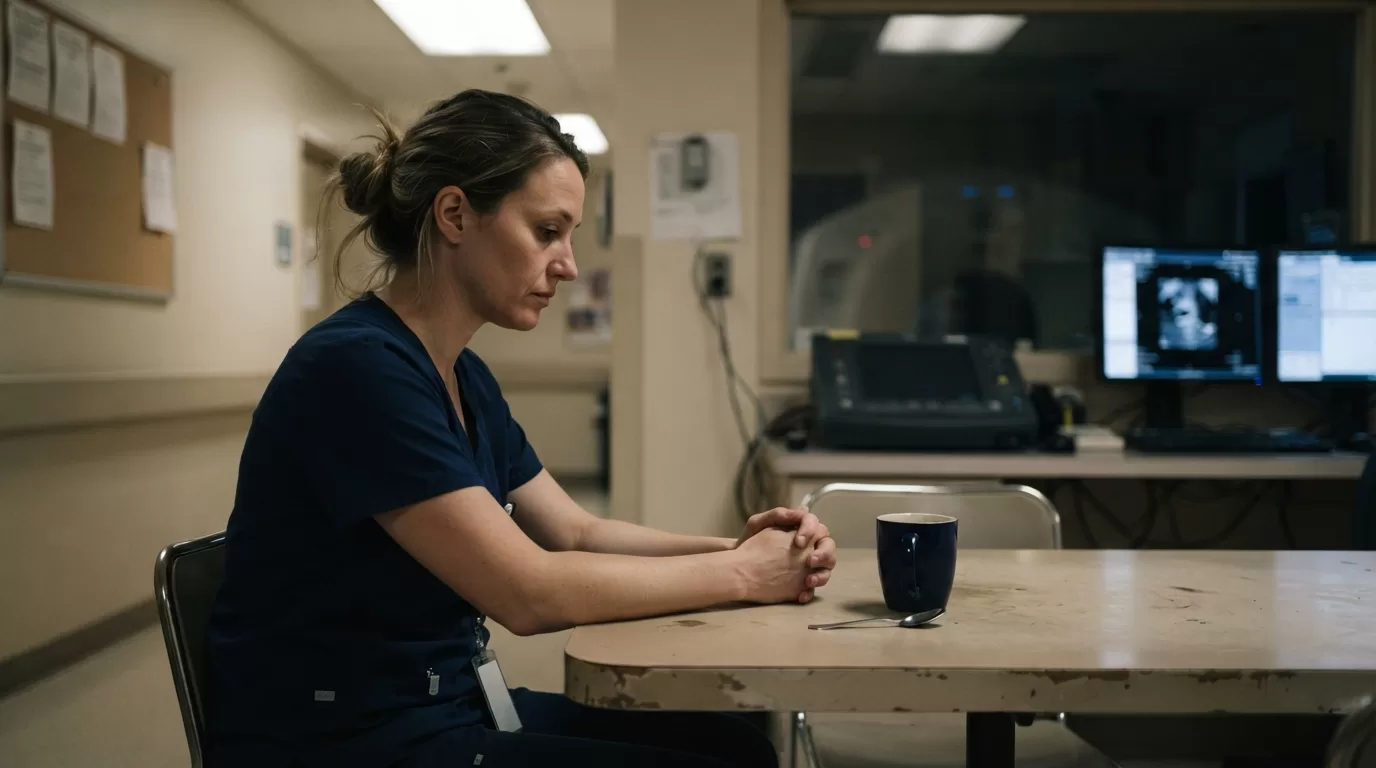
It was a weeknight in October 2019. The ER called up a stat CT for a three-year-old—motor vehicle accident. You prepped the scanner, checked the protocol twice, and kept your voice calm while the child's mother stood in the hallway, frozen. The scan took eleven minutes. The images told a story you didn't want to read.
Seven years later, you can still see that series when you close your eyes. Not every shift, but enough. Enough that you recognize the tightness in your chest when peds trauma rolls through the door. Enough that you've learned which songs not to play on the drive home.
If you work in diagnostic imaging—radiology, CT, MRI, ultrasound, mammography, nuclear medicine—you know that some images don't fade. This isn't about a single bad day. It's about cumulative pediatric trauma exposure, and what happens when we carry it alone.
The Weight Imaging Techs Carry Differently
Nurses and physicians have begun talking openly about secondary traumatic stress and healthcare worker PTSD. But imaging technologists occupy a unique position in the trauma care chain. You see the structural truth before anyone else does. The subdural. The non-accidental injury pattern. The mass that explains three months of a parent's worry.
You deliver that information without speaking a word—your job is the image, not the interpretation. But you're human, and the KB file transfers with a weight the PACS system doesn't measure.
According to data compiled by the American Society of Radiologic Technologists, between thirty and forty percent of imaging professionals report symptoms consistent with secondary traumatic stress at some point in their careers. Pediatric cases, particularly those involving trauma or suspected abuse, rank among the most psychologically challenging scenarios across all modalities.
The isolation is structural. You work alone in a control room. There's no huddle, no bedside nurse to exchange a glance with, no attending to debrief the case. You transmit the images, document the technical factors, and move to the next exam. The child goes to surgery or the ICU. You go to your next patient, often within minutes.
What Cumulative Exposure Actually Looks Like
Rad tech mental health struggles don't always announce themselves with a crisis. More often, they accumulate. You might notice:
- Intrusive recall of specific cases during unrelated tasks—driving, showering, trying to sleep
- Heightened anxiety when the ER pages for peds trauma, even before you know the details
- Emotional numbing or detachment during high-acuity scans as a protective mechanism
- Avoidance of certain age groups or case types in your personal life
- Persistent belief that you should be 'tougher' because you're not providing direct patient care
- Physical symptoms—GI issues, headaches, insomnia—that start after particularly difficult shifts and don't resolve
That last point matters. The Joint Commission's 2025 standards on healthcare worker well-being explicitly recognize that trauma exposure occurs across all clinical roles, not just those involving direct bedside care. Imaging professionals are specifically named in their guidance on secondary traumatic stress screening.
The myth persists that because you're behind lead glass, you're somehow insulated from the emotional impact. In practice, the opposite is often true. You have time to see details the trauma team won't notice until the read comes back. You're alone with knowledge that hasn't yet become action.
Why Pediatric Cases Hit Differently
Most imaging techs will tell you the same thing: adult trauma is hard, but pediatric trauma lives in a different category entirely. There are developmental reasons for this. Our brains are wired to respond to children's distress with heightened alertness and emotional intensity—it's an evolutionary imperative that doesn't clock out when your shift ends.
When the trauma is non-accidental, the moral weight compounds. You're mandated to report, which is the right thing and the only legal option. But standing in the control room, watching a parent who may have caused the injuries comfort a child who doesn't understand why they're in pain, creates a cognitive dissonance that doesn't resolve when you file the report.
Cases involving terminal diagnoses carry their own burden. A seventeen-year-old comes in for what everyone hopes is a sports injury. The MRI shows osteosarcoma. You were the first person to see it. You'll remember their face longer than they'll remember yours.
These aren't abstract scenarios. If you've worked imaging for more than two years, you have a version of each stored somewhere. The question isn't whether the exposure affects you—the research from the National Institute for Occupational Safety and Health makes clear that it does. The question is what you do with it.
Practical Steps That Actually Help
Acknowledging imaging tech trauma is necessary but not sufficient. Here's what makes a measurable difference, based on peer-reviewed interventions and feedback from hospital-based peer support programs:
Document the hard ones within twenty-four hours. Not in the medical record—in a private journal or voice memo. Name what you saw, what you felt, and what you did. Externalizing the experience creates psychological distance and prevents the memory from calcifying into something bigger than it was. Trauma therapists call this 'narrative processing,' and it works even when done alone.
Identify your two people. Not your entire department, not a generic EAP hotline. Two specific colleagues who have worked long enough to understand, who won't minimize, and who won't require you to perform resilience. Text one of them within an hour of a rough case. You don't need a conversation—sometimes 'Peds MVA, I'm okay but it was hard' is enough to prevent isolation from hardening into something clinical.
Request a post-event debrief for the worst cases. Many hospitals now have critical incident stress management teams, but they don't always loop in imaging unless you ask. If your facility doesn't have a formal structure, email your manager and the social work department the same day. Say, 'I was the tech on [case], and I'd like to talk with someone who understands healthcare trauma exposure.' Most institutions will arrange it within forty-eight hours.
Track your exposure load. If you're doing more than two high-acuity pediatric trauma cases per week for consecutive weeks, your risk for secondary traumatic stress increases significantly. That's not weakness—it's statistics. Talk to your scheduler about rotating into lower-acuity assignments or adult-only coverage for a few weeks. Frame it as sustainable staffing, which it is.
Use your EAP for actual therapy, not just a crisis line. Most employee assistance programs cover six to eight sessions per issue, per year, at no cost. 'Processing cumulative occupational trauma exposure' qualifies as an issue. Ask specifically for a therapist with experience in healthcare worker PTSD or secondary traumatic stress—not all counselors understand the difference between civilian trauma and occupational exposure.
Peer Support Resources That Understand Imaging
The American Society of Radiologic Technologists launched the ASRT Connect peer support platform in late 2024, and it's one of the few resources designed specifically for imaging professionals dealing with difficult case exposure. It's not a crisis line—it's a structured program that pairs you with another credentialed tech who's been through training in peer support for traumatic case exposure.
Access is free for ASRT members and available 24/7 through their website. The techs staffing it understand the specific weight of being the first and often only person to see certain findings. They won't tell you to practice self-care or take a bubble bath. They'll ask what the case was, what you needed in the moment, and what would help now.
If you're not an ASRT member, many state radiologic technology societies have launched similar programs in the past two years. The California Society of Radiologic Technologists, the Texas Society of Radiologic Technologists, and the New York State Society of Radiologic Technologists all maintain peer support networks you can access even if you're working a travel contract in their state.
Hospital-based programs vary widely. The best ones train peer supporters from every department, including imaging, and make participation confidential and off-the-record. The weakest ones treat peer support as a checkbox and staff it exclusively with nurses or social workers who've never worked behind a scanner. Ask whether imaging is represented before you invest time in a program that may not understand your specific exposures.
When It's More Than Peer Support Can Handle
Peer support works for processing individual cases and preventing cumulative stress from building into something clinical. But if you're experiencing flashbacks, persistent hypervigilance, avoidance of work situations that didn't used to bother you, or a sense that you can't do this job anymore because the emotional cost is too high, you're describing symptoms that meet criteria for occupational PTSD.
That's a clinical diagnosis, and it requires clinical intervention—not a peer call, not a wellness app, not a department pizza party. The Substance Abuse and Mental Health Services Administration maintains a national directory of therapists who specialize in first responder and healthcare worker trauma. Search by your ZIP code and filter for 'occupational trauma' or 'secondary traumatic stress.'
Many imaging techs hesitate because they believe PTSD is reserved for combat veterans or people who've survived assaults. The Diagnostic and Statistical Manual of Mental Disorders, Fifth Edition, explicitly includes 'repeated or extreme exposure to aversive details of traumatic events' as a qualifying criterion. That's the job description for imaging professionals who work trauma centers, pediatric hospitals, or busy ERs.
Treatment typically involves trauma-focused cognitive behavioral therapy or eye movement desensitization and reprocessing (EMDR), both of which have strong evidence bases for occupational trauma. Most clinicians can work with you in twelve to sixteen sessions, and improvement is measurable—reduced intrusive memories, better sleep, less anticipatory dread before shifts.
Moving Forward Without Forgetting
Some images don't fade, and that's not a failure of resilience. It's evidence that you're doing work that matters enough to leave a mark. The goal isn't to unsee what you've seen or to become immune to pediatric suffering. The goal is to metabolize the exposure in a way that lets you keep showing up without losing parts of yourself you're not willing to give.
That three-year-old from 2019 is part of your professional story now. So are the seventeen-year-old with osteosarcoma, the infant with the healing fractures that didn't match the fall story, and the dozen others you carry. Honoring that weight means not carrying it alone.
If you're reading this and recognizing yourself in the examples, start with one small step this week. Message one of your two people. Look up your state radiology society's peer support contact. Call your EAP and say the words 'cumulative trauma exposure' out loud to another human. The images may not fade, but the isolation around them can.
If you're looking for imaging contracts that offer robust mental health benefits, structured peer support, and manageable acuity mixes, email contact@intuites.healthcare with 'imaging tech trauma-informed placements' in the subject line.
Sources
Ready for your next imaging assignment?
Browse open imaging jobs across the US — weekly pay, stipends, and a recruiter who reads every application.