
If you’re weighing a move into interventional radiology, you’ve probably heard the upside: higher pay, cutting-edge procedures, tight-knit teams, real procedural autonomy. You may also have heard whispers about the pager that never stops, the cases that run until midnight, and the unique kind of exhaustion that comes from never quite knowing when your day will end.
Both stories are true. Interventional radiology tech work sits at the intersection of diagnostic imaging, sterile technique, patient advocacy, and urgent procedural care — and that intersection delivers both the highest earning potential in imaging and some of the toughest schedule volatility you’ll encounter. Let’s walk through what the IR tech career actually looks like: the scope, the money, the on-call reality, and the burnout factors that don’t show up in the job posting.
Whether you’re a rad tech considering specialty certification or a new graduate wondering if interventional radiology is worth the investment, this guide gives you the honest picture before you commit.
What Interventional Radiology Techs Actually Do
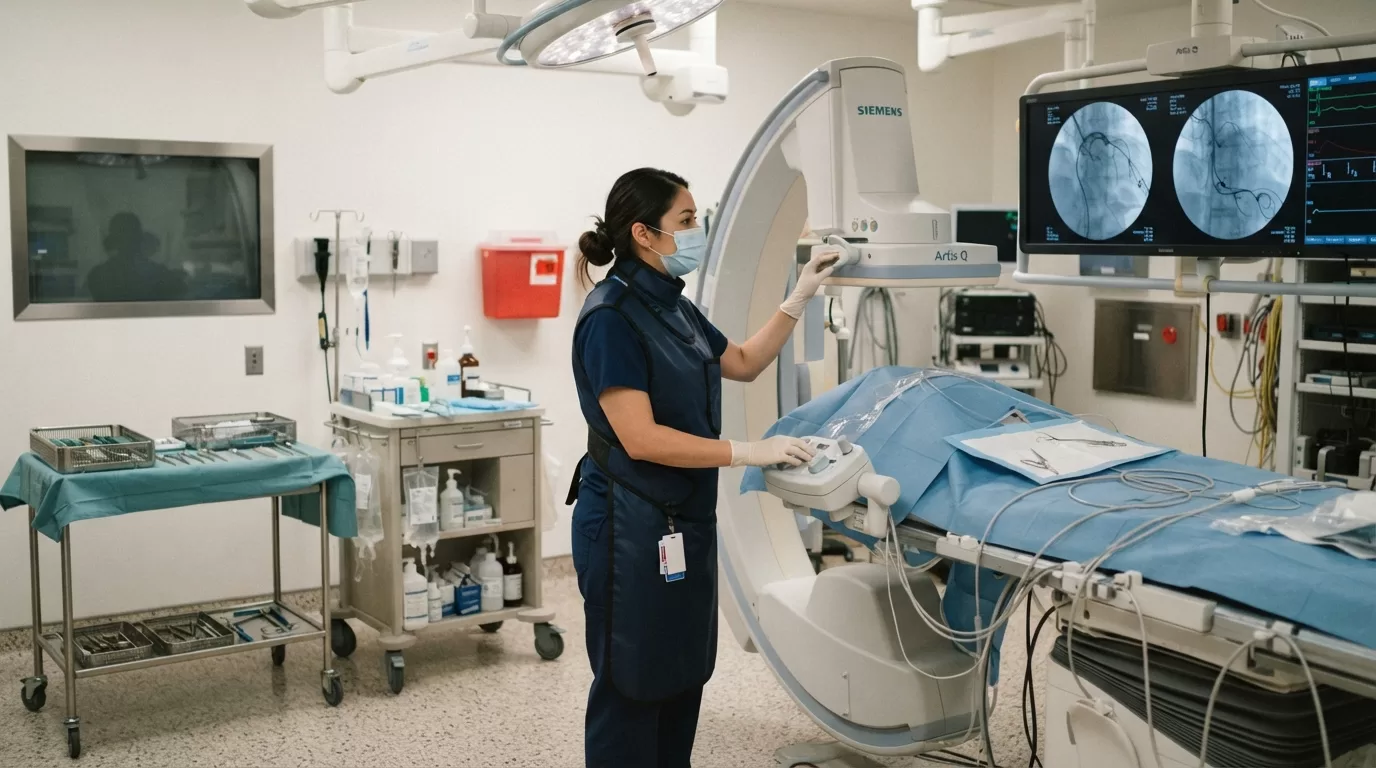
Interventional radiology techs support minimally invasive, image-guided procedures that replace or complement traditional surgery. You’re not taking static images and moving on; you’re in the room for the entire case, often standing for two to six hours while a radiologist threads catheters, deploys stents, performs biopsies, drains abscesses, or embolizes bleeding vessels — all under live fluoroscopy.
Your responsibilities span three domains:
- Technical imaging: Position the C-arm, adjust fluoroscopy settings, manage dose, capture digital subtraction angiography runs, and ensure image quality throughout the procedure.
- Sterile technique: Prep and drape the patient, maintain the sterile field, hand instruments to the radiologist, and manage contrast injections through power injectors or manual syringes.
- Patient care: Monitor vitals, communicate with anxious or sedated patients, coordinate with anesthesia or nursing, and watch for contrast reactions or procedural complications in real time.
Common procedures include cerebral angiograms, liver biopsies, uterine fibroid embolizations, dialysis fistula interventions, TIPS placements, and emergent hemorrhage control. The case mix varies by facility size and trauma level, but one constant holds: you won’t know your schedule more than a day in advance, and emergencies don’t care about your dinner plans.
IR Tech Salary: The Numbers and the Add-Ons
Interventional radiology techs command some of the highest wages in diagnostic imaging. According to the U.S. Bureau of Labor Statistics’ Occupational Outlook Handbook for radiologic and MRI technologists, median pay for all rad techs sits around $65,000 annually, but IR specialists typically earn 20 to 40 percent above that baseline.
Realistic salary ranges for credentialed IR techs in 2026:
- Staff IR tech (hospital-employed, day shift): $72,000 to $88,000 base
- Staff IR tech with regular on-call rotation: $78,000 to $95,000 total compensation
- Lead or senior IR tech: $85,000 to $105,000
- Travel IR tech (13-week contracts): $95,000 to $120,000 annualized, including taxable hourly and non-taxable stipends
On-call pay structures vary widely but generally follow one of two models: a flat daily or weekly standby rate (typically $3 to $6 per hour while on call but not in-house) plus a callback premium (time-and-a-half or double-time once you’re paged in), or a guaranteed minimum number of callback hours per pay period regardless of actual volume. High-volume trauma centers often pay the most competitive on-call rates because the pager will go off — sometimes multiple times per night.
Geography matters. Metropolitan markets with academic medical centers and level-one trauma designation — think Boston, San Francisco, Seattle, Dallas — pay at the top of the range. Rural or community hospitals may offer lower base pay but sweeter on-call incentives to retain staff willing to carry the pager every third or fourth night.
Certification adds value. Holding both ARRT (R) and the ARRT Vascular-Interventional Radiography (VI) credential consistently correlates with higher starting offers and faster advancement. Some facilities won’t interview without the VI; others will hire on the (R) alone but expect you to sit for the VI within 18 to 24 months.
The On-Call Reality: Predictability Is the Real Cost
On-call work is the defining lifestyle feature of IR tech careers, and it’s where burnout often begins — not because the hours are necessarily brutal in aggregate, but because the unpredictability erodes your ability to plan anything outside work.
A typical on-call rotation might look like this: you work Monday through Friday, 7 a.m. to 3:30 p.m., then carry the pager from 5 p.m. Friday through 7 a.m. Monday. You’re required to arrive within 30 minutes of a page (or 45 to 60 minutes in rural settings). You might get paged at 6 p.m. Friday for a GI bleed embolization that runs until 10 p.m., sleep until 2 a.m., then get called back for a stroke thrombectomy that finishes at 6 a.m. — and you’re still on call until Monday morning handoff.
Some weeks you’ll never hear the pager. Other weeks you’ll work an extra 15 to 20 hours on top of your regular 40. The volume is impossible to predict because it’s driven by trauma, stroke alerts, acute hemorrhage, and emergent vascular access — none of which follow a schedule.
The toll isn’t just lost sleep. It’s the canceled birthday dinner, the missed half-marathon you trained for, the constant low-grade anxiety that you can’t fully relax because the pager might go off during the movie, the hike, the family gathering. Over time, that vigilance becomes exhausting even on quiet weeks.
Travel IR techs often face more on-call burden, not less, because facilities hire travelers specifically to cover gaps in their on-call rotation. A 13-week assignment might include every-other-night call or even solo weekend coverage. The pay compensates for the intensity, but the lifestyle cost is real.
Strategies That Help
Techs who sustain long IR careers without burning out tend to share a few practices:
- Rotate on-call duty fairly: Push for equitable schedules that spread the weekend and holiday load across the team, not just the travelers or the newest hires.
- Set boundaries on your off-call weeks: Protect that time fiercely. Don’t volunteer to pick up extra call unless you genuinely need the money and have the margin.
- Build callback recovery into your life: If you worked until 4 a.m. on a callback, negotiate a late start the next day or take a comp day. Facilities that refuse this courtesy lose staff fast.
- Track your total hours: Log everything — standby time, callback hours, drive time. If you’re consistently working more than 50 to 55 hours per week for months on end, the compensation model isn’t covering the real cost.
Burnout Factors Unique to Interventional Radiology
Burnout in IR isn’t identical to burnout in general radiology or CT. The procedural intensity, the emergent nature of the work, and the patient acuity create specific stressors:
Lack of closure. In diagnostic imaging, you perform the exam and move on; the radiologist reads it later. In IR, you’re in the room for the entire case, but you rarely follow the patient long-term. You stabilize a massive hemorrhage at 3 a.m., and you may never know if that patient walked out of the hospital or coded two days later. That lack of narrative closure can feel unsatisfying over time.
Physicality and radiation exposure. You’re wearing 15 to 20 pounds of lead for hours, often in awkward positions while managing the C-arm and sterile field simultaneously. Chronic back, neck, and knee pain is common. Radiation dose adds up despite shielding, and while modern equipment and dose-monitoring protocols keep exposure within safe limits, the cumulative concern is always in the back of your mind.
Emotional intensity. IR cases are often emergent and high-stakes. You’re working on bleeding trauma patients, stroke victims in the narrow thrombectomy window, cancer patients receiving palliative embolization. The atmosphere is quieter than an OR — often just you, the radiologist, and a sedated patient — but the pressure is no less real.
Team size. Many IR suites run with just one or two techs on duty. If you’re solo and get two simultaneous emergent cases, someone is waiting, and the radiologist is stressed, and you’re the only person who can prep both rooms. That isolation and the weight of being the single point of failure wears on people.
According to a 2024 survey published in the Journal of Vascular and Interventional Radiology, nearly 40 percent of IR technologists reported moderate to high burnout, with unpredictable scheduling and inadequate staffing cited as the top two contributors — ahead of workload volume itself. The study underscores that burnout in IR is less about working hard and more about working without predictability, support, or control over your time.
Is the IR Tech Career Right for You?
Interventional radiology is one of the most intellectually engaging, procedurally diverse, and well-compensated paths in imaging. It’s also one of the least compatible with a nine-to-five lifestyle. The question isn’t whether IR is objectively “good” or “bad” — it’s whether the trade-offs align with your priorities right now.
Consider the IR tech specialty if:
- You want procedural involvement, not just image acquisition.
- You thrive in high-acuity, fast-moving environments where no two days are the same.
- You’re comfortable with irregular hours and can build a life that accommodates on-call unpredictability.
- You value higher compensation and are willing to earn it through schedule flexibility and occasional intensity.
- You’re early in your career or in a life stage where weekend and evening work doesn’t conflict with major caregiving or family obligations.
Reconsider or delay the move if:
- You’re already stretched thin with caregiving responsibilities or managing a chronic health condition that requires routine sleep and predictable schedules.
- You’re looking for true work-life separation and the ability to plan personal commitments weeks in advance.
- You’re prone to anxiety when you can’t control your time or when plans change suddenly.
- You’re hoping to avoid physical strain — the lead, the standing, and the ergonomic demands are non-negotiable in IR.
There’s no shame in recognizing that a specialty doesn’t fit your life right now. Plenty of rad techs move into IR after a few years in general radiology, and others move out of IR into CT, MRI, or leadership roles when their life circumstances change. The pathway isn’t one-way.
Preparing for the Transition
If you’re ready to pursue interventional radiology, start with these concrete steps:
Get your ARRT (R) first. You need the basic radiography credential before you can sit for the Vascular-Interventional (VI) exam. If you’re still in school, focus on mastering positioning, anatomy, and fluoroscopy principles — they’re the foundation.
Seek clinical exposure early. Volunteer to rotate through your facility’s IR suite during your rad tech clinicals, or ask to shadow an IR tech for a few shifts. Observe the workflow, the pace, the communication style, and the on-call reality before you commit to certification.
Study the ARRT VI content outline. The exam covers vascular anatomy, procedural protocols, sterile technique, pharmacology (contrast agents, anticoagulants, sedation basics), and patient care during interventions. Many candidates use self-study guides or online review courses; budget two to four months of focused prep if you’re working full-time.
Research facility cultures. Not all IR departments are equally supportive. During interviews, ask about on-call rotation structure, callback frequency, team size, and how the facility handles schedule predictability and comp time after long callbacks. A facility that respects your time off-call is worth more than a slightly higher base salary.
Consider travel contracts strategically. Travel IR tech rates are high, but the on-call load is often intense. If you’re new to IR, a staff position with mentorship and predictable onboarding might serve you better initially. Once you’re confident and credentialed, travel work can be lucrative and offer geographic variety.
Interventional radiology offers a career that’s procedurally rich, intellectually stimulating, and financially rewarding — but it asks for flexibility, resilience, and a willingness to live with unpredictability. The techs who thrive long-term are the ones who go in with open eyes, build boundaries where they can, and regularly reassess whether the trade-offs still make sense for their lives.
If you’re exploring IR tech opportunities or want to discuss how travel contracts compare to staff roles in interventional radiology, reach out to our imaging specialty team at contact@intuites.healthcare — we work with facilities across the country and can walk you through real contract structures, on-call expectations, and market differences before you make the leap.
Sources
Ready for your next imaging assignment?
Browse open imaging jobs across the US — weekly pay, stipends, and a recruiter who reads every application.