
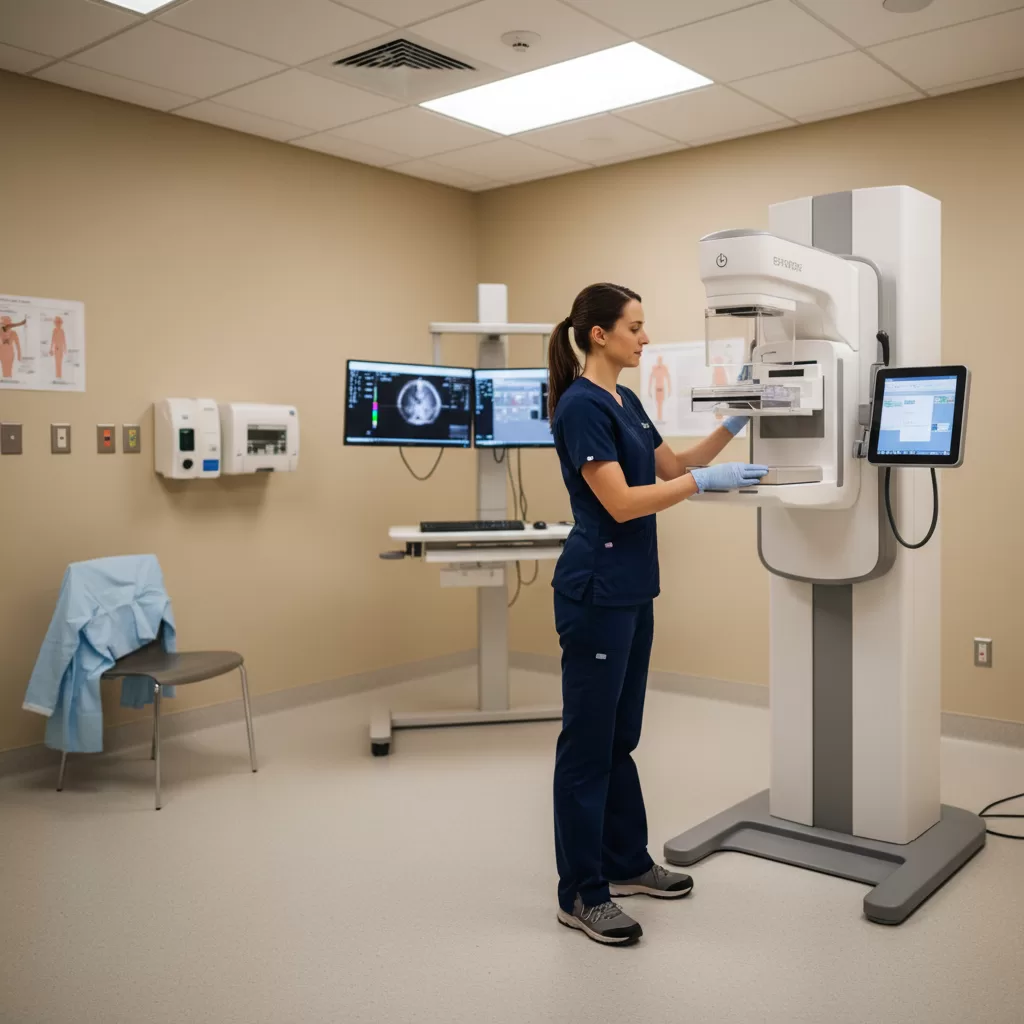
If you are a mammographer, you already know: the work is physically demanding, emotionally heavy, and often relentlessly paced. Repetitive positioning. Anxious patients. The weight of knowing your eyes might catch something life-changing. And then there is the sheer volume — exam after exam, with little room to reset.
Mammographer burnout is not about lacking resilience. It is about workflow design that does not account for the realities of breast imaging. The good news? Small, targeted fixes — ergonomic tweaks, smarter scheduling, and structured emotional support — can make a measurable difference.
Here is what actually works, drawn from imaging departments that have reduced turnover and improved tech satisfaction.
Ergonomic Setup: Stop Fighting Your Workstation
Mammography is one of the most physically taxing imaging modalities. You are constantly reaching, positioning, compressing — often while patients lean on you for stability. Poor ergonomics do not just cause soreness; they drive people out of the field.
Height-adjustable positioning is non-negotiable. If your workstation is fixed at the wrong height, you are compensating with your shoulders and back all day. Ideal positioning station height is 36 to 42 inches, depending on your height and the patient's build. Facilities that install hydraulic or electric-lift positioning platforms report fewer shoulder and rotator cuff complaints within months.
Footwear and floor mats matter more than you think. Anti-fatigue mats at the positioning station reduce lower-back strain. Pair that with supportive, cushioned shoes — not the fashion sneakers that fall apart in three months. Some techs swear by clogs with arch support; others prefer trail-running shoes. Find what works and replace them every six months.
Compression paddle ergonomics: If you are reaching across your body or twisting to adjust the paddle, your setup is wrong. The paddle controls should be within easy reach, and you should be able to make fine adjustments without leaning. Some newer units have wireless remotes; if your facility is upgrading equipment, advocate for that feature.
Scheduling: Manage Patient Load Like the Finite Resource It Is
Breast imaging workload is not just about exam count — it is about exam type, patient anxiety, and turnaround pressure. A day of twelve screening mammograms is not the same as twelve diagnostic exams with callbacks and ultrasounds.
Cap screening loads at 12 to 15 exams per shift. Beyond that, positioning quality slips, patient interactions become rushed, and error risk climbs. Some high-volume centers push 20+ screenings per tech per day. That is not sustainable, and it is a burnout recipe.
Separate callback slots from screening blocks. Diagnostic exams take longer and carry more emotional weight. Schedule them in dedicated windows — ideally with a 10-minute buffer between cases. That buffer is not downtime; it is reset time. You need it to regroup, check image quality, and mentally prepare for the next anxious patient.
Stagger start times to avoid morning bottlenecks. If all techs start at 7 a.m. and the first patients arrive at 7:15, you are setting up a chaotic morning. Stagger starts by 30 minutes so one tech can handle early arrivals while another preps rooms and reviews the schedule.
Build in admin time. Quality control, equipment checks, and peer review are part of the job — not tasks to squeeze in between patients. Block 30 to 45 minutes mid-shift for these responsibilities. It prevents the “stay late to finish paperwork” trap that erodes work-life boundaries.
Emotional Labor: Name It, Structure Support for It
Mammography carries unique emotional labor. You are often the first person to see something suspicious. You deliver positioning instructions to patients who are scared, in pain, or reliving trauma. You cannot show alarm when you spot a concerning density, even though you are already thinking three steps ahead.
This is real work, and it is exhausting. Facilities that treat it as an afterthought lose good techs.
Peer debrief sessions after difficult cases. Not formal counseling — just structured time to process with a colleague who gets it. Some departments hold brief “check-ins” at shift end: five minutes in the break room, optional attendance, no forced sharing. It normalizes the emotional load and prevents isolation.
Rotate callback responsibilities. If the same tech always handles diagnostic follow-ups, they absorb a disproportionate share of the anxiety and patient distress. Rotate callback duties weekly so the emotional weight is distributed.
Training on trauma-informed positioning. Many patients have a history of trauma, and breast imaging can be re-traumatizing. Learning to offer control (“I will let you know before I touch you”), explain each step, and read non-verbal cues reduces both patient distress and your own emotional exhaustion. Some health systems now offer half-day workshops on this; advocate for it if yours does not.
Workload Visibility: Make the Invisible Work Visible
Administrators often do not understand why mammographers burn out. They see exam counts and assume the workload is manageable. What they miss: the physical repetition, the emotional labor, the cognitive load of artifact recognition and positioning troubleshooting.
Track and report the full scope of work. Log not just exams completed, but also patient callbacks, equipment troubleshooting, peer consults, and quality-control tasks. When leadership sees the real workload, they are more likely to approve staffing increases or workflow changes.
Use anonymous surveys to surface burnout risk. Quarterly check-ins — even a simple five-question survey — can flag problems before people quit. Questions to include:
- Do you have time to complete quality-control tasks during your shift?
- How often do you skip breaks to stay on schedule?
- Do you feel supported after emotionally difficult cases?
- Is your workstation ergonomically comfortable?
Celebrate small wins. When a workflow change works — patient satisfaction scores improve, callback turnaround shortens, or shoulder pain complaints drop — acknowledge it. Recognition matters, especially in a field where the work is often invisible until something goes wrong.
Facility-Level Changes: What to Advocate For
Individual coping strategies help, but systemic fixes prevent burnout at the source. If you are in a position to influence department decisions — or if you are considering a new role — these are the changes that move the needle:
- Dedicated positioning assistants for high-volume screening days
- Cross-training so you can rotate between mammography and other modalities (ultrasound, bone density) to vary physical demands
- Protected time for continuing education and certification prep, not just annual compliance modules
- Equipment upgrades prioritized based on tech input, not just radiology preferences
- Flexible scheduling that accommodates 10- or 12-hour shifts instead of rigid eight-hour blocks, for those who prefer fewer days on-site
These are not perks. They are retention strategies. Facilities that invest in mammographer wellness see lower turnover, fewer call-outs, and better image quality.
Your Next Step
If your current facility is not addressing mammographer burnout — or if you are ready for a workplace that prioritizes imaging tech wellness — reach out. Email contact@intuites.healthcare with “mammography workflow support” in the subject line, and let us know what matters most in your next role. We work with breast imaging centers that are serious about sustainable staffing.
Ready for your next imaging assignment?
Browse open imaging jobs across the US — weekly pay, stipends, and a recruiter who reads every application.