If you have spent five or more years positioning patients, optimizing sequences, and navigating the physics of magnetic resonance imaging, you already know the unspoken truth: MRI is the specialty where safety expertise separates good techs from great ones. What many experienced technologists do not yet realize is that this expertise can translate into a distinct leadership role with significantly higher earning potential and weekday-hours autonomy.
The MRI Safety Officer — often abbreviated MRSO — is a relatively young but rapidly growing position in U.S. hospitals and imaging centers. Driven by Joint Commission standards, ACR accreditation requirements, and a string of high-profile safety incidents over the past decade, healthcare organizations now recognize that MRI safety demands dedicated oversight. For the right candidate, this role offers a clear path to six figures, meaningful influence over department protocols, and a schedule that typically excludes nights, weekends, and on-call rotations.
Here is what the MRSO career path looks like in 2026, from certification requirements to salary benchmarks to the day-to-day responsibilities that define the role.
What an MRI Safety Officer Actually Does
The MRSO is not a scanner operator. Instead, this professional serves as the facility’s subject-matter expert and compliance lead for all aspects of MRI safety — from screening protocols and implant compatibility to emergency response planning and staff education. The role exists at the intersection of clinical operations, risk management, and regulatory compliance.
According to The Joint Commission, the MRSO is responsible for developing and enforcing written safety policies, ensuring all MRI personnel receive documented training, and maintaining current knowledge of device labeling, contraindications, and incident investigation procedures. In practical terms, that means you become the go-to person when a surgeon asks whether a new spinal implant is safe at 3T, when administration needs to draft an MRI safety plan for ACR accreditation, or when an adverse event requires root-cause analysis and corrective action.
Day-to-day responsibilities typically include:
- Reviewing and approving patient screening forms for high-risk cases or uncertain implant histories
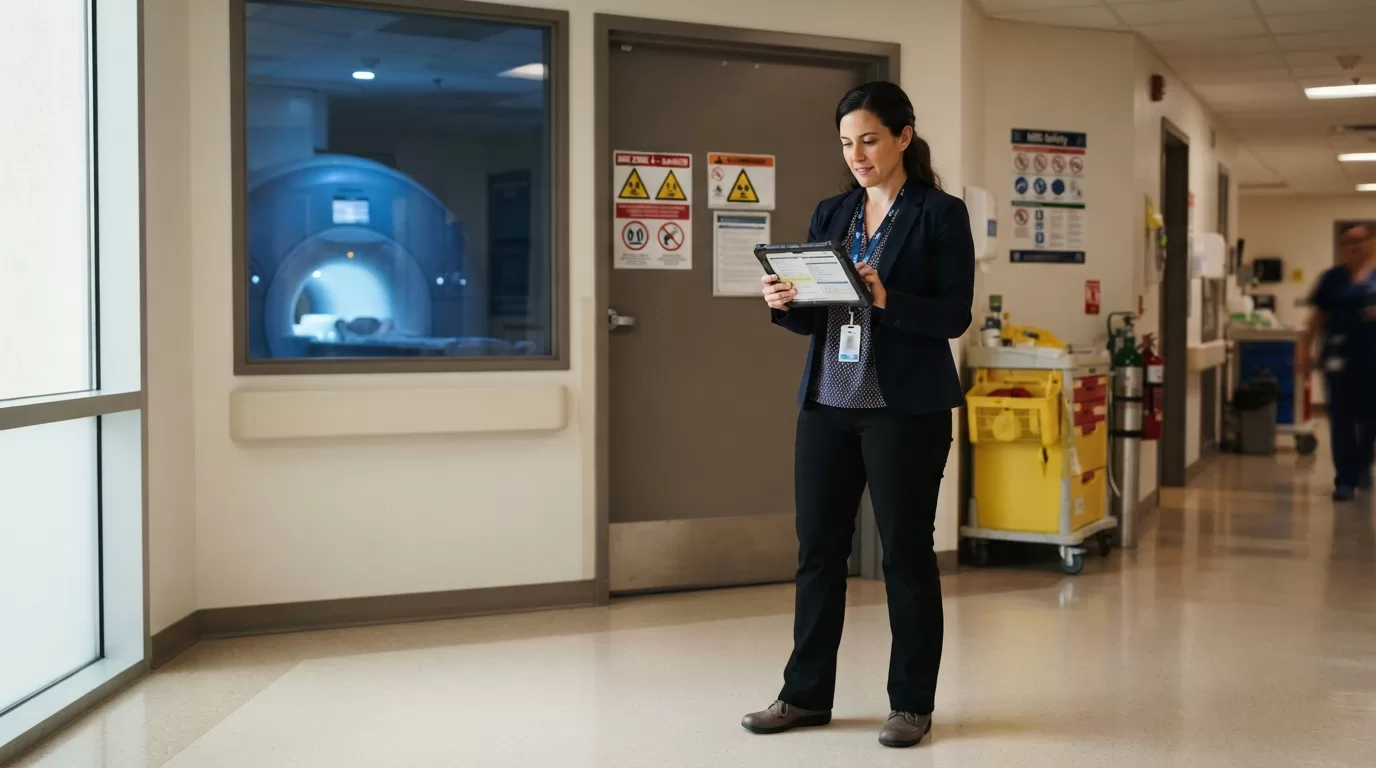
- Conducting quarterly safety audits of MRI suites, including zone signage, fire extinguisher placement, and ferromagnetic detection systems
- Delivering annual competency training to radiologists, techs, nurses, anesthesia staff, and ancillary personnel who enter the MRI environment
- Serving as the liaison between radiology, biomedical engineering, and risk management during equipment installations or protocol changes
- Tracking and investigating safety incidents, near-misses, and equipment malfunctions
- Maintaining up-to-date documentation for accreditation surveys and state inspections
The role is overwhelmingly administrative and educational rather than hands-on scanning, though many MRSOs continue to take occasional shifts in the magnet room to stay current with workflow realities.
Certification Pathways and Prerequisites
Unlike the entry-level ARRT(MR) credential that most practicing MRI techs hold, MRSO certification is a post-experience, board-level credential. The primary certifying body is the American Board of Magnetic Resonance Safety (ABMRS), which launched its Board Certified MRI Safety Officer exam in 2014 and has certified more than 1,200 professionals as of early 2026.
Eligibility for the ABMRS exam requires candidates to meet one of several pathways. The most common route for technologists is three years of documented clinical MRI experience plus completion of an ABMRS-recognized MRI safety training course. These courses — offered by organizations such as the Institute for Magnetic Resonance Safety, Education, and Research — run two to three days in person or online and cover topics including magnetic field interactions, cryogen safety, implant evaluation, contrast protocols, and regulatory standards.
The exam itself is a 150-question, multiple-choice assessment administered at Pearson VUE testing centers. Content domains include:
- MRI physics and the biological effects of static, gradient, and radiofrequency fields
- Screening and risk assessment for implants, devices, and foreign bodies
- Zone classification, access control, and facility design per ACR guidance
- Emergency procedures, including quench protocols and patient extraction
- Regulatory standards from FDA, ACR, Joint Commission, and CMS
Pass rates hover around 70 percent for first-time test-takers, and candidates typically invest 60 to 80 hours in focused study. Certification is valid for three years and requires 36 hours of continuing education for renewal.
Some larger academic medical centers also accept or prefer the MRI Safety Expert certification offered through international bodies, but ABMRS remains the U.S. standard recognized by most accreditation surveyors and hospital credentialing committees.
Salary Potential and Market Demand
Compensation for MRI Safety Officers reflects both the specialized knowledge required and the administrative scope of the role. According to the U.S. Bureau of Labor Statistics, the median pay for diagnostic imaging supervisors and specialists — a category that includes MRSOs — was approximately $87,000 in 2025. However, real-world salary data from recent job postings and recruiter feedback shows a wider and higher range.
In 2026, the typical MRSO salary spans $95,000 to $135,000 annually, depending on geography, facility size, and whether the role includes additional imaging leadership responsibilities. Major metropolitan markets such as New York, Boston, San Francisco, and Seattle consistently post openings at the upper end of that band, while smaller hospitals and outpatient centers in the South and Midwest trend closer to $95,000 to $110,000. Academic medical centers with multiple MRI scanners and research protocols often add premium pay for MRSOs who also manage safety oversight for experimental sequences or high-field systems.
A meaningful portion of MRSO compensation comes in the form of stable, weekday schedules. Because the role is primarily administrative, most positions operate Monday through Friday during business hours, with no evening, weekend, or on-call obligations. For technologists who have spent years working 12-hour shifts, rotating weekends, and covering nights, that predictability alone represents substantial lifestyle value.
Demand for credentialed MRI Safety Officers has grown steadily since 2020. The Joint Commission’s Environment of Care standards explicitly require hospitals to designate an MRI Safety Officer and document that person’s qualifications, training, and ongoing competency. ACR accreditation similarly mandates a named MRSO as part of its MRI facility requirements. As more outpatient imaging centers pursue ACR accreditation to remain competitive for payer contracts, the need for qualified safety officers extends beyond the hospital setting.
Job listings for MRSO roles increased by approximately 18 percent between 2024 and 2026, and turnover remains relatively low — most professionals who transition into the role stay for three or more years, viewing it as a terminal career step rather than a temporary assignment.
Who Thrives in the Role
Not every experienced MRI tech will find satisfaction in the MRSO position. The work favors technologists who are detail-oriented, comfortable with documentation and policy writing, and energized by teaching and problem-solving rather than direct patient care. If you find yourself gravitating toward the safety checklist rather than the scan protocol, if you are the person your colleagues ask when they encounter an unfamiliar implant card, or if you have ever caught yourself reading an FDA safety communication for fun, the MRSO role may be a natural fit.
Strong candidates typically possess the following characteristics:
- Three or more years of hands-on MRI experience across multiple scanner platforms and field strengths
- Comfort with regulatory language and the ability to translate Joint Commission or ACR standards into practical departmental policies
- Confidence in public speaking and delivering education to mixed audiences, from entry-level techs to attending physicians
- A methodical approach to risk assessment and the patience to investigate incidents thoroughly rather than rush to conclusions
- Willingness to say “no” when safety protocols conflict with clinical convenience or throughput pressures
Conversely, technologists who thrive on the adrenaline of a fast-paced scan room, who prefer working independently rather than coordinating across departments, or who dislike repetitive documentation tasks may find the MRSO role less fulfilling than anticipated. It is a leadership position, but the leadership is exercised through systems, training, and oversight rather than direct supervision of scanning operations.
Next Steps for Interested Technologists
If the MRSO path aligns with your career goals and work preferences, the transition typically unfolds over 12 to 18 months. Start by assessing your current experience base — if you have fewer than three years in MRI, focus on building diverse scanner exposure and volunteering for safety committee participation at your current facility. Many radiology directors view internal MRSO candidates favorably, so expressing interest early can position you for a promotion when your department creates or vacates the role.
Once you meet the experience threshold, enroll in an ABMRS-recognized safety training course. These programs run $1,500 to $2,500 and are occasionally covered by employer education budgets, particularly if you frame the request as part of accreditation preparation. After completing the course, schedule your board exam within three to six months while the material remains fresh.
Passing the exam does not automatically create an MRSO opening at your facility, so concurrent networking matters. Join the MRI Safety Officer LinkedIn group, attend sessions at RSNA or AHRA conferences, and consider reaching out directly to MRI Safety Officers at nearby hospitals to learn how they built their roles. Some technologists pursue per diem MRSO consulting, working with multiple outpatient centers that need part-time safety oversight but cannot justify a full-time position.
If your current employer does not have an MRSO role and shows no plans to create one, be prepared to look externally. Urban and suburban markets with multiple hospital systems offer the most opportunities, and recruiters who specialize in imaging leadership can often surface openings before they are publicly posted.
For experienced MRI technologists seeking a leadership trajectory that values depth over breadth, the MRI Safety Officer role delivers both financial reward and professional purpose. If you are ready to explore MRSO contract opportunities or want to discuss how your background aligns with current openings, email contact@intuites.healthcare with your resume and a brief note about your certification timeline.
Sources
Ready for your next imaging assignment?
Browse open imaging jobs across the US — weekly pay, stipends, and a recruiter who reads every application.