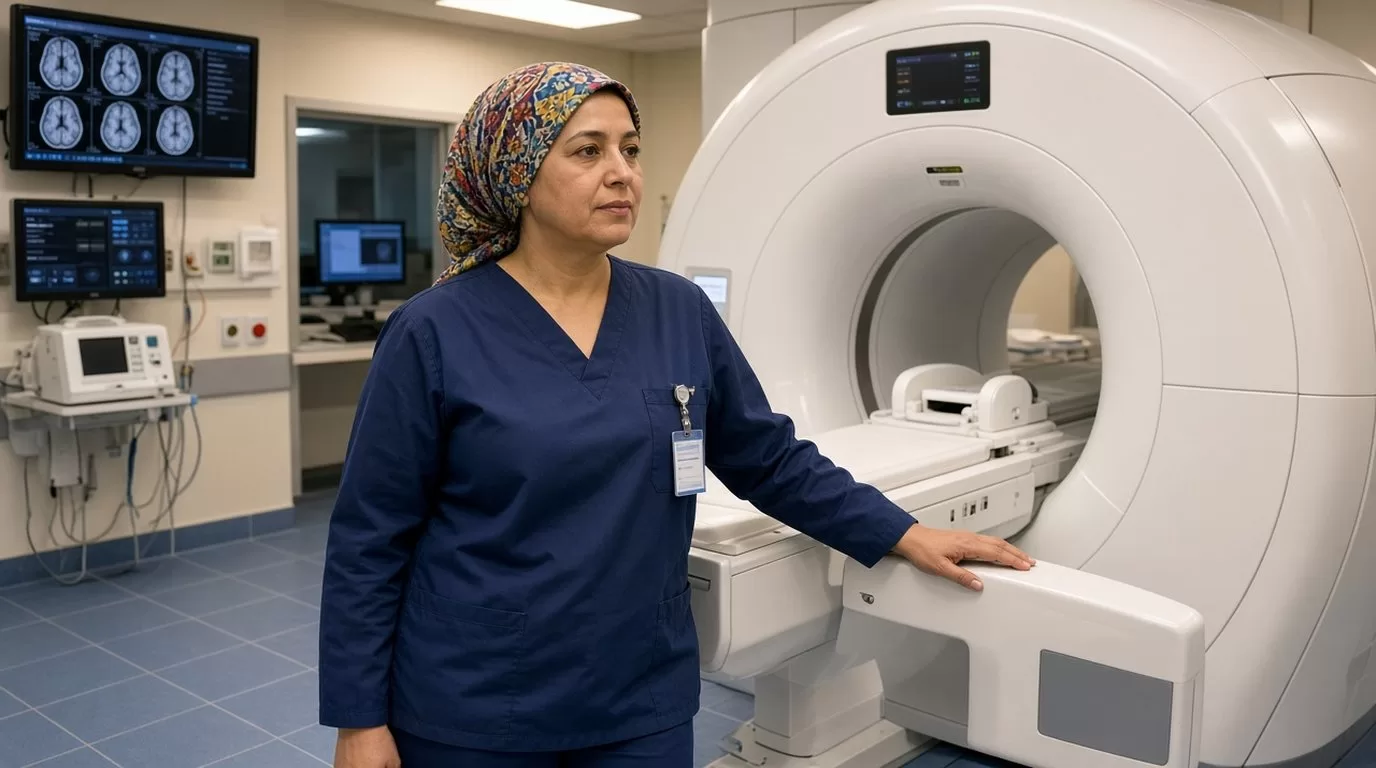
She clocked in at 6:47 a.m., three days after her second round of chemotherapy. The nausea had finally leveled out enough that she trusted herself to drive. Her headscarf — deep purple with small white flowers — was tied the way her daughter had taught her, snug enough that it wouldn't slip when she leaned over the MRI control panel.
Nobody asked her to come in. Her manager had told her to take whatever time she needed. But she showed up anyway, because the scans still needed to happen, because her patients were already anxious enough without wondering why their regular tech wasn't there, and because — honestly — sitting at home made the diagnosis feel bigger than it was.
This is a story about one imaging technologist who chose to work through treatment. It is not a story about what anyone should do. It is a reflection on what happens when clinician illness collides with the instinct to care for others, and why the choice to step back is just as valid as the choice to keep going.
The Weight of Being the Patient and the Professional
Healthcare worker cancer puts you in two worlds at once. You are suddenly the person in the gown, fielding the same anxious questions you have answered a thousand times for others. You know exactly what the radiologist is looking for on your own imaging. You understand the staging terminology before the oncologist finishes the sentence.
That double awareness can be grounding or it can be unbearable. For some imaging techs, returning to work offers a sense of control — a place where their expertise still matters, where they are not defined by their diagnosis. For others, the cognitive dissonance of positioning patients on the same table where they recently lay as a patient is too much.
The American Hospital Association reported in 2025 that nearly eighteen percent of healthcare workers have managed a serious personal illness while employed in clinical roles. The number rises to twenty-two percent when you include imaging and diagnostic professionals, likely because these roles often involve shift work and per diem flexibility that makes partial schedules more feasible.
Neither choice — working or not working — says anything about your strength. The MRI tech in this story kept her Tuesday and Thursday morning shifts because the structure helped her mentally. Another tech at the same hospital took eight weeks of full leave and came back when she was ready. Both decisions were right.
What the Law Actually Protects
If you are facing clinician illness, you have specific legal protections that your employer must honor. The Family and Medical Leave Act guarantees up to twelve weeks of unpaid leave per year for serious health conditions, and your job must be held for you. The Americans with Disabilities Act requires reasonable accommodation if your condition qualifies as a disability — which most cancer diagnoses do during active treatment.
Reasonable accommodation can mean:
- Modified shift schedules that align with treatment days
- Temporary reassignment to lower-radiation or less physically demanding imaging modalities
- Permission to sit during scans or take additional breaks
- Access to a private space for medication or rest
- Extended leave beyond FMLA if your employer has a policy allowing it
The key word is “reasonable.” Your hospital or imaging center does not have to create a role that does not exist or eliminate essential job functions. But if you can still perform the core duties of your position with adjustments, they are required to explore those options with you.
The tech in this story negotiated a schedule that kept her off the on-call rotation and limited her to brain and spine MRIs — shorter exams that let her manage fatigue. Her manager documented the accommodation in writing and confirmed it would remain in place through the end of her treatment cycle. That documentation mattered when a scheduling conflict arose two months later and a new supervisor tried to assign her a full weekend shift.
The Practicalities Nobody Warns You About
Working through treatment is logistically complicated in ways that are hard to predict until you are in it. Chemotherapy does not follow a neat nine-to-five schedule. Radiation appointments might be at ten a.m. three days a week. Labs get drawn early. Fatigue does not announce itself — it just arrives mid-shift and refuses to leave.
If you are considering a partial return to work during your own treatment, these practicalities help:
- Front-load your hardest shifts early in your treatment cycle, when side effects are typically milder
- Build in a buffer day after infusion before you work again
- Stock your locker with anti-nausea medication, electrolyte packets, and shelf-stable snacks
- Let one trusted coworker know your situation so someone can cover if you need to step out
- Wear compression socks if neuropathy or fluid retention becomes an issue
- Keep a change of scrubs at work in case of unexpected illness
The imaging tech in this story kept a small whiteboard in her locker with her treatment dates and her work schedule side by side. It helped her see conflicts before they became crises. When her oncologist moved an infusion up by two days, she had enough notice to swap a Thursday shift without scrambling.
She also learned to stop apologizing. Early on, she prefaced every schedule request with “I'm sorry, but…” Her manager finally told her: “You are managing a serious illness and still showing up for patients. You don't owe anyone an apology for needing flexibility.”
When Work Becomes the Lifeline
For some clinicians, the decision to keep working is not about obligation. It is about identity. The role of imaging technologist — the skill, the patient interaction, the rhythm of the day — can feel like the one part of life that cancer has not touched. Losing that can feel like losing yourself.
The Bureau of Labor Statistics Occupational Outlook Handbook notes that diagnostic imaging roles require a blend of technical skill and patient rapport that takes years to develop. You do not just learn to operate an MRI scanner. You learn to calm the claustrophobic patient, to position the post-surgical knee without causing pain, to explain the loud knocking sounds in a way that reassures instead of frightens. That expertise does not disappear because you are sick.
The tech in this story said her patients gave her something to think about besides scan results and cell counts. A seventy-two-year-old man getting his annual brain MRI told her jokes. A teenager with a torn ACL asked her about her headscarf and then showed her photos of his own grandmother, who had worn scarves during treatment thirty years earlier. These small moments were not distractions. They were reminders that her work still mattered.
But she also admitted there were days she should not have come in. Days when the fatigue was so heavy she had to sit between scans. Days when a patient's anxiety mirrored her own too closely and she had to step into the hallway to collect herself. On those days, she wished she had given herself permission to call out without guilt.
What This Story Is Not Asking You to Do
This piece is not a call to work through illness. It is not a suggestion that dedication means ignoring your body's limits. It is not a celebration of pushing through when you need rest. The healthcare industry has a long, troubling history of valorizing self-sacrifice, and we are not adding to that narrative here.
If you are facing clinician illness, you do not owe your employer your presence during treatment. You do not owe your patients continuity at the expense of your health. You do not owe anyone an explanation for taking the leave you are entitled to. The choice to work is exactly that — a choice. And the choice to stop working, to step back, to prioritize your recovery is equally valid and equally courageous.
The tech in this story worked because it helped her cope. Another tech might cope by resting, traveling, spending time with family, or simply not thinking about MRI machines for a few months. Both paths are right. The only wrong path is the one where you feel you have no choice.
If You Are the Coworker
If someone on your imaging team is going through treatment, your role is not to assume what they need. It is to ask and then follow through. Some clinicians want their diagnosis kept private. Others find it easier when the team knows and can offer small accommodations without being asked.
Helpful coworker actions include offering to swap shifts without requiring a detailed explanation, checking in without hovering, and respecting boundaries when someone says they would rather not talk about it. Unhelpful actions include telling cancer survival stories unless asked, offering unsolicited medical advice, or treating your coworker like they are fragile when they have made it clear they want to be treated normally.
The tech in this story said the most meaningful support came from a coworker who simply texted her the night before her first day back: “I'll bring extra coffee. Let me know if you need anything.” No drama. No pity. Just practical, quiet care.
The Weeks After Treatment Ended
The last infusion happened on a Wednesday in March. The tech worked her regular Thursday shift the next morning, then took the following week off — not because she was too sick to work, but because she finally felt safe enough to rest. The weight of showing up, of holding it together, of being both patient and professional, lifted. She slept for fourteen hours straight.
When she came back, she returned to her full schedule. The headscarf came off in May. The neuropathy in her fingers took longer to fade, and she still struggles with certain IV starts. But the scans still happen. The patients still get the care they came for. And she still shows up — not because she has to, but because she chooses to.
Her story is one of thousands. Healthcare workers face serious illness at rates similar to the general population, but the stakes feel different when you are the one who is supposed to have the answers. If you are navigating imaging tech work and personal treatment right now, know that your value is not measured by how many shifts you cover. It is measured by the skill and compassion you bring when you are there — however often “there” looks for you.
If you are exploring contract opportunities that offer the schedule flexibility to manage health needs alongside clinical work, email contact@intuites.healthcare with your specialty and the type of arrangement you are looking for.
Sources
Ready for your next imaging assignment?
Browse open imaging jobs across the US — weekly pay, stipends, and a recruiter who reads every application.