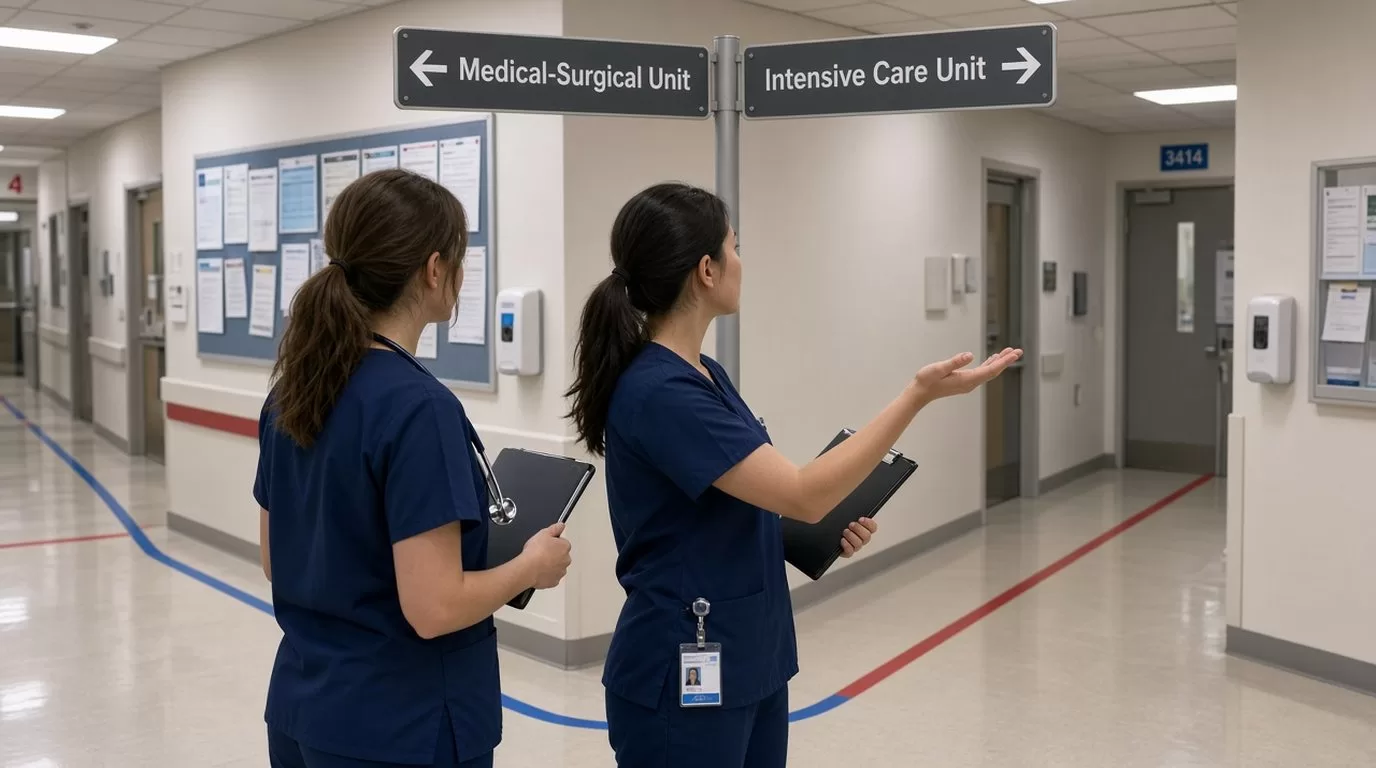
If you graduated nursing school in the past year, you have heard this approximately eight hundred times: “You really should start in med-surg.”
Maybe it came from your clinical instructor. Maybe your aunt who has been an RN for thirty years. Maybe three different preceptors during your capstone rotation. The message is always the same: medical-surgical nursing builds your foundation, teaches you time management, exposes you to everything, and prepares you for any specialty down the road.
But here is the thing nobody mentions: in 2026, the rules have quietly changed. New data from the American Nurses Association shows that 68% of new graduates who started directly in a specialty unit in 2025 remained in that role for two years or longer — a retention rate that actually beats the traditional med-surg pathway. So what is really going on with the nursing specialty debate, and does the old wisdom still hold?
What the “Med-Surg First” Camp Gets Right
Let us be fair to the traditionalists. The argument for starting your nursing career on a medical-surgical floor is not based on nostalgia or hazing. There are real, practical reasons this advice became standard in the first place.
Med-surg units expose you to an enormous variety of patient conditions in a compressed timeframe. You will manage post-operative patients, diabetic crises, respiratory infections, cardiac monitoring, wound care, and medication administration across multiple body systems — often all on the same shift. That breadth builds pattern recognition fast.
Time management skills develop differently on a med-surg floor than almost anywhere else in the hospital. When you are juggling six patients with different acuity levels, staggered medication times, competing care priorities, and constant interruptions, you learn to triage on the fly. The Bureau of Labor Statistics notes in its 2026 Occupational Outlook for registered nurses that adaptability and prioritization rank among the top skills employers seek, and med-surg is boot camp for both.
The mentorship infrastructure is usually stronger, too. Because med-surg has historically been the new-grad landing zone, most hospitals have invested in structured orientation programs, preceptorship models, and peer support specifically designed for nurses with zero experience. You are not the only one figuring things out.
But — and this is the part that deserves honest examination — med-surg is also where burnout hits hardest. The National Council of State Boards of Nursing reported in its 2025 workforce survey that first-year turnover on med-surg units averaged 32%, compared to 24% in specialty units with dedicated new-grad residency programs. High patient ratios, constant interruptions, and the emotional weight of managing complex, often chronically ill patients without the focused scope of a specialty can erode enthusiasm quickly.
The Case for Jumping Straight Into Specialty
Now the counterargument, which is gaining serious traction in 2026: if you know what you want to do, and a quality program exists to support you, why wait?
Critical care residencies, ED new-grad programs, and perioperative fellowships have proliferated over the past five years. According to the American Association of Critical-Care Nurses, 34% of hospitals now offer structured programs that accept nurses with zero experience directly into ICU roles — up from just 18% in 2021. These are not sink-or-swim placements. They are six-to-twelve-month residencies with extended orientation, simulation training, and lower patient ratios during the learning curve.
The retention data tells a compelling story. New graduates who start in the specialty they specifically chose stay longer, report higher job satisfaction, and show faster skill acquisition within that specialty domain. That 68% two-year retention figure from ANA is not an accident. When you are learning skills you actually want to master, in an environment you are excited about, motivation does half the work.
There is also an economic argument. Specialty roles often come with higher base pay and shift differentials. Starting in critical care, labor and delivery, or the operating room can mean an additional four to eight dollars per hour compared to med-surg, which adds up to roughly $8,000 to $16,000 annually. For new grads carrying student debt, that gap matters.
The counterpoint? Competency timelines are longer. A new grad RN in med-surg might feel independently functional in four to six months. In a specialized ICU or OR, that timeline stretches to ten to fourteen months on average. You will need more patience with yourself, and you will need an employer willing to invest in that extended learning period.
The Data Nobody Talks About: What Happens After Year Two
Here is where the conversation gets interesting. Most of the med-surg-first advice assumes you will eventually move to a specialty anyway, so the question is not “if” but “when.”
But retention data from the Bureau of Labor Statistics healthcare employment projections shows that nurses who complete two full years in their first role — whether med-surg or specialty — have an 81% likelihood of staying in acute care nursing long-term. The ones who bounce between units in year one or leave their first job before the eighteen-month mark? Only 54% remain in hospital nursing five years later.
Translation: the “right” first job is the one you will actually stick with long enough to build competence and confidence. If starting in your target specialty keeps you engaged, that might matter more than checking the med-surg box.
The flip side is also true. If you are genuinely undecided about your path, or if your dream specialty has zero new-grad programs in your area, med-surg remains the most reliable way to build a transferable skill set while you figure things out. Flexibility has value.
Four Questions to Ask Yourself Right Now
So where does that leave you, scrolling through job postings at midnight, wondering whether to apply for the med-surg opening or hold out for the NICU residency?
Try these four questions:
- Does the specialty role include a structured residency or extended orientation? If the answer is “three weeks of orientation, then you are on your own,” that is a red flag for any new grad, specialty or not. Look for programs offering at least twelve weeks of structured support.
- How certain are you about this specialty? If you have done multiple clinical rotations in critical care, shadowed in the OR, and genuinely cannot imagine yourself anywhere else, that clarity matters. If you are choosing based on a single eight-week rotation or what sounds cool, consider whether a broader foundation might serve you better.
- What does your financial situation allow? Specialty residencies sometimes pay slightly less during the training period. Med-surg roles often come with sign-on bonuses right now due to staffing shortages. Can you afford a slower ramp to full pay, or do you need income stability immediately?
- What is the turnover rate in the specific unit? This is the question nobody asks during interviews, and you should. High turnover means weak support structures, regardless of whether it is med-surg or specialty. A stable unit with experienced mentors beats a prestigious specialty with a revolving door.
What We Are Seeing in 2026 Hiring Patterns
Staffing agencies — and yes, we talk to hiring managers at dozens of hospitals monthly — are seeing a genuine shift in how facilities approach new-grad hiring. The old gatekeeping around specialty units is eroding, but not disappearing.
Magnet-designated hospitals and large academic medical centers are expanding specialty residencies because the return on investment is clear: lower turnover, higher satisfaction, better patient outcomes. Community hospitals and rural facilities still lean heavily on med-surg as the entry point, partly due to budget constraints around extended training programs.
Travel nursing contracts for new grads remain rare, but staff positions with relocation assistance are everywhere. Hospitals in competitive markets are willing to invest in training if you will commit to a two-year contract. That is your leverage.
The nursing specialty debate is not going away, but the terms are changing. You have more options than the previous generation did, and you also have more responsibility to choose intentionally.
So What Is the Right Answer?
Honestly? There is not one.
The “right” path depends entirely on your goals, your learning style, your financial needs, and the quality of the specific programs available to you. A well-structured med-surg orientation with strong mentorship will serve you better than a disorganized specialty program with inadequate support. A thoughtfully designed ICU residency will accelerate your growth faster than a chaotic med-surg floor with unsafe ratios.
The real mistake is not choosing med-surg or choosing specialty. The real mistake is taking a job — any job — without asking hard questions about orientation length, preceptor availability, patient ratios, turnover rates, and what support looks like when you are struggling.
Med-surg builds breadth. Specialty builds depth. Both are legitimate. Both require solid infrastructure to succeed. And both will teach you whether you are in the right place within six months.
The nurses who thrive long-term are not the ones who followed someone else's script. They are the ones who picked a path that matched their wiring, found a workplace that invested in their growth, and stayed long enough to get good at something that mattered to them.
If you are weighing a specialty opportunity right now, take a close look at the open roles in critical care, perioperative, or your target area — or reach out to contact@intuites.healthcare with specific questions about what structured support actually looks like in the contracts we are seeing.
Sources
- Bureau of Labor Statistics — Registered Nurses Occupational Outlook (bls.gov)
- National Council of State Boards of Nursing (ncsbn.org)
- American Nurses Association (nursingworld.org)
Ready for your next nursing assignment?
Browse open nursing jobs across the US — weekly pay, stipends, and a recruiter who reads every application.