
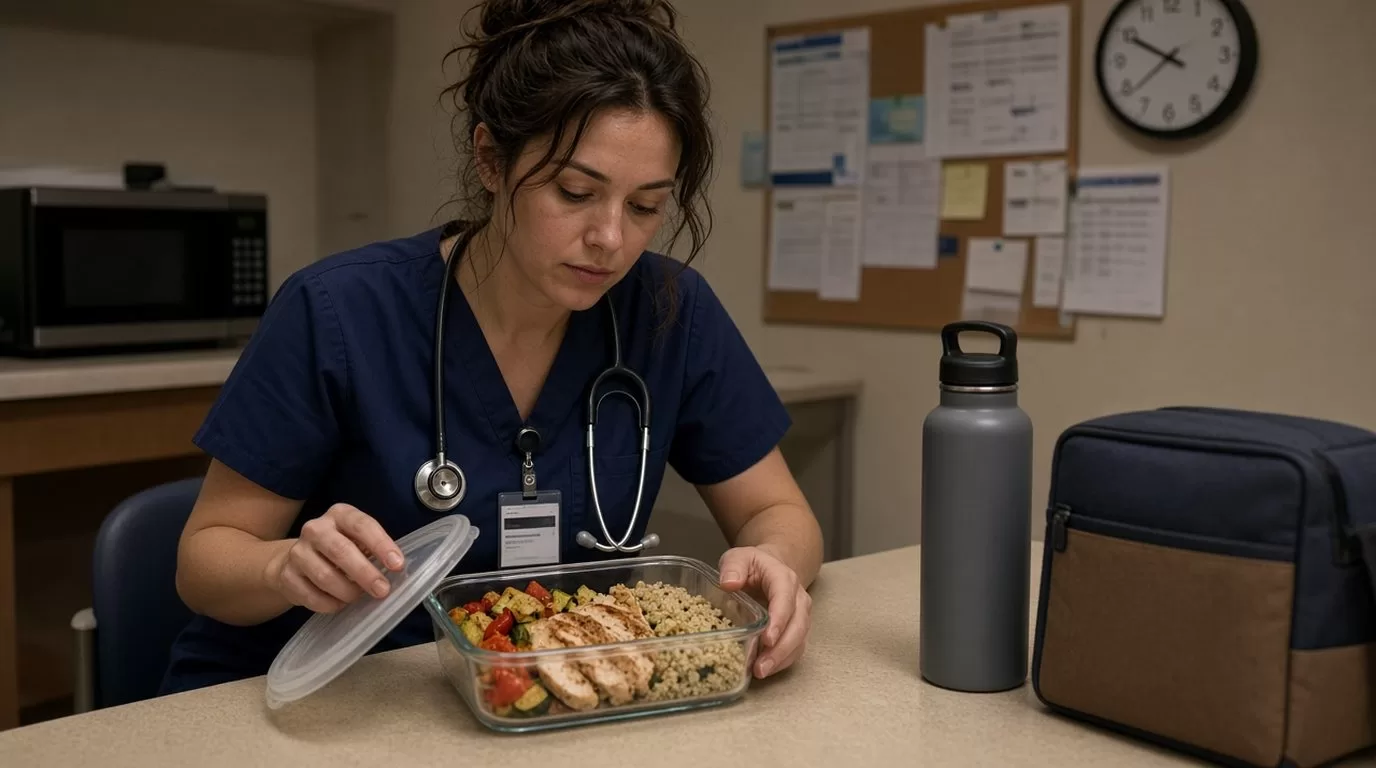
You’ve worked enough nights to know: what you eat at 2 AM hits differently than what you eat at 2 PM. Your circadian rhythm is running backward, your insulin sensitivity is lower, and that protein bar you grabbed from the vending machine three hours ago has left you foggy and irritable during the exact window when your ICU patients need you sharpest.
Night-shift nutrition isn’t just “eat healthy.” It’s a timing game. The National Institute for Occupational Safety and Health estimates that over 15 million Americans work nights, and healthcare makes up a disproportionate share of that cohort. Yet most generic meal-prep advice assumes you’re awake when the sun is up.
This guide is built for 12-hour night-shift healthcare workers who need a framework that actually works when your body thinks it should be asleep.
Why Standard Nutrition Advice Fails Night Workers
Here’s what happens physiologically when you flip your schedule: your body’s core temperature, cortisol rhythm, and glucose metabolism are all programmed to peak during daylight hours. When you eat a carb-heavy meal at 3 AM, your pancreas is less efficient at clearing glucose from your bloodstream than it would be at 3 PM. The result? Energy crashes, brain fog, and a higher risk of metabolic syndrome over time.
A 2023 study published in the American Journal of Clinical Nutrition found that night-shift workers who ate their largest meal during the biological night had significantly worse glucose control than those who front-loaded calories earlier in their shift. The takeaway: meal timing matters as much as meal content.
That doesn’t mean you can’t eat during your shift. It means you need a strategy that respects your upside-down metabolism.
The Three-Meal Framework for 12-Hour Nights
Forget grazing. Forget five small meals. The most sustainable pattern for night-shift healthcare workers is three deliberate eating windows that align with your shifted circadian clock.
Meal One: The Pre-Shift Anchor (2-3 hours before shift start)
This is your metabolic foundation. Eat this meal at home, before you walk into the hospital. Think of it as your “dinner,” even if the clock says 4 PM.
Macro target: 30-40g protein, 40-50g complex carbs, 15-20g fat.
Why it works: You’re still in your body’s natural high-metabolism window. A protein-forward meal here stabilizes blood sugar for hours and reduces the temptation to raid the break-room donuts at midnight.
Real-world example: Grilled chicken thighs, roasted sweet potato, sautéed spinach, olive oil. Or a large smoothie with protein powder, oats, almond butter, and frozen berries if you’re not hungry for solid food yet.
Meal Two: The Mid-Shift Refuel (hour 4-6 of your shift)
This is where most people go wrong. They wait until they’re starving, then crush 800 calories of whatever’s available in the cafeteria. Instead, plan a moderate second meal that keeps you level without spiking insulin during your body’s low-efficiency hours.
Macro target: 20-25g protein, 20-30g carbs, 10-15g fat.
Why it works: Smaller portions during the biological night minimize glucose dysregulation. Prioritize protein to preserve lean mass and satiety.
Real-world example: Turkey and avocado wrap on a low-carb tortilla. Hard-boiled eggs with cherry tomatoes and hummus. Greek yogurt with a handful of almonds and a drizzle of honey.
Meal Three: The Optional Late-Shift Snack (hour 9-10, only if genuinely hungry)
Not everyone needs this. If you do, keep it small and protein-dominant.
Macro target: 10-15g protein, minimal carbs and fat.
Why it works: You want to stop eating at least three hours before you plan to sleep. Eating too close to bedtime — especially when your body’s already confused about day and night — wrecks sleep quality.
Real-world example: A single-serve protein shake. A small handful of deli turkey rolled with cucumber slices. Cottage cheese with everything bagel seasoning.
The Macro Strategy That Actually Matters
Forget obsessing over hitting exact percentages. Night-shift workers benefit from one clear rule: front-load protein.
The International Society of Sports Nutrition recommends distributing protein evenly across meals to maximize muscle protein synthesis, but emerging research suggests that night workers should skew protein intake toward the first half of their shift. Why? Protein has a higher thermic effect than carbs or fat, meaning your body burns more energy just digesting it. That metabolic bump is more useful at 8 PM than at 4 AM when you’re trying to wind down.
Here’s the practical breakdown:
- Total daily protein target: 0.7-1.0g per pound of body weight if you’re active or trying to preserve muscle mass. For a 150-lb nurse, that’s 105-150g per day.
- Meal one (pre-shift): 35-40% of daily protein (35-60g)
- Meal two (mid-shift): 25-30% of daily protein (25-45g)
- Meal three (post-shift, before bed): 15-20% of daily protein (15-30g)
- Your “breakfast” when you wake up in the afternoon: The remainder
Carbs should follow a similar front-loaded pattern. Save starchy carbs for meal one when your insulin sensitivity is highest. By hour six of your shift, prioritize fibrous vegetables and small amounts of fruit over bread, rice, or pasta.
Caffeine: The Double-Edged Night-Shift Tool
Let’s be honest: you’re drinking coffee. The question is when and how much.
Caffeine has a half-life of about five hours. If you drink a large coffee at 4 AM and try to sleep at 8 AM, you still have significant caffeine in your system during the exact window when your body is struggling to produce melatonin.
The better strategy:
- Front-load caffeine in the first four hours of your shift. One or two cups between 7 PM and 11 PM.
- Switch to green tea or a small amount of matcha after midnight if you need a gentle lift. Lower caffeine content, plus L-theanine to smooth the jitters.
- Cut off all caffeine at least five hours before your intended bedtime. For most night workers finishing at 7 AM and sleeping by 9 AM, that means no coffee after 2 AM.
One more tip: if you’re fighting to stay awake at 5 AM, a 10-minute walk through the hospital hallways or five minutes of cold water on your wrists will wake you up more sustainably than another espresso shot.
Hydration Rules When Your Body Thinks It’s Asleep
Your kidneys also run on a circadian rhythm. During the biological night, they’re less efficient at processing fluids. Translation: it’s easier to end up either dehydrated or running to the bathroom every 45 minutes if you chug water the way you would during a day shift.
The hydration framework:
- Start your shift already hydrated. Drink 16-20 oz in the two hours before you leave for work.
- Sip steadily throughout your shift rather than chugging large amounts at once. Aim for 4-6 oz every hour.
- Track urine color. Pale yellow is the goal. Dark yellow means you need more fluids; clear means you’re overdoing it.
- Taper water intake in the last two hours of your shift so you’re not waking up repeatedly to pee when you’re trying to sleep.
- Add electrolytes if you’re sweating or working in a hot unit. A pinch of sea salt and a squeeze of lemon in your water bottle works just as well as expensive packets.
What to Actually Pack in Your Shift Bag
Meal prep is non-negotiable for night-shift workers. You will not make good decisions at 1 AM in the cafeteria when you’re tired and the only thing available is pizza and fries.
The minimalist night-shift meal-prep formula:
- Two insulated containers: one for meal one (pack this even if you eat it at home — having it ready removes friction), one for meal two.
- A shaker bottle for protein shakes or electrolyte drinks.
- Pre-portioned snacks in small bags or containers: almonds, string cheese, turkey slices, baby carrots, individual nut butter packets.
- A refillable water bottle that holds at least 32 oz.
- Backup non-perishables in your locker: protein bars (look for 15g+ protein, under 10g sugar), shelf-stable tuna or chicken packets, instant oatmeal cups.
Batch-cook on your days off. Grill six chicken breasts, roast three sheet pans of vegetables, cook a big pot of quinoa or rice. Divide into containers. Freeze half, refrigerate the rest. You now have grab-and-go meals that take zero brain power at 5 PM when you’re groggy and trying to get out the door.
The One Thing Most Night Workers Get Wrong
Here it is: they eat their biggest meal right before bed.
You’re exhausted. You get home at 7:30 AM. You’re starving because you tried to “be good” and didn’t eat much during your shift. So you make eggs, toast, maybe some bacon. Then you crash into bed within an hour.
Your body cannot digest efficiently while you sleep, especially when you’re sleeping during daylight hours and fighting your natural rhythm. The result: poor sleep quality, acid reflux, weight gain, and you wake up feeling worse than if you’d eaten nothing.
The fix: Eat your post-shift meal small and early. If you get home at 7:30 AM and plan to sleep by 9 AM, eat something light at 7:45 AM — a protein shake, a banana with almond butter, a small bowl of Greek yogurt — and then stop. Let your body focus on sleep, not digestion.
Save your real “breakfast” for when you wake up in the afternoon. That’s when your metabolism is firing again and you can eat a full meal without sabotaging your rest.
Your Next Step
Pick one shift this week and test the three-meal framework. Prep meal one and meal two the night before. Front-load your protein. Cut caffeine five hours before bed. Track how you feel at hour ten of your shift compared to your usual routine. If you’re looking for night-shift positions that offer the schedule flexibility to make nutrition planning easier, email contact@intuites.healthcare with “night shift” in the subject line and we’ll walk through current contracts that match your specialty and preferred rotation pattern.
Sources
- National Institute for Occupational Safety and Health — Shift Work and Long Hours (cdc.gov)
- International Society of Sports Nutrition (sportsnutritionsociety.org)
Ready for your next healthcare assignment?
Browse open healthcare jobs across the US — weekly pay, stipends, and a recruiter who reads every application.