If you work in an emergency department or provide anesthesia services, your job changed significantly between 2024 and now — and the No Surprises Act is the reason why. What started as patient-protection legislation in 2022 has evolved into one of the most disruptive forces in healthcare staffing over the past four years.
The numbers tell the story: emergency physician shift volumes have dropped 12% nationally since NSA enforcement intensified in 2024, according to the American College of Emergency Physicians. Anesthesia groups that operated independently for decades are now scrambling to negotiate in-network contracts. And hospitals are rethinking their entire approach to staffing high-acuity services.
Let's break down exactly what's happening in 2026 and what it means for your career, your paycheck, and your scheduling options.
What the No Surprises Act Actually Does
The No Surprises Act protects patients from unexpected medical bills when they receive emergency care or certain services at in-network facilities from out-of-network providers. The law, which took effect in January 2022, prohibits balance billing in these scenarios and caps patient cost-sharing at in-network rates.
Here's where it affects staffing: when patients can't be balance-billed, facilities and physician groups must either negotiate in-network contracts with insurers or accept payment through an independent dispute resolution process. That process — administered by arbitrators who consider the qualifying payment amount along with other factors — has become the pressure point reshaping how emergency departments and anesthesia departments operate.
According to the Centers for Medicare & Medicaid Services, more than 490,000 disputes had been initiated through the federal IDR portal by mid-2026. Emergency medicine and anesthesiology account for roughly 61% of those cases. When reimbursement becomes uncertain and administrative costs rise, staffing models shift.
How ED Staffing Has Changed Since 2024
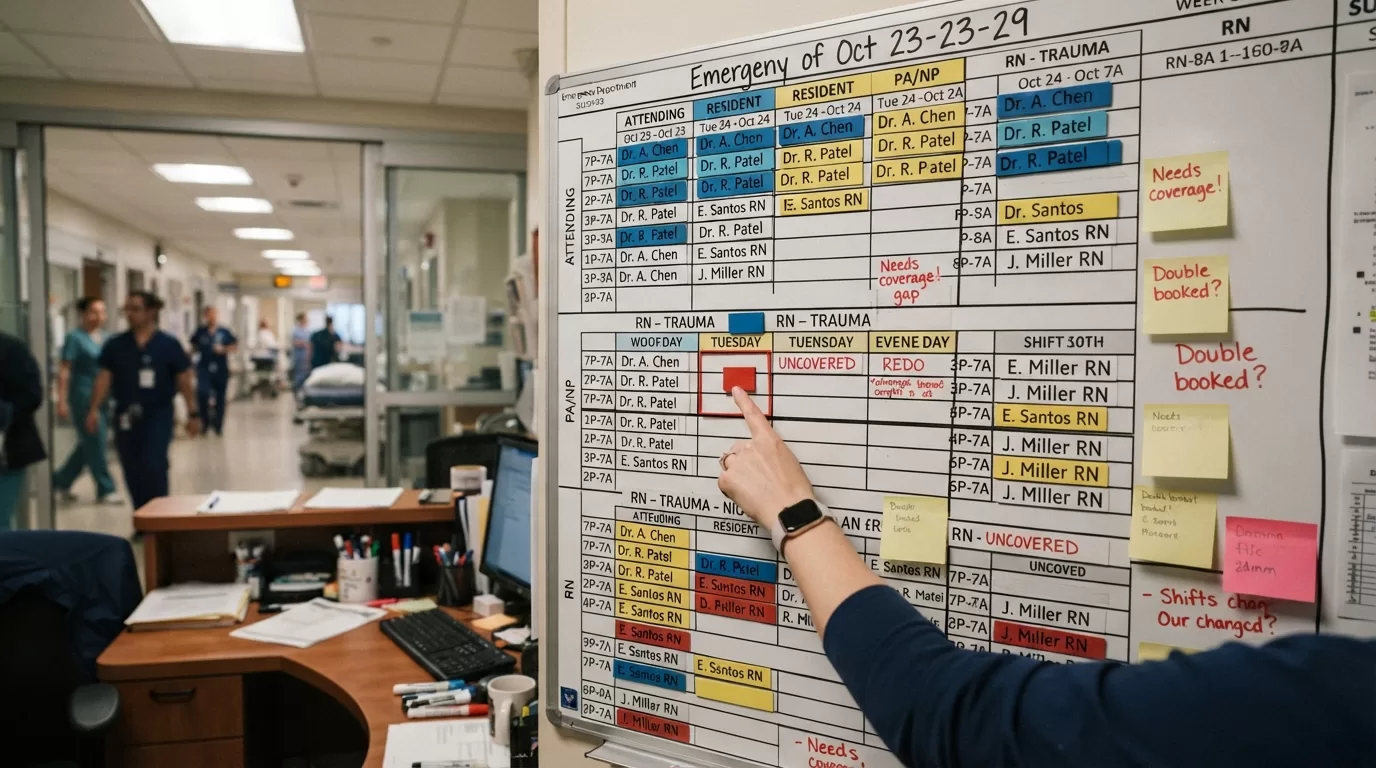
Emergency medicine has seen the most dramatic transformation. Large contract management groups that traditionally staffed EDs with a mix of employed and independent physicians are restructuring their workforce strategies.
The shift breaks down into three patterns:
- Increased employment models: Hospitals are bringing emergency physicians onto their payrolls at higher rates than any time since the 1990s, ensuring in-network status and eliminating surprise-bill risk entirely.
- Consolidated contract groups: Smaller emergency medicine groups are being acquired by or merging with larger entities that have the administrative infrastructure to manage IDR disputes and negotiate with multiple payers simultaneously.
- Per-diem and locums growth: Facilities facing coverage gaps during the transition are turning to contract staffing — a trend that has increased short-term opportunities but reduced predictable full-time positions in some markets.
For individual emergency physicians and advanced practice providers working ED shifts, this means more variability in compensation structures. Traditional productivity-based models are giving way to hybrid arrangements that blend base hourly rates with quality metrics and patient-satisfaction scores — measures that are easier to track and defend in contract negotiations with payers.
The Physician Fee Schedule updates from CMS in late 2025 didn't directly address NSA dynamics, but they did adjust evaluation and management codes in ways that affect how ED visits are documented and billed, adding another layer of change to an already shifting landscape.
The Anesthesia Staffing Transformation
Anesthesia services have faced parallel pressure. Historically, many anesthesia groups operated independently within hospitals, maintaining out-of-network status with some or all commercial insurers while the facilities themselves held in-network contracts. The NSA made that model unsustainable.
By 2026, roughly 89% of hospitals now require exclusive in-network anesthesia coverage as a condition of facility contracts, according to the American Society of Anesthesiologists. This represents a 34-percentage-point increase from 2022 levels. The result: anesthesia groups either joined insurance networks, entered hospital employment arrangements, or lost their facility contracts.
For CRNAs and anesthesiologists, the practical effects include:
- Geographic variation in opportunities: Markets where dominant anesthesia groups successfully negotiated favorable in-network rates are seeing stable positions. Markets where negotiations stalled are experiencing turnover and higher locums demand.
- Compensation adjustments: Moving in-network typically reduces per-case reimbursement, which has translated to modified compensation formulas — often with guaranteed minimums but lower upside potential compared to the out-of-network model.
- Expanded hospital employment: Hospital systems are acquiring anesthesia practices outright, converting independent practitioners to W-2 employees with benefits packages and productivity expectations that differ from traditional anesthesia group structures.
The shift isn't uniform. Academic medical centers and large health systems adapted fastest. Smaller community hospitals in rural markets are still working through coverage challenges, creating short-term contract opportunities for anesthesia professionals willing to work in underserved areas.
The IDR Process and Why It Matters to Staffing
Understanding the independent dispute resolution process helps explain why staffing models are changing. When an out-of-network provider and a payer can't agree on payment for a service covered by the NSA, either party can initiate IDR. An independent arbitrator reviews offers from both sides and selects one — without compromise or negotiation.
The problem: IDR costs money. Filing fees, administrative time, legal review — these expenses add up fast when you're disputing hundreds or thousands of claims annually. Only large organizations with dedicated revenue-cycle teams can manage IDR volume efficiently.
This economic reality has driven the consolidation wave. Solo practitioners and small groups simply can't afford the administrative overhead of operating out-of-network under NSA rules. They're joining larger entities, accepting hospital employment, or moving into other practice settings entirely.
For healthcare professionals evaluating job opportunities in 2026, the IDR dynamic matters because it signals which organizations have staying power. Groups with strong payer relationships and robust administrative infrastructure offer more stable long-term positions. Organizations still fighting large-scale IDR battles may face restructuring down the road.
Practical Steps for Healthcare Professionals in 2026
Whether you're currently working in emergency medicine or anesthesia, considering a move, or simply trying to understand your job security, here's what to focus on:
Ask about network status. When evaluating positions, clarify whether the employer or contract group maintains in-network agreements with major commercial payers in that market. Out-of-network positions aren't inherently bad, but understand the sustainability plan.
Understand your compensation structure. If your pay is shifting from pure productivity to a hybrid model, get the formula in writing. Know what happens if patient volumes fluctuate or if payer mix changes.
Watch for contract language changes. Employment agreements and independent contractor arrangements are being rewritten to address NSA compliance, liability allocation for billing disputes, and documentation requirements that affect reimbursement. Read the updates carefully.
Consider geographic flexibility. Markets adapting smoothly to NSA enforcement have different opportunity profiles than markets still in transition. If you're open to relocation or short-term contracts, understanding which regions need coverage can expand your options significantly.
Track licensing requirements. With increased locums and contract work, multi-state licensure and credentials become more valuable. Compact licenses for nurses and expedited credentialing pathways matter more in a market with higher workforce movement.
What Comes Next
The No Surprises Act isn't going away, and neither are its effects on healthcare staffing. Regulatory clarity continues to evolve — CMS releases updated guidance regularly, and federal courts are still ruling on challenges to specific IDR provisions. But the fundamental shift is locked in: out-of-network billing for emergency and facility-based services has been permanently curtailed.
For the healthcare workforce, that means ongoing adaptation. Employment models will continue to evolve. Compensation structures will keep adjusting to new reimbursement realities. And the line between employed, contracted, and independent practice will blur further as organizations test different approaches to staffing high-acuity services under NSA constraints.
The most successful healthcare professionals in this environment will be those who stay informed, remain flexible, and actively manage their careers rather than waiting for clarity that may never fully arrive. The NSA reshaped the playing field — but opportunity still exists for those who understand the new rules.
If you're navigating a career decision in emergency medicine, anesthesia, or another specialty affected by surprise-billing regulations, reach out to contact@intuites.healthcare with your specific questions about current market conditions and contract structures in your target region.
Sources
Ready for your next healthcare assignment?
Browse open healthcare jobs across the US — weekly pay, stipends, and a recruiter who reads every application.