
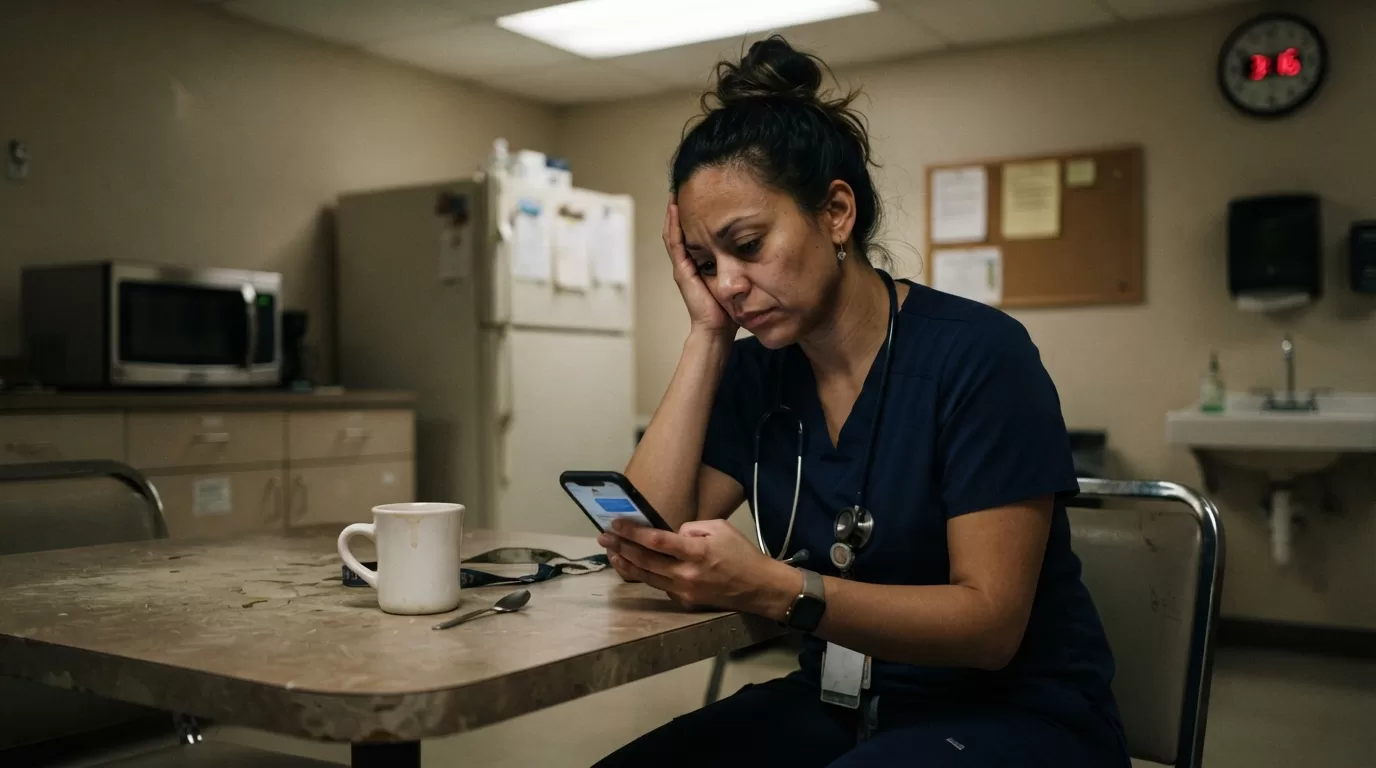
Your phone buzzed at 6:47 AM, thirteen minutes before your weekend shift started. Your sister’s name lit up the screen. Mom had chest pain overnight. The ambulance took her to the cardiac unit at Regional — forty-five minutes from the med-surg floor where you were about to take report on six patients, two of them fresh post-ops.
You clocked in anyway.
If you’ve ever worked a shift while someone you love was sick in another hospital, you know the specific, suffocating weight of that day. You know what it feels like to check vitals on someone else’s mother while your own is getting an EKG you can’t see. You know the guilt that sits on your chest like a second stethoscope.
The Dual Identity No One Warns You About
Nursing school prepares you for a lot. Clinical rotations teach you to manage airways, wounds, and crashing blood sugars. Your preceptors walk you through de-escalation and family meetings and the art of the perfect handoff report.
What nobody teaches is how to be a nurse and a daughter at the same time. How to toggle between professional competence and personal terror in the span of a bathroom break.
According to the American Nurses Association’s 2023 workforce survey, nearly 64% of nurses report experiencing significant stress related to balancing caregiving responsibilities at home with patient care responsibilities at work. That number climbs when the ‘caregiving at home’ becomes acute — a parent’s sudden hospitalization, a spouse’s diagnosis, a child’s emergency.
The term for what you feel is nursing emotional labor — the work of managing your own feelings so you can hold space for others’ pain. It’s exhausting on a regular Tuesday. When your own family is in crisis, it becomes unsustainable.
What Healthcare Worker Guilt Actually Looks Like
Guilt is not a monolith. When you’re a nurse whose mom is sick elsewhere, it fractures into very specific shapes:
- Competence guilt: You can interpret a twelve-lead EKG for your patient in Room 12, but you can’t get through to your mom’s cardiologist to ask about her troponin levels.
- Presence guilt: You’re physically here, giving excellent care to strangers, while your sister sits alone in a waiting room you’ve never seen.
- Knowledge guilt: You know what ‘watching telemetry overnight’ actually means. You know the questions your family should be asking, but you’re not there to ask them.
- Boundary guilt: You told your charge nurse you were fine. You didn’t call off. You didn’t ask to leave early. Now you’re second-guessing whether that was strength or avoidance.
Here’s what makes healthcare worker guilt so corrosive: it implies you should be superhuman. That you should be able to do both — flawlessly, simultaneously, without cost.
You are not superhuman. You are a person who happens to have clinical skills, and those skills do not erase your need to be with the people you love when they’re scared.
The Myth of ‘Just Compartmentalize’
Twelve years into nursing, I can compartmentalize with the best of them. I can run a code, then step into the hallway and take a breath, then walk into the next room with a calm face and steady hands.
But compartmentalizing works when the crisis is contained to your shift. It falls apart when the crisis is ongoing, unresolved, and involves someone whose name is in your emergency contact list.
The weekend my mom was admitted for a pulmonary embolism, I worked Friday night, Saturday day, and Sunday night. I was scheduled. We were short. I didn’t want to leave my team without coverage.
I told myself I was compartmentalizing. What I was actually doing was dissociating.
I gave meds. I updated care plans. I caught a patient whose blood sugar had dropped to 41 and probably saved her from a seizure. I did my job well.
I also missed the conversation with the pulmonologist about whether my mom would need long-term anticoagulation. I wasn’t there when she cried because she was scared of the heparin drip. I answered my sister’s frantic texts from a supply closet, whispering medical translation while my own patients’ call lights blinked down the hall.
Compartmentalizing is a survival skill. It is not a long-term strategy for nurse personal story moments that will shape how you remember this season of your life.
What Actually Helps When You’re Torn in Two
There is no perfect answer. But there are small, concrete things that make the impossible slightly more bearable.
Before the crisis: Know your facility’s emergency leave policy. Not the general PTO guidelines — the actual family emergency protocol. Some hospitals offer unpaid emergency leave separate from your PTO bank. Some have shift-swap systems that prioritize urgent requests. If you don’t know the policy until you need it, you’re navigating bureaucracy while also navigating terror.
During the crisis: Tell your charge nurse the truth. Not the minimized version (‘my mom’s in the hospital but I’m fine’), the actual truth (‘my mom’s in the hospital and I’m struggling to focus’). A good charge nurse will either help you leave or assign you a lighter patient load or check in more frequently. A great charge nurse has been exactly where you are and knows you need permission to not be fine.
Build your backup list now: Identify two or three colleagues you trust who would cover an emergency shift for you, and offer the same in return. Make it explicit. ‘If I ever text you at 5 AM, I need help, and I will do the same for you.’ This is not about formal shift swaps through the scheduling system — this is about having people who will show up.
Set communication boundaries with your family: When you’re at work, you cannot be the real-time medical interpreter. Decide ahead of time: one designated family member texts you updates at set times (lunch break, end of shift), and you’ll call when you can. You are allowed to say, ‘I can’t have my phone on me during the shift — text Sarah, and she’ll loop me in.’
The Permission You’re Waiting For
You are allowed to call off. You are allowed to use your PTO for a family emergency, even if it leaves your unit short. You are allowed to prioritize your mother over your patient assignment.
The healthcare system has conditioned us to believe that our duty to our patients outweighs our duty to ourselves and our families. That belief is a policy failure, not a moral truth.
According to the Bureau of Labor Statistics’ 2025 Occupational Outlook report on registered nurses, hospitals and healthcare facilities continue to face persistent staffing shortages — a systemic problem that individual nurses did not create and cannot solve by martyring themselves. Your presence or absence on one shift does not fix or break the system.
What it does affect is whether you get to hold your mom’s hand when she’s scared. Whether you get to hear the cardiologist’s explanation firsthand. Whether, ten years from now, you remember being there or remember the crushing regret of not being there.
I am not saying calling off is easy. It’s not. It comes with guilt and logistical complexity and sometimes financial cost. But so does staying. And only one of those choices lets you look back without wondering what you missed.
What Comes After
My mom’s PE resolved. She went home on Eliquis and a walking plan and a lot of follow-up appointments. I worked the shifts I worked, and I missed the moments I missed.
What I learned is this: nursing emotional labor doesn’t end when your shift ends. The work of caring for others while caring for your own heart is long-term, cumulative, and often invisible.
You will have hard weekends. You will have shifts where you are split in two, trying to be excellent at work while your mind is forty-five minutes away in a cardiac unit you can’t see.
You are allowed to choose yourself. You are allowed to say, ‘Not today.’ You are allowed to be a daughter, a son, a partner, a parent first — and a nurse second.
The patients will be cared for. Your unit will survive. The system that asks you to sacrifice your own family for its convenience does not deserve your loyalty more than your mother does.
If you’re reading this in the middle of your own hard weekend, take a breath. You are doing the best you can with an impossible situation. That is enough.
And if you’re weighing your next contract or considering a schedule that gives you more control over your time when life gets hard, email contact@intuites.healthcare to talk through options that build flexibility into your work life before the next crisis hits.
Sources
Ready for your next nursing assignment?
Browse open nursing jobs across the US — weekly pay, stipends, and a recruiter who reads every application.