
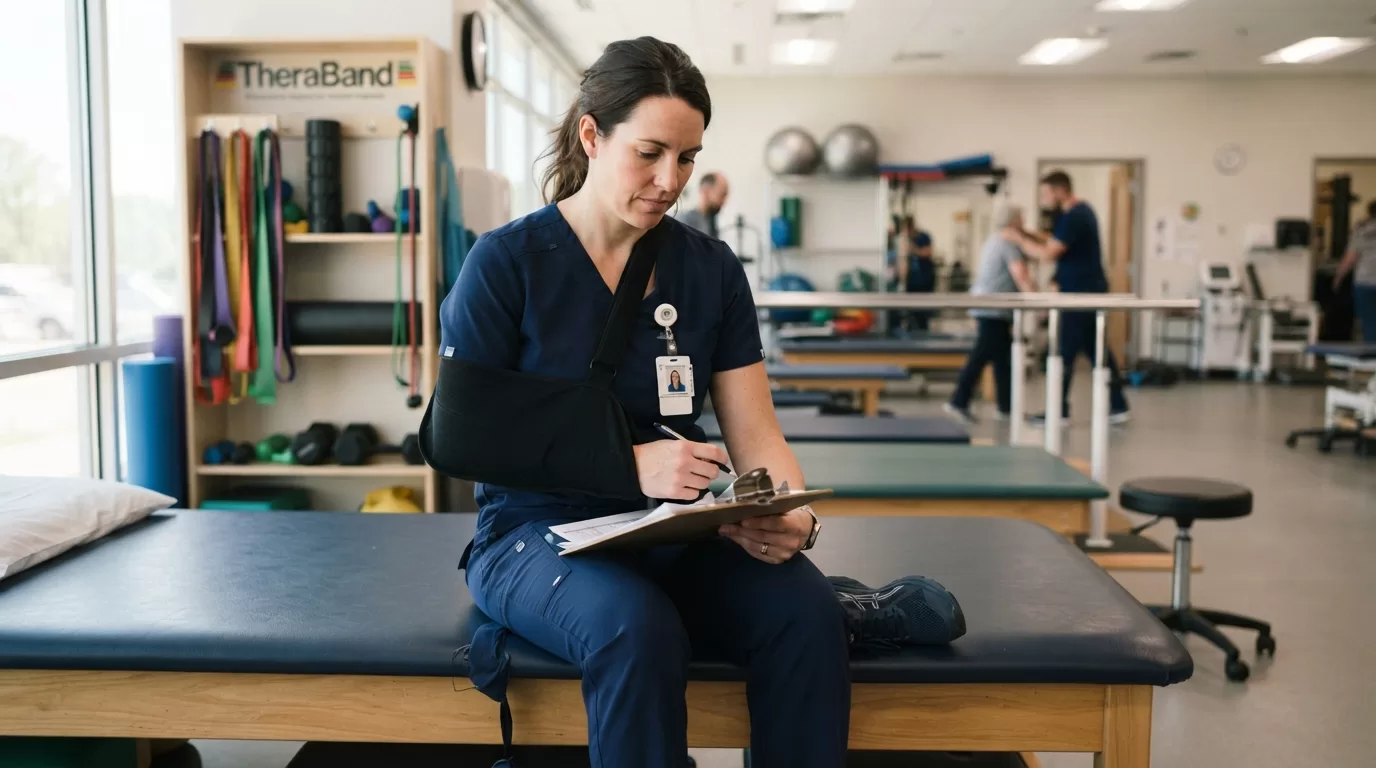
Sarah Chen had transferred patients a thousand times. Maybe ten thousand. The mechanics were muscle memory: wide base, bent knees, pivot from the hips. She could teach proper body mechanics in her sleep — and had, to countless nursing students and new rehab aides over her twelve years as an occupational therapist.
The afternoon it happened, she was covering for a colleague in the hospital’s stroke unit. The patient was post-CVA, moderate assistance, nothing she had not handled before. But he startled mid-transfer, his weight shifted unexpectedly, and Sarah felt something deep in her shoulder give way. Not a pop. More like a tearing sensation, followed by pain that took her breath.
Three weeks later, an MRI confirmed a full-thickness rotator cuff tear. The orthopedic surgeon used words like “significant retraction” and “surgical candidate.” Sarah, who spent her days helping people regain independence after injury, was now staring down months of recovery. She had become her own patient.
When the Clinician Becomes the Case Study
Workplace injuries among healthcare workers are more common than many realize. According to the Bureau of Labor Statistics, healthcare and social assistance workers experience musculoskeletal disorders at rates significantly higher than the private industry average. For rehabilitation professionals — physical therapists, occupational therapists, and related specialists — the risk is especially pronounced. Patient handling, repetitive movements, and awkward positioning create cumulative stress on joints and soft tissue.
Sarah knew the statistics. She had even presented on injury prevention at a state OT conference two years earlier. But knowing the numbers and living through a clinician injury are two different experiences.
“I felt embarrassed,” she admits. “Like I should have known better. I teach body mechanics. I assess home safety. And here I was, injured doing the exact thing I train others to do safely.”
That shame is common among injured healthcare workers. A 2024 study published in the American Journal of Occupational Therapy found that clinicians often delay reporting workplace injuries due to concerns about being perceived as careless or weak. Sarah waited three days before filing an incident report, working through the pain and icing her shoulder between patients. Only when she could not lift her arm above shoulder height did she finally tell her supervisor.
Navigating Workers’ Compensation and Modified Duty
The workers’ compensation process felt foreign and frustrating. Sarah had helped patients navigate insurance denials and prior authorization headaches, but she had never been on this side of the paperwork.
Her employer’s HR department walked her through the initial claim. In most states, workplace injuries must be reported within a specific timeframe — often 24 to 48 hours — to preserve eligibility for workers’ comp benefits. Sarah’s three-day delay nearly complicated her claim, a mistake she now warns colleagues to avoid.
Key steps she learned the hard way:
- Report any work-related injury immediately to your supervisor, even if it seems minor
- Request a written incident report and keep a copy for your records
- Document the injury details: date, time, what you were doing, witnesses present
- Attend all required medical appointments and follow treatment plans exactly
- Communicate regularly with your employer about restrictions and recovery progress
- Understand your state’s workers’ comp timelines and appeal processes
After surgery, Sarah faced a choice many injured clinicians confront: take unpaid leave or accept modified duty. Modified duty meant staying on payroll while performing tasks within her medical restrictions — no patient transfers, no overhead reaching, limited computer work to avoid aggravating her shoulder.
Her manager offered her a temporary role updating treatment protocols and training materials. It kept Sarah connected to the team and maintained her income, but it also meant watching colleagues carry the patient load she used to share. That was harder than the physical pain some days.
The Unexpected Lessons of OT Recovery
Physical therapy started six weeks post-op. Sarah’s surgeon referred her to a colleague in the same hospital system — someone she had worked alongside for years. Now their roles were reversed.
“Sitting in the waiting room with my intake paperwork, I saw everything differently,” Sarah reflects. “The forms asking about pain levels and functional limitations — I had handed those out a million times. I never realized how hard it is to rate your own pain when you are scared it might never get better.”
She noticed things she had missed as a clinician. The way anxiety spikes when a therapist explains an exercise but does not demonstrate it first. How much emotional energy it takes to show up for therapy when progress feels invisible. The vulnerability of needing help with tasks you used to do automatically.
Sarah started keeping notes — not just about her exercises, but about what helped and what did not from a patient perspective. Small things made a difference: her PT explaining why each exercise mattered, not just how to do it. Being asked what her recovery goals were instead of being told what they should be. Having her fears about re-injury acknowledged instead of dismissed.
Three months into recovery, she could lift a coffee mug overhead without wincing. Four months in, she completed a full patient transfer using a mechanical lift during a supervised return-to-work trial. By month six, she was cleared for full duty with no restrictions.
Rebuilding Practice After Clinician Injury
Returning to full clinical work brought a mix of relief and unease. Sarah was grateful to be back, but she was also hyperaware of her body in new ways. Every patient transfer triggered a split-second mental calculation: Is my positioning right? Am I compensating? What if it happens again?
She was not alone in that fear. The Centers for Disease Control and Prevention notes that healthcare workers who experience one musculoskeletal injury are at increased risk for subsequent injuries, often due to incomplete recovery or changes in movement patterns developed during rehabilitation.
Sarah made changes to protect herself:
- She started using mechanical lifts for all transfers, even when patients were technically able to assist — no more “just this once” exceptions
- She requested a caseload adjustment to reduce consecutive heavy-assist patients in a single day
- She built in micro-breaks between patients to reset her positioning and check in with her body
- She advocated for her department to invest in ceiling lifts for the stroke unit, using her own injury as evidence in the budget proposal
Some colleagues saw these changes as overcautious. Others quietly admitted they wished they felt comfortable making similar requests. Sarah realized her injury had given her a kind of permission to prioritize safety in ways that felt harder to justify before she got hurt.
What the Experience Changed
A year post-injury, Sarah’s shoulder is strong. She has full range of motion and no pain with normal activities. But the experience changed her in ways that have nothing to do with rotator cuff strength.
She listens differently now. When a patient says an exercise hurts, she does not automatically assume they are not trying hard enough. When someone expresses fear about re-injury, she validates it instead of rushing to reassure. When a client struggles to follow through with a home exercise program, she asks about barriers instead of lecturing about compliance.
“Becoming my own patient made me a better OT,” Sarah says. “Not because I have some special insight — but because I remember what it feels like to be scared and in pain and dependent on someone else’s expertise. That stays with you.”
She also became an advocate. She joined her facility’s safety committee and pushed for policy changes: mandatory lift equipment for all patient transfers, no exceptions. Ergonomic assessments for therapy staff every six months. Protected time for body mechanics refresher training.
The proposals were not always popular. Budget constraints, workflow concerns, and “we have always done it this way” pushback made progress slow. But Sarah kept showing up to meetings with data from the Bureau of Labor Statistics on healthcare worker injury rates and costs. Slowly, things shifted.
For Clinicians Facing Their Own Recovery
If you are reading this because you are injured — or because you are scared you might be — Sarah wants you to know a few things.
First: it is not your fault. Workplace injuries in healthcare happen even to careful, experienced clinicians. The physical demands of the work, combined with unpredictable patient needs and systemic staffing shortages, create risk no amount of proper body mechanics can fully eliminate.
Second: report it. Do not wait. Do not minimize it. Do not try to tough it out. Delayed reporting can jeopardize your workers’ comp claim and delay treatment that could speed your recovery.
Third: modified duty is not failure. Staying connected to your workplace and your team during recovery can protect your mental health and your income. It also keeps your clinical skills and knowledge active, even if you are not doing hands-on patient care.
Fourth: recovery is not linear. There will be setbacks. There will be days when you feel like you are going backward. That is normal. Trust the process, communicate with your PT or OT, and give yourself the same patience you would offer a patient.
And finally: you will find your way back. Maybe not to exactly the same role or the same caseload or the same fearlessness you had before. But you will find a version of practice that works for your body and honors what you have learned. Sarah did. And she is convinced that her injury, as painful as it was, made her the clinician she was always meant to be. 🤍
If you are recovering from a workplace injury and considering per diem or travel assignments that offer more control over your schedule and caseload, reach out to our team at contact@intuites.healthcare — we work with OTs, PTs, SLPs, and other allied health professionals navigating return-to-work transitions.
Sources
Ready for your next allied health assignment?
Browse open allied health jobs across the US — weekly pay, stipends, and a recruiter who reads every application.