
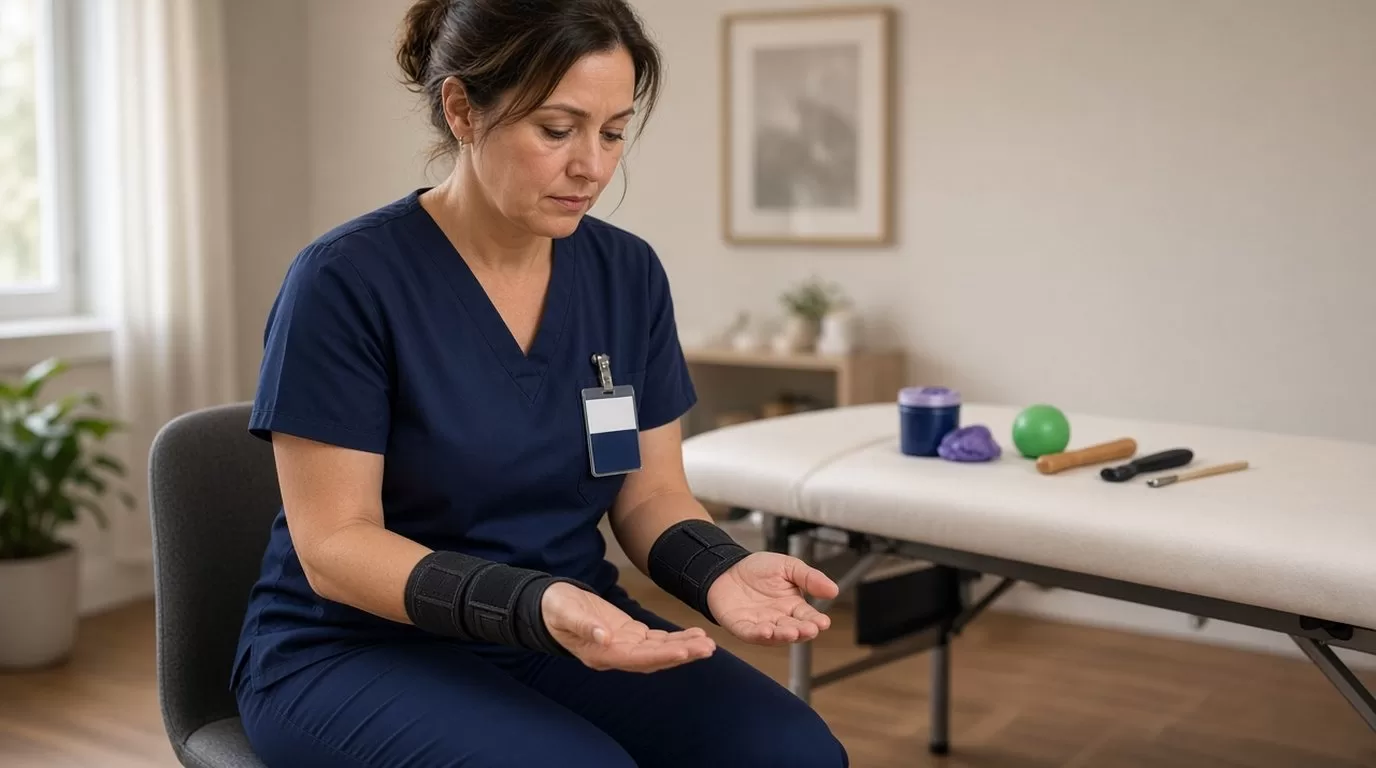
Rachel didn't recognize the tremor at first. It started during the eleventh patient of the day—a construction worker three weeks post-carpal tunnel release—and by the time she finished his scar mobilization, her right thumb ached in a way she knew too well. She'd treated this exact injury a hundred times. Now it was hers.
She was thirty-four, a certified hand therapist, and burning out not from emotional exhaustion but from the grinding, repetitive manual work that her clinic's productivity model demanded. Twelve to fifteen patients a day. Sixty-minute evals compressed to forty-five. Every hand that needed joint mobilization, every wrist that required instrument-assisted soft tissue work, every thumb that she splinted—it all ran through her own hands, her own wrists, her own body.
By year six, Rachel's body was failing. And she made a choice that surprised everyone, including herself: she walked away.
The Productivity Machine That Breaks Therapists
Rachel's clinic wasn't an outlier. Across outpatient rehab, productivity pressure has become the norm. The American Physical Therapy Association's 2025 workforce survey found that over sixty percent of outpatient therapists—PT, OT, and speech alike—report productivity expectations of eighty-five percent or higher, with many mills pushing ninety.
For hand therapists, the math is brutal. Manual therapy is the backbone of treatment. Scar tissue doesn't release itself. Stiff joints don't mobilize with words. And when you're the only CHT in a high-volume clinic, every post-op hand, every tendon repair, every nerve injury lands on your schedule.
Rachel's weekly caseload looked like this:
- Sixty patient visits across four and a half clinical days
- Forty of those requiring hands-on manual work—joint mobs, scar massage, edema management
- At least twelve new evals per week, each demanding detailed ROM measurements, strength testing, and splint fabrication
- Documentation quotas that pushed her to finish notes during lunch or after her daughter's bedtime
Her clinic director praised her efficiency. Her patients loved her. Her hands were destroying themselves in silence.
When the Healer Becomes the Patient
The Bureau of Labor Statistics notes that occupational therapy practitioners face work-related musculoskeletal disorders at rates comparable to nursing—and for hand therapists, the risk concentrates in the very structures they treat. Thumbs. Wrists. Forearms.
Rachel's first symptom was a dull ache in her right CMC joint—the base of her thumb—that flared during joint mobilizations. She iced it at night. Wore a thumb spica splint to bed. Told herself it was temporary.
Six months later, she had bilateral wrist tendinitis and early signs of De Quervain's tenosynovitis. The irony wasn't lost on her: she was teaching patients to modify activity and respect tissue healing timelines while ignoring every principle in her own body.
She tried to adapt. She swapped some manual techniques for instrument-assisted tools, which only shifted the load. She asked her clinic director about reducing her caseload. He reminded her that her productivity was already “at the low end” of the regional average and suggested she “work smarter.”
Translation: see more patients, faster, with the same hands that were already failing.
The Moment She Knew
The breaking point came during a splint fabrication. Rachel was molding thermoplastic for a radial nerve palsy patient—a routine task she'd done thousands of times—and her right hand cramped so sharply she dropped the material. The patient asked if she was okay.
She lied and said yes. But in that moment, Rachel understood something she'd been avoiding for months: if she stayed, she would lose her career entirely. Not in a decade. Not when she was fifty. Soon.
The Math of Walking Away
Leaving wasn't romantic. Rachel had a mortgage, a six-year-old daughter, and student loans from her post-professional hand therapy residency. Her husband's income covered basics, but not comfortably. She wasn't walking toward some dream—she was walking away from injury.
She gave four weeks' notice. Her clinic director was shocked. Her colleagues were supportive but worried. One asked her what she'd do instead, as if leaving a job that was destroying her body required a fully formed backup plan to be legitimate.
Rachel didn't have one. What she had was a referral to a colleague who ran a small private practice thirty minutes away—a clinic that averaged six to eight patients per therapist per day, turned away insurance plans with impossible documentation requirements, and specialized in complex hand cases that allowed slower, more intentional treatment.
The pay was fifteen percent lower. The schedule was four days a week. There was no retirement match.
Rachel took it anyway.
What Changed When the Pressure Lifted
The first week in her new role felt disorienting. Six patients a day meant Rachel could spend a full hour with each one. She could palpate tissue slowly, adjust techniques when her hands were tired, and actually teach patients the home program instead of printing a handout and hoping.
Her body began to recover. The constant low-grade ache in her wrists eased. Her thumb pain, while not gone, stopped worsening. She started sleeping without a splint.
But the bigger shift was cognitive. Rachel realized how much of her clinical reasoning had been eroded by volume. In the mill, she'd been running treatment protocols on autopilot—effective enough to keep patients progressing, but shallow compared to the nuanced, patient-specific problem-solving she'd been trained to do.
Now, with time to think, she was a better therapist. She caught subtle patterns in movement dysfunction. She modified techniques in real time. She had the bandwidth to read new research and apply it the same week.
The Trade-Offs She Made
Lower pay was real. Rachel and her husband adjusted their budget—fewer dinners out, no spring break trip, a pause on kitchen renovations. It wasn't devastating, but it wasn't nothing.
She also lost the professional identity she'd built. In her old clinic, she was the go-to hand therapist, the one surgeons requested by name. In her new role, she was part of a smaller, quieter practice. The ego hit was harder than she'd expected.
But her hands worked. She could play with her daughter without pain. She could imagine practicing into her fifties and sixties instead of wondering when the next flare-up would end her career.
What This Means for Allied Health Professionals
Rachel's story isn't unique. Across PT, OT, SLP, and respiratory therapy, clinicians are navigating the same tension: productivity models that maximize billing at the expense of provider longevity.
For hand therapists and other OTs doing intensive manual work, the risk is structural. You can't outsource joint mobilization to an aide. You can't automate scar massage. And when your clinical skill is inseparable from your body's capacity, protecting that body isn't optional—it's survival.
Some practitioners are finding creative solutions:
- Negotiating hybrid roles that blend direct care with consultation, education, or program development
- Seeking contract or per-diem work that allows caseload control without full-time employment pressure
- Transitioning to specialties or settings with lower manual therapy demands—school-based OT, ergonomic consulting, driver rehab
- Pursuing travel or short-term contracts in lower-volume settings that respect therapist limits
Others, like Rachel, are simply walking away from environments that treat their bodies as disposable. And while that decision is deeply personal, it's worth naming what it represents: a refusal to accept that burnout and injury are the cost of being a good clinician.
A Different Kind of Productivity
A year and a half after leaving the mill, Rachel still practices hand therapy. She treats six patients a day, four days a week. She's not maximizing her earning potential. She's not hustling.
She's still here. Her hands work. Her career isn't over.
That's its own kind of productivity.
If you're an OT, PT, SLP, or other allied health professional weighing similar choices—whether it's reducing hours, seeking lower-volume settings, or exploring contract work that offers more control—you're not alone in questioning the sustainability of high-productivity models. Email contact@intuites.healthcare to explore hand therapy and allied health contract opportunities that prioritize clinical quality and therapist longevity. 🤍
Sources
Ready for your next allied health assignment?
Browse open allied health jobs across the US — weekly pay, stipends, and a recruiter who reads every application.