
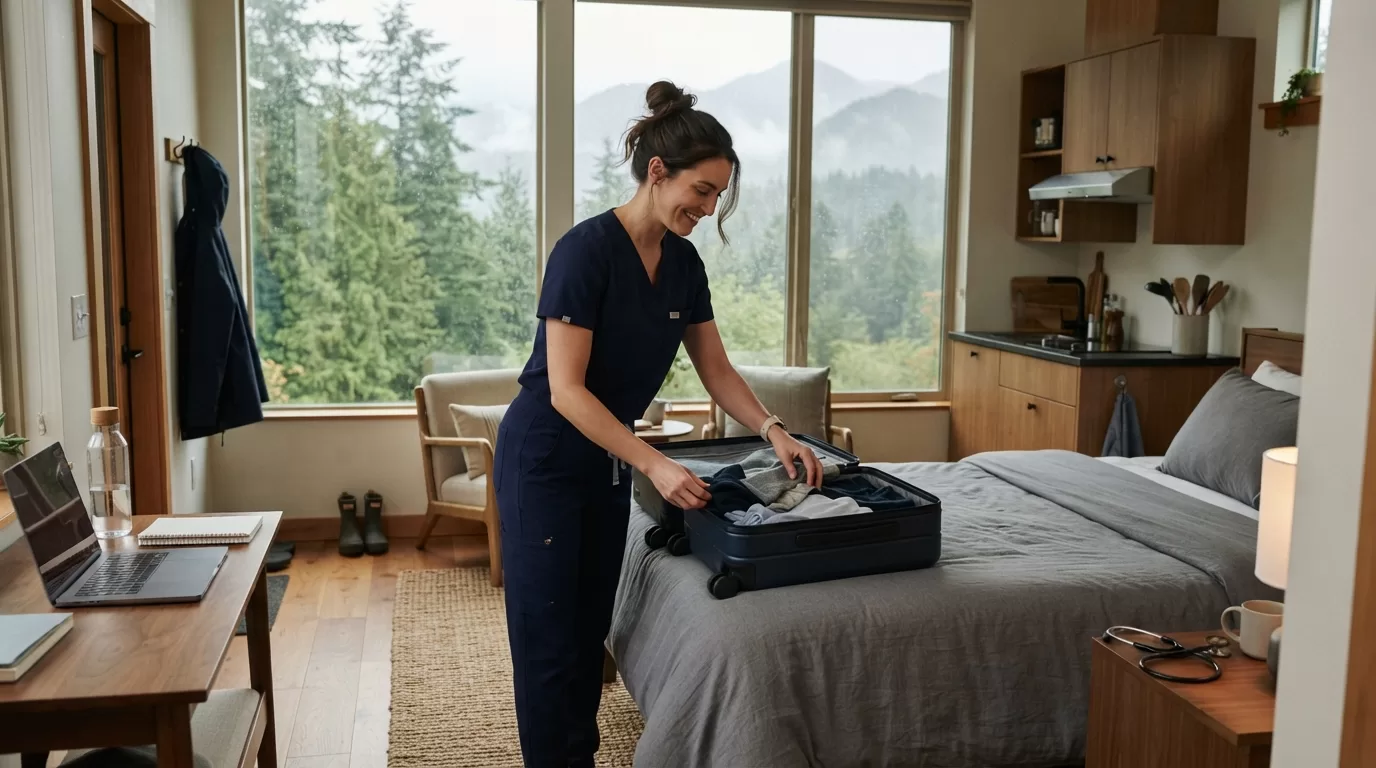
The Pacific Northwest is having a moment — and not just because of the coffee and the hiking trails. Winter 2026 is shaping up to be one of the strongest seasons for travel nurses in Washington, Oregon, and Idaho in recent memory. Hospitals across the region are competing for experienced RNs and LPNs, and the pay reflects it.
But before you book that flight to SeaTac or start Googling ‘best rain boots for Portland,’ you need the real logistics: licensing timelines that actually matter, housing costs that won’t eat your stipend, and which facilities are worth your 13 weeks. This is your field guide to making a Pacific Northwest travel nursing assignment work this winter — no fluff, just what you need to know before you sign.
Why the Pacific Northwest Is Booming for Travel Nurses Right Now
Let’s start with the numbers. According to the Bureau of Labor Statistics, Washington and Oregon both rank in the top ten states for registered nurse employment, with projected growth rates above the national average through 2032. That demand isn’t theoretical — it’s showing up in your inbox as contract offers.
Seattle metro facilities are posting travel RN rates between $2,100 and $2,800 per week for med-surg, ICU, and emergency department assignments. Portland rates are running slightly lower but still strong at $1,900 to $2,500 weekly. Boise and smaller Idaho markets like Coeur d’Alene are offering $1,800 to $2,300, often with lower housing costs that make the net math compelling.
Winter specifically drives this demand. Respiratory cases spike with cold and flu season, ski injuries fill orthopedic units, and staffing gets tight when permanent staff take holiday time off. If you’re comfortable with higher acuity or can float between units, you’ll have leverage in negotiations.
One more thing that changed the game: Washington joined the Nurse Licensure Compact in January 2026. That means if you hold a compact license from another NLC state, you can practice in Washington without applying for a separate state license. Oregon and Idaho were already compact states, so the entire PNW is now accessible with one multistate license. This wasn’t true a year ago, and it’s a massive simplification for travelers.
Licensing: Timelines and Gotchas for WA, OR, and ID
Even with compact access, you need to understand each state’s quirks — especially if you’re coming from a non-compact state or need to apply for a single-state license.
Washington
Washington’s Department of Health Nursing Commission processes applications in roughly three to five weeks right now, according to their online portal. If you’re applying for endorsement from another state, you’ll need to submit fingerprints through an approved vendor and complete Washington’s suicide prevention training (a two-hour online course). Budget $200 to $250 for the application and fingerprinting combined.
Since Washington is now an NLC state, travelers with a compact license can start immediately — but your home state license must be your primary residence. If you declare Washington residency, your compact license converts to a Washington single-state license within 60 days. Most travelers keep their home-state residency to preserve compact privileges.
Oregon
Oregon is compact, but their board is processing applications more slowly than usual. Current wait times are running four to six weeks for endorsement applications, per the Oregon State Board of Nursing’s website. Oregon also requires a criminal background check and charges $175 for licensure by endorsement.
One traveler trap: Oregon requires continuing education for license renewal, and if your home state doesn’t require CE, you might not have the hours Oregon wants when you apply. Check your transcript before you submit, because incomplete CE documentation is the most common reason for delayed approvals.
Idaho
Idaho is the smoothest of the three. Compact license holders can practice immediately. If you need an Idaho-specific license, the state board typically processes endorsements in two to three weeks. Cost is $85, and Idaho accepts the NURSYS verification system, which speeds things up considerably.
All three states participate in NURSYS, so if your home state does too, you can often get verification sent electronically instead of mailing paper transcripts. It’s a small thing, but it can save you a week.
Housing Strategy: What Your Stipend Actually Buys
Housing stipends in the PNW are generous compared to many regions — but so are rents, especially in Seattle and Portland. Here’s the reality check.
Seattle metro one-bedroom apartments are averaging $2,000 to $2,600 per month in neighborhoods within 30 minutes of major hospitals like UW Medical Center, Harborview, or Swedish. If you’re willing to go further south (Renton, Tukwila) or north (Shoreline, Lynnwood), you can find units in the $1,600 to $1,900 range. Furnished corporate housing adds another $300 to $500 monthly, but it eliminates the hassle of buying furniture for 13 weeks.
Portland’s housing market cooled slightly in 2026, and you’ll see one-bedrooms in the $1,800 to $2,200 range near OHSU, Legacy Emanuel, or Providence Portland. The suburbs — Beaverton, Hillsboro, Gresham — drop closer to $1,400 to $1,700. Parking is included in most complexes outside downtown, which matters if you brought your car.
Boise and Coeur d’Alene offer the best housing value. Boise one-bedrooms near St. Luke’s or Saint Alphonsus run $1,200 to $1,600. Coeur d’Alene is even lower at $1,000 to $1,400, and you’re 30 minutes from world-class skiing at Schweitzer Mountain.
Pro tip: If your agency offers a housing stipend instead of arranged housing, take the stipend and book your own place. You’ll almost always come out ahead, and you control location and amenities. Use Furnished Finder or Airbnb’s monthly discount feature to compare short-term options. Some travelers split the difference and book the first two weeks in an extended-stay hotel while they apartment-hunt in person — it gives you time to see neighborhoods and avoid signing a lease on a place you hate.
Top Facilities and Specialties Hiring This Winter
Not all contracts are created equal, and knowing which facilities treat travelers well makes a difference in how much you enjoy your 13 weeks.
Washington
Seattle’s big academic centers — UW Medical Center and Harborview — hire a lot of travelers but expect high acuity and fast orientation. If you’ve got solid ICU, emergency, or trauma experience, these are premier resume-builders. Swedish has multiple campuses and tends to have better work-life balance, with strong ratios and traveler support.
Outside Seattle, Tacoma General and St. Joseph Medical Center in Tacoma are consistently rated well by travelers. Spokane’s Providence Sacred Heart is the major regional trauma center for eastern Washington and sees high volumes in winter with ski and highway accidents.
Oregon
Oregon Health & Science University in Portland is the state’s flagship teaching hospital and consistently needs travelers in critical care, perioperative, and labor and delivery. Orientation is thorough, and the facility has a good reputation for respecting traveler contracts.
Legacy Health operates six hospitals in the Portland metro, and their Emanuel campus is a Level I trauma center with steady traveler demand. Salem Health in Salem (about 45 minutes south) offers lower cost of living and competitive rates, especially for med-surg and telemetry.
Idaho
Boise’s St. Luke’s Health System is the largest employer in the state and hires travelers year-round. Winter brings increased demand in orthopedics and med-surg. Kootenai Health in Coeur d’Alene is a regional referral center and popular with travelers who want mountain access — you can ski on your days off without a long drive.
Specialties seeing the highest winter demand across all three states: ICU, emergency department, med-surg, and perioperative. If you have CVICU, neuro ICU, or NICU experience, you’ll have your pick of contracts. Labor and delivery is tight in Portland and Seattle but less so in smaller markets.
Practical Tips for Your First PNW Assignment
A few things that aren’t obvious until you’ve done a winter contract in the Pacific Northwest.
- Rain gear matters more than snow gear. It rains constantly from November through March, but it rarely snows in the valleys. Invest in a good waterproof jacket, waterproof shoes, and a compact umbrella. You’ll use them daily.
- Vitamin D supplements are real. The cloud cover is dense and persistent. A lot of travelers feel the seasonal mood dip. Consider a light therapy lamp if you’re prone to that.
- Car vs. no car depends on your facility. Seattle and Portland have decent public transit near major hospitals, but most other PNW cities require a car. If you’re flying in, compare the cost of renting a car for three months versus shipping yours. Sometimes renting is cheaper once you factor in gas and insurance.
- Tax home rules apply. Your housing stipend is only tax-free if you maintain a tax home in another state. That means paying rent or a mortgage somewhere else and not staying in any one assignment location more than 12 months in a rolling 24-month period. Talk to a travel-nurse-specialized CPA if you’re not sure your setup qualifies.
- Outdoor access is unmatched. One reason travelers love the PNW is the proximity to hiking, skiing, and coastline. Mount Rainier, Crater Lake, the Columbia River Gorge, and the Oregon Coast are all day-trip accessible from major cities. If you’re into outdoor recreation, this is your region.
What to Watch For: Red Flags in PNW Contracts
A few contract pitfalls are more common in this region than others.
First, confirm your guaranteed hours. Some facilities in smaller Oregon and Idaho markets offer 36-hour guarantees but then flex you down if census drops. That’s legal, but it wrecks your budget. Push for a 40-hour guarantee or at least clarity on the cancellation policy.
Second, ask about float requirements. Seattle and Portland facilities often float travelers to multiple units within the same service line. If you’re an ICU nurse, you might float between MICU, SICU, and CVICU. That’s reasonable. Floating from ICU to a completely different specialty like postpartum is not, and it happens. Get the float policy in writing.
Third, weekend and holiday requirements vary widely. Some PNW contracts are ‘every third weekend,’ others are ‘every other,’ and a few require consecutive weekends during peak winter staffing shortages. If holiday coverage is a dealbreaker for you, clarify that before you submit.
Finally, watch for hidden costs in Seattle specifically. Parking at Seattle hospitals can run $15 to $20 per shift, and it’s rarely reimbursed. Some travelers bike or use the light rail to avoid it, but if you’re working nights in winter, transit safety becomes a consideration.
Ready to Book Your Winter PNW Contract?
The Pacific Northwest combines strong pay, compact licensing, and genuine quality of life in a way that few other regions match. Winter might mean rain instead of sunshine, but it also means hospitals that need you, rates that reflect that need, and mountains that are worth the drive on your days off.
If you’re eyeing a Seattle ICU contract, a Portland ED gig, or a Boise med-surg assignment, now is the time to get your compact license squared away and start comparing offers. Email contact@intuites.healthcare with your specialty and preferred PNW market, and we’ll match you with facilities that align with your experience and timeline.
Sources
Ready for your next travel nursing assignment?
Browse open travel nursing jobs across the US — weekly pay, stipends, and a recruiter who reads every application.