
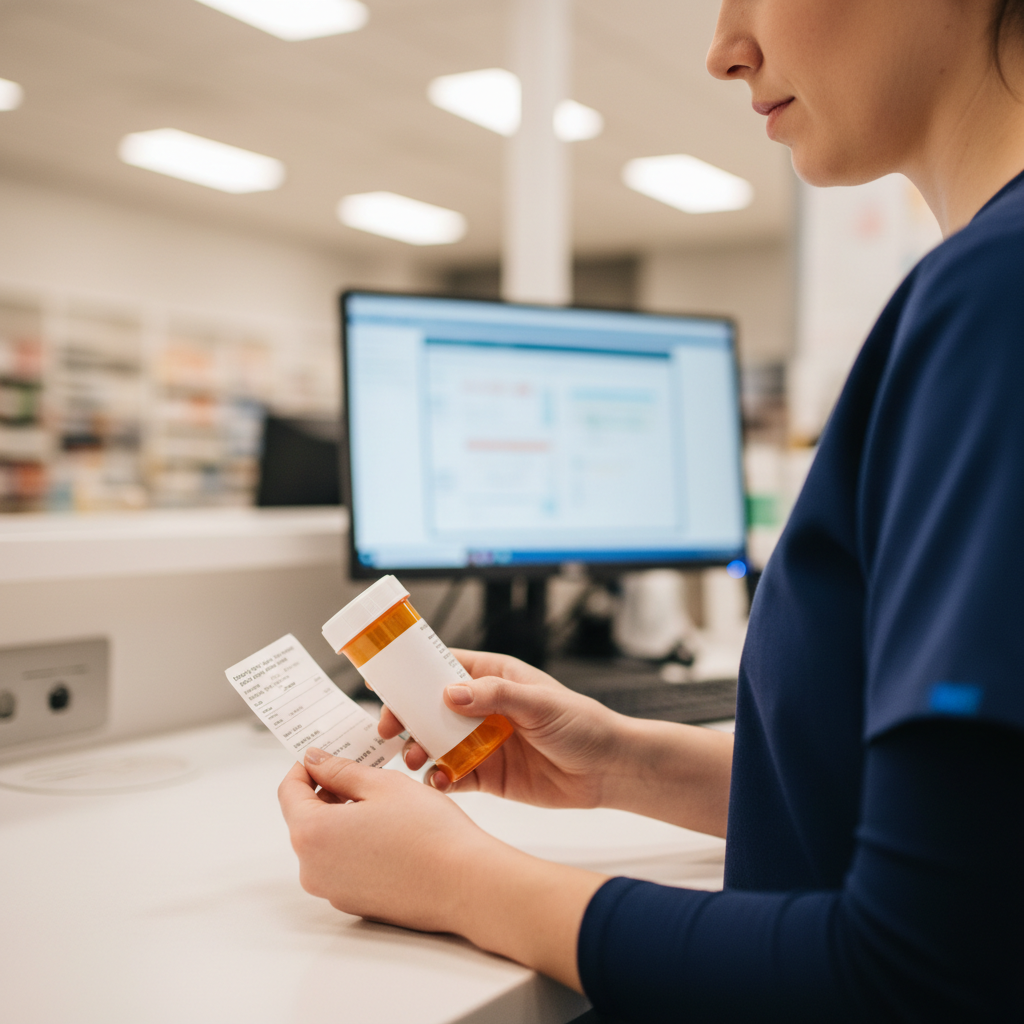
I remember the exact moment my stomach dropped.
It was a Tuesday afternoon, three years into my career as a pharmacy tech. The kind of shift where you are moving on autopilot because you have filled these orders a hundred times before. Pull the stock bottle. Count the tablets. Print the label. Scan. Next.
Except this time, something made me pause.
The Moment Everything Stopped
The prescription was for a pediatric patient on the cardiac floor. Digoxin, a medication I had dispensed dozens of times. But when I picked up the bottle to verify the dose against the label, my hand froze.
The order read 0.125 mg. The label I had just printed read 1.25 mg.
A single decimal point. A tenfold overdose. For a six-year-old recovering from heart surgery.
I stood there for what felt like an hour but was probably thirty seconds, my heart pounding in my ears. I rechecked the original order. I rechecked the label. I pulled the pharmacist over immediately.
The error had originated in the prescribing system — a typo that slipped through one layer of verification. If I had not caught it, that medication would have gone to the floor. A nurse would have administered it. A child could have been seriously harmed or worse.
We caught it. We fixed it. The correct dose went up to the unit, and the patient never knew how close things came to going wrong.
But I will never forget that moment. And I carry it with me every single shift.
The Emotional Weight No One Warns You About
Pharmacy school and tech training programs teach you the science. They teach you the systems, the software, the safety protocols. What they do not teach you is how it feels to hold someone's life in your hands during a routine task on an ordinary Tuesday.
That pharmacy tech near miss changed me. Not in a dramatic, life-altering way — I did not quit my job or have a breakdown. But it recalibrated something fundamental about how I see my role.
Every label I print now gets a second look. Every pediatric dose gets triple-checked. Every time I feel that tiny whisper of “something is not quite right,” I stop and listen to it.
Because medication safety is not just about following procedures. It is about staying present, even when you are tired. It is about honoring the weight of what we do, even when the task feels routine.
The truth is, most of our work is invisible. When we do our jobs well, nothing happens. No alarms go off. No one gets hurt. The patient gets better and goes home, and they will never know that a pharmacy tech in the basement caught a decimal point error that could have changed everything.
That invisibility is both the hardest and most sacred part of what we do.
What I Learned From That Near-Miss
In the weeks after that incident, I reflected a lot on what made me pause that day. Why did I catch it when I easily could have missed it? What can I do to make sure I stay that vigilant on every shift, not just the ones where I happen to be extra alert?
Here is what I have learned about preventing medication errors and staying sharp:
- Decimal points and pediatric doses require extra vigilance. Children's medications often involve smaller doses and more precise calculations. Tenfold errors are unfortunately common.
- Autopilot is efficient until it is dangerous. Routine is important, but so is staying mentally present. I now take micro-breaks between tasks to reset my focus.
- Trust your gut. If something feels off — even if you cannot immediately articulate why — stop and investigate. That intuition is your brain pattern-matching based on experience.
- Speak up without hesitation. I used to worry about looking incompetent if I questioned an order or asked a pharmacist to double-check my work. Now I know that asking questions is a sign of competence, not weakness.
- Near-misses are teaching moments, not failures. Our pharmacy held a team debrief after my catch. We identified the system gap that allowed the error to reach us and implemented an additional verification step for pediatric cardiology orders.
That last point matters. A near-miss that gets caught is not a failure — it is the system working. It is proof that multiple layers of verification exist for a reason.
The Stories We Carry
Every experienced pharmacy tech I know has a story like mine. A catch that mattered. A moment when their attention to detail made the difference between safety and harm.
We do not talk about these pharmacy stories enough. We do not share the weight we carry or the vigilance required to do this work well. And because we do not talk about it, newer techs can feel isolated when they experience that same stomach-dropping realization of how much responsibility rests on their shoulders.
So I am sharing mine. Not to be dramatic or to claim I am a hero — I am not. I am just a tech who was paying attention on a day when it really mattered.
And I want other pharmacy techs, especially those early in their careers, to know: that weight you feel? It is real. It is valid. And it is okay to acknowledge that what we do is both routine and profound.
The tech reflection that matters most is not “why did I almost make a mistake?” It is “what will I do to stay present and vigilant tomorrow, and the day after that, and the day after that?”
Moving Forward With Purpose
Three years later, I still think about that six-year-old patient sometimes. I wonder if they are healthy now, if they have grown, if they are living a full life without any idea that a pharmacy tech once stood between them and serious harm.
That is the work. The invisible, unglamorous, deeply important work of showing up and staying sharp and trusting your training and your instincts.
Medication safety depends on systems, yes. But it also depends on people — on techs who care enough to pause when something feels wrong, who do not let fatigue or routine dull their vigilance, who understand that every label we print is someone's daughter or father or friend.
If you are a pharmacy tech reading this, I hope you never have a near-miss moment like mine. But if you do, I hope you will recognize it for what it is: not a failure, but a reminder of why we do this work and how much it matters. 🤍
At Intuites Healthcare Staffing, we understand the emotional complexity of allied health work — the invisible weight, the quiet heroism, the moments that stay with you. If you are looking for your next pharmacy tech role or simply want to talk with a recruiter who gets what you do every day, our team is here. Reach out anytime at contact@intuites.healthcare or visit intuites.healthcare. We would be honored to support your career journey.
#PharmacyTech #MedicationSafety #HealthcareHeroes #PharmacyStories #PatientSafety #AlliedHealth #PharmacyLife #HealthcareCareers #NearMiss #TechReflection #HospitalPharmacy #PharmacyTechLife #MedSafety #HealthcareJobs #IntuitesCareers
Looking for a healthcare team that truly sees your value?
The Intuites Recruiting Team is here to listen, support your career, and connect you with roles across the USA — when you're ready.