
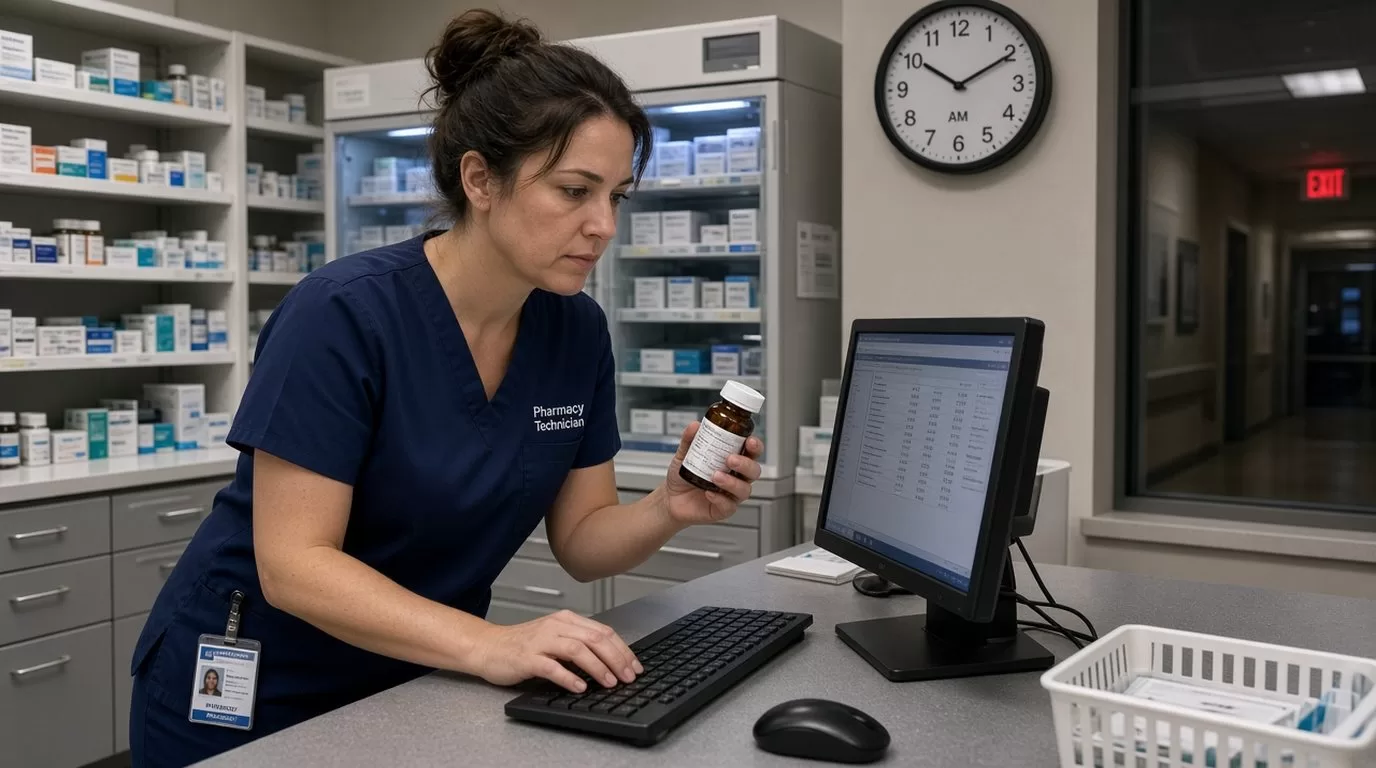
Sarah Martinez did not plan to be a hero that Tuesday night. She planned to verify the overnight medication orders, restock the automated dispensing cabinets on the fourth and sixth floors, and maybe steal fifteen minutes in the break room around 3 AM to eat the sandwich she had packed eight hours earlier.
But at 2:17 AM, while double-checking a stat order for the ICU, something made her pause. The dosage looked right. The patient name matched. The physician signature was there. Everything should have been fine.
Except it was not.
The Quiet Catch That Changed Everything
The order called for 5 mg of a high-alert medication — a dose Sarah had prepared dozens of times. But this patient, according to the notes she pulled up on her second screen, had renal function labs from earlier that evening showing significant impairment. For a patient with those kidney numbers, even a standard dose could accumulate to dangerous levels.
She called the ICU. The nurse was grateful but busy. Sarah asked her to page the resident. Twenty minutes later, the order was revised to 2.5 mg with extended monitoring. The patient received the correct dose. No adverse event report was filed because there was no adverse event.
Nobody thanked Sarah. The patient never knew her name. The revised order did not generate a safety report because the error was caught before it reached the patient. In the morning, the day-shift pharmacy director saw the order modification in the system log, noted it, and moved on to the next task.
This is what being indispensable but unseen looks like in healthcare.
The Invisible Safety Net
According to the Institute for Safe Medication Practices, pharmacy technicians are involved in catching an estimated 2.4 medication errors per day per technician in hospital settings. Multiply that across the roughly 440,000 pharmacy techs working in the United States, according to Bureau of Labor Statistics data, and you are looking at more than a million potential errors intercepted every single day.
Most of those catches happen exactly like Sarah's:
- A dosage that does not match updated lab values
- A drug interaction the prescribing system missed
- A sound-alike medication selected from a drop-down menu
- An allergy documented in one system but not cross-referenced in another
- A decimal point in the wrong place
Night shift healthcare workers face an added layer of challenge. Fewer staff means fewer eyes. The physicians who wrote the orders are often asleep, replaced by on-call residents who may not know the patient's full history. The pharmacist may be covering three units instead of one. And the pharmacy tech becomes the final human checkpoint before a medication reaches a patient's bloodstream.
The work requires extreme attention during hours when the human brain is biologically programmed to rest. Circadian rhythm research shows that cognitive performance dips significantly between 2 AM and 4 AM, yet that is exactly when many critical medication orders are filled.
What It Takes to Be the Last Line
Sarah's catch was not luck. It was the result of years of training, pattern recognition, and a professional culture that treats every order as if someone's mother or child is on the receiving end — because they are.
Pharmacy technicians complete formal education programs, pass national certification exams, and maintain continuing education requirements. They learn pharmacology, medical terminology, dosage calculations, sterile compounding, and inventory management. They memorize hundreds of drug names, both brand and generic. They know which medications cannot be crushed, which require refrigeration, which interact with grapefruit juice or alcohol.
But the textbook knowledge is only part of it. The other part — the part that caught the error at 2 AM — comes from what healthcare workers call clinical intuition. It is the feeling that something is off even when you cannot immediately articulate why. It is the habit of double-checking even when you are tired. It is the willingness to make the phone call that might annoy someone because patient safety matters more than being liked.
These are not skills you can automate. Medication dispensing systems are increasingly sophisticated, with barcode scanning and electronic verification at multiple steps. But those systems still depend on humans entering the right data, and they cannot always account for the clinical context — the updated lab, the patient's weight change, the interaction with a medication ordered by a different service.
The Cost of Being Unseen
The Joint Commission estimates that medication errors harm at least 1.5 million people annually in the United States, even with all our safety systems in place. The errors that do not happen — the catches like Sarah's — do not generate data. They do not make it into incident reports or quality dashboards. They disappear into the ordinary flow of a shift.
And that invisibility has consequences. Pharmacy technicians report some of the highest rates of feeling undervalued in healthcare, according to workforce surveys. The median pay, per BLS data, is around $36,740 annually — less than many roles that carry far less responsibility for human life. Turnover is significant. Burnout is common. Many experienced techs leave the field for positions that pay more and demand less cognitive load during overnight hours.
We lose institutional knowledge every time an experienced tech walks away. We lose the pattern recognition that catches the subtle errors. We lose the professionals who know which physicians always forget to specify the route of administration, which nurses need extra clarification on high-alert drugs, which patients have a history of adverse reactions not captured in the allergy field.
What Recognition Actually Looks Like
Sarah did not need a plaque or a bonus for her catch. But she would have appreciated basic acknowledgment — a note in her file, a mention in the pharmacy team meeting, a simple “thank you for the close call you prevented” from the ICU resident.
Recognition in healthcare does not have to be elaborate. It has to be specific and sincere. It has to come from people who understand what actually happened and why it mattered. It has to happen close in time to the event, not six months later in a generic employee appreciation email.
For unseen healthcare workers, recognition also means:
- Being included in safety debriefs and quality improvement meetings where their catches are discussed
- Having their clinical observations taken seriously by physicians and nurses, not dismissed because they “just” have a tech certification
- Receiving compensation that reflects the cognitive demands and liability of the work
- Getting schedule flexibility that accounts for the physical toll of night shifts
- Being asked for input on workflow changes that affect their ability to catch errors
These are not luxuries. They are the conditions that help people like Sarah stay in the field long enough to become the senior tech who trains the next generation, who builds the double-check habits, who creates the culture where catching an error at 2 AM is normal and expected.
The Ripple You Will Never See
Somewhere, the patient whose dose Sarah corrected went home from the ICU. Maybe they recovered fully. Maybe they have no idea how close they came to a medication injury. Maybe they complained about the hospital food or the noise in the hallway, ordinary frustrations that mean their body was well enough to notice discomfort.
That patient's family did not send a thank-you card to the pharmacy. They do not know Sarah's name. But their loved one is alive and healing, in part because a pharmacy tech working the overnight shift decided that “something does not add up” was reason enough to stop, look closer, and make the call.
This happens thousands of times a day, in hospitals and retail pharmacies and long-term care facilities across the country. The tech who notices the duplicate order. The tech who catches the ten-fold dosing error. The tech who realizes the patient picked up a new prescription from another pharmacy and flags the interaction risk.
Most of those catches will never be celebrated. Many will never be formally documented. But they are the reason our imperfect healthcare system works as well as it does.
If You Are the One Making the Catch
If you are a pharmacy tech reading this — especially if you work nights, weekends, or the shifts when backup is thin — know that your vigilance matters. The error you caught last week kept someone out of the ICU. The clarification you requested saved a physician from a lawsuit they will never know they avoided. The extra thirty seconds you took to verify the patient weight prevented harm.
You are not invisible to the patients whose safety you protect, even if they never learn your name. You are not invisible to the nurses who trust that the medications you send are correct. You are not invisible to the experienced healthcare workers who know exactly what you do and how much it matters.
And if you are considering a role in pharmacy or healthcare support, know that this field needs people who are detail-oriented, willing to speak up, and committed to getting it right even when no one is watching. The work is hard. The hours can be brutal. The recognition is often absent. But the impact is real, measurable, and ongoing.
If you are interested in exploring pharmacy technician or other healthcare opportunities where your attention to detail and patient advocacy make a tangible difference, email contact@intuites.healthcare with your specific role interests and shift preferences — we work with facilities that value the professionals who keep the system safe.
Sources
Ready for your next healthcare assignment?
Browse open healthcare jobs across the US — weekly pay, stipends, and a recruiter who reads every application.