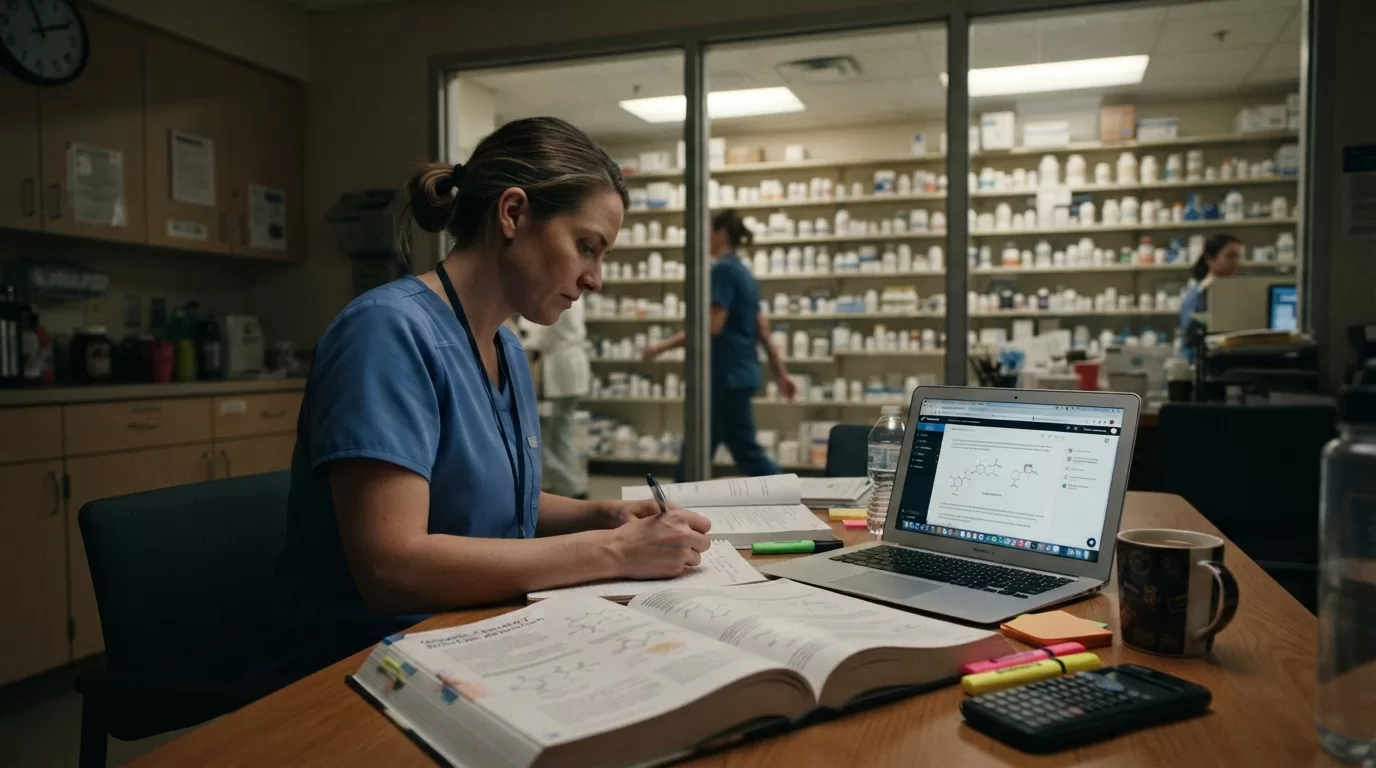
You’ve spent years counting pills, verifying scripts, and counseling patients under a pharmacist’s supervision. Now you’re wondering: can I become the pharmacist? The short answer is yes. The realistic answer requires understanding exactly what stands between your current CPhT credential and that Doctor of Pharmacy degree.
The pharmacy tech-to-PharmD pathway is well-traveled, but it’s not a shortcut. In 2026, most programs require two to three years of prerequisite coursework before you even apply to pharmacy school, followed by four years of professional study. That’s a six-to-seven-year commitment from starting your first biology class to taking the NAPLEX. But for techs who want prescribing authority, clinical autonomy, and a median salary of $136,030 according to the Bureau of Labor Statistics, the bridge is worth crossing.
Here’s what the 2026 pharmacy school pathway actually looks like, how the PCAT landscape has changed, and how working techs are funding the journey without abandoning their paychecks.
Understanding the Prerequisite Reality
Pharmacy schools don’t admit techs directly into the professional PharmD program. Instead, you’ll complete 60 to 90 semester credits of undergraduate coursework first, covering the sciences that underpin pharmacology and patient care.
The American Association of Colleges of Pharmacy notes that typical prerequisites include two semesters each of general chemistry, organic chemistry, biology, physics, and anatomy and physiology, plus courses in microbiology, calculus or statistics, and English composition. Many programs also require biochemistry and at least one social or behavioral science elective.
Translation: you’re looking at roughly two academic years of full-time science coursework if you have zero prior college credits, or closer to three years if you’re studying part-time while working. Most pharmacy techs take the part-time route, enrolling in one or two evening or weekend classes per semester at a community college or state university.
Here’s the good news: your prior college credits count, even if they’re a decade old. If you completed an associate degree before becoming a tech, you may already have general education requirements and some science courses checked off. Request official transcripts from every institution you’ve attended and have a pre-pharmacy advisor evaluate them against your target school’s prerequisite list.
Why Organic Chemistry Is the Gatekeeper
Ask any pharmacy student which prerequisite nearly derailed them, and “orgo” comes up again and again. Organic chemistry demands pattern recognition, spatial reasoning, and memorization at a level most techs haven’t encountered since high school.
Plan to take organic chemistry during a semester when you can reduce your work hours or skip other demanding courses. Many successful applicants take Organic I in the spring and Organic II in the fall, giving themselves a summer break in between to let reaction mechanisms settle. Tutoring isn’t a sign of weakness here; it’s standard operating procedure.
The PCAT in 2026: Required, Recommended, or Waived?
The Pharmacy College Admission Test used to be a universal gatekeeper. In 2026, it’s optional at approximately 40 percent of accredited US pharmacy schools, and the list of PCAT-optional programs grows each admissions cycle.
Schools that still require the PCAT use it to compare applicants’ science readiness when GPAs come from different institutions with different grading standards. The test covers biology, chemistry, quantitative reasoning, and verbal skills. The composite score ranges from 200 to 600, and competitive programs typically look for scores above 400.
If your target school lists the PCAT as “recommended” rather than required, weigh your academic profile carefully. A strong prerequisite GPA above 3.5 may make the test optional in practice. A GPA closer to 3.0, especially if it includes a repeated course or a C in organic chemistry, benefits from a solid PCAT score that demonstrates you’ve mastered the material since then.
PCAT prep courses run $300 to $1,200, and the exam itself costs $210. Register at least six weeks before your test date to secure your preferred location. Most techs take the PCAT in the spring of their final prerequisite year, giving them time to retake it in the summer if needed before fall application deadlines.
Schools That Have Dropped the PCAT Requirement
Notable programs that no longer require the PCAT as of 2026 include the University of Southern California, University of Washington, and several campuses in the State University of New York system. Always verify current admissions requirements directly on each school’s pharmacy admissions page, as policies shift year to year.
Funding the Pharmacy School Pathway
The American Association of Colleges of Pharmacy reports that the average Doctor of Pharmacy graduate carries roughly $170,000 in student loan debt. Add in two to three years of prerequisite tuition, and the total investment climbs past $200,000 for many students.
Working pharmacy techs have three funding levers to pull: employer tuition assistance, federal and state financial aid, and loan forgiveness programs that activate after graduation.
Employer Tuition Benefits You May Already Have
Many hospital systems and retail pharmacy chains offer tuition reimbursement to full-time employees pursuing degrees in healthcare fields. CVS Health, Walgreens, and several major health systems reimburse $3,000 to $5,250 per year for prerequisite and professional coursework.
The catch: you typically must remain employed full-time and maintain a minimum GPA. Read your benefits handbook carefully. Some programs require you to pay tuition upfront and submit receipts for reimbursement after the semester ends; others partner with specific universities for direct billing.
If your current employer doesn’t offer tuition benefits, consider a strategic move. Health system jobs often come with richer educational benefits than retail chains, and some hospitals waive tuition entirely for employees attending affiliated university programs.
Federal Aid and the FAFSA
File the Free Application for Federal Student Aid every October, even if you think you won’t qualify for need-based grants. The FAFSA determines your eligibility for federal Direct Loans, which carry lower interest rates and more flexible repayment options than private loans.
Dependent students can borrow up to $7,500 per year in Direct Loans during prerequisite coursework. Once you’re admitted to a professional PharmD program, you’ll qualify for graduate-level Direct Unsubsidized Loans up to $20,500 per year, plus Grad PLUS loans to cover any remaining cost of attendance.
Interest rates for federal loans disbursed in the 2026-27 academic year are set each July. As of mid-2026, Direct Unsubsidized rates for graduate students hover near 6.5 percent. Lock in those rates by avoiding private loans whenever possible.
Public Service Loan Forgiveness for Pharmacists
If you plan to work in a nonprofit hospital, community health center, or government facility after earning your PharmD, Public Service Loan Forgiveness can erase your remaining federal loan balance after 120 qualifying monthly payments.
Here’s the strategy: enroll in an income-driven repayment plan as soon as you enter repayment, work full-time for a qualifying employer, and certify your employment annually using the PSLF form available at studentaid.gov. After ten years of payments, the remaining balance disappears tax-free.
Many hospital pharmacists qualify for PSLF without realizing it. The US Department of Education maintains a PSLF Help Tool that lets you search whether a specific employer qualifies. Run that search before you accept your first post-graduation job offer.
Building a Competitive Application
Pharmacy school admissions are holistic. Your prerequisite GPA and PCAT score matter, but committees also weigh your pharmacy experience, letters of recommendation, and personal statement.
As a working tech, you bring something most traditional applicants lack: years of real-world exposure to pharmacy operations, insurance adjudication, and patient counseling. Highlight specific experiences in your application essays. Did you catch a dangerous drug interaction? Did you help a patient navigate a prior authorization maze? Did you train new techs or implement a workflow improvement?
Admissions committees want to see that you understand what pharmacists actually do beyond the romanticized “helping people” narrative. Your tech background proves you’ve already spent years in the field and you’re choosing this path with open eyes.
Who Should Write Your Letters of Recommendation?
Most programs require three letters: one from a science professor who taught you in a prerequisite course, one from a pharmacist who has supervised your work, and one wildcard from a healthcare professional or academic advisor.
Ask your letter writers at least eight weeks before your application deadline. Provide them with a brief summary of your career goals, a copy of your resume, and a list of experiences they might reference. The best letters include specific anecdotes, not generic praise.
Timeline for Pharmacy Techs Starting in 2026
If you’re beginning your prerequisites in fall 2026, here’s a realistic timeline to PharmD graduation:
- Fall 2026 through Spring 2029: Complete 60-90 prerequisite credits part-time while working as a pharmacy tech (approximately five to six semesters).
- Spring 2029: Take the PCAT if required by your target schools. Request official transcripts and begin drafting your personal statement.
- Summer 2029: Submit applications through PharmCAS, the centralized application service used by most US pharmacy schools. Deadlines typically fall between September and March, but earlier is better for rolling admissions.
- Fall 2029 through Spring 2030: Complete interviews at schools that invite you. Receive acceptance letters between December and April.
- Fall 2030: Begin the four-year professional PharmD program.
- Spring 2034: Graduate, take the NAPLEX and state law exams, and begin practicing as a licensed pharmacist.
Yes, that’s an eight-year arc from starting prerequisites to earning your license. But remember: you’re working and earning throughout the prerequisite phase, and many students complete clinical rotations during the final year of pharmacy school, building connections that lead directly to job offers.
Is the Pharmacy Tech-to-PharmD Bridge Right for You?
Not every pharmacy technician should pursue a PharmD, and that’s okay. The pathway makes sense if you want clinical autonomy, enjoy patient counseling more than operational tasks, and feel ready to take on prescriptive authority and the liability that comes with it.
It’s a harder fit if you value work-life balance above all else, prefer hands-on technical tasks to patient interviews, or already carry significant student debt from a previous degree. Pharmacist job growth is slower than other healthcare fields, with the Bureau of Labor Statistics projecting just 3 percent growth through 2032, about average for all occupations.
Spend time shadowing pharmacists in different settings: hospital clinical roles, ambulatory care clinics, community independent pharmacies, and retail chains. The day-to-day work varies dramatically. A clinical pharmacist rounding with a medical team in a hospital looks nothing like a retail pharmacist verifying 300 scripts during a twelve-hour shift.
Ask yourself: do I want to do what that pharmacist is doing, or do I want the credential and the salary? Only the first answer justifies the investment.
If you’re ready to take the first step toward pharmacy school, start by requesting a prerequisite evaluation from your nearest state university’s pre-pharmacy advisor. Or email contact@intuites.healthcare with questions about flexible pharmacy tech contracts that accommodate evening coursework — we work with techs building toward advanced degrees every day, and we know which facilities offer tuition benefits and schedule flexibility for students.
Sources
Ready for your next allied health assignment?
Browse open allied health jobs across the US — weekly pay, stipends, and a recruiter who reads every application.